
How to Track Recruiter Payouts Without Spreadsheet Errors (And Stop After-Hours Pay Questions)

Key Takeaways
- Spreadsheet-based recruiter payout tracking is a common source of commission disputes and trust erosion in direct hire and executive search firms.
- A reliable system starts with a single source of truth for placement data, not three different tabs that disagree with each other.
- Defining your split logic in writing before a deal closes is what keeps end-of-month reconciliation from turning into a negotiation.
- Giving recruiters real-time visibility into their own earnings reduces the volume of after-hours pay questions.
- Purpose-built tools like CollectedHQ automate commission calculations so firm owners aren't manually running numbers at 9pm on a Friday.

It's 8:47pm on a Thursday. You just sat down after dinner when your phone buzzes. It's a Slack message from one of your senior recruiters: "Hey, quick question: what's my commission on the CFO deal that closed last week? I think the split was 60/40 but I'm not sure how that stacks against my Q3 threshold."
You know the answer is somewhere in a spreadsheet. You're just not sure which one.
This guide is about fixing that, permanently. Reliable recruiter payout tracking isn't just a nice-to-have for a growing search firm. It's the infrastructure that keeps your best billers trusting you, keeps your books clean, and keeps your evenings your own. By the time you finish reading, you'll have a step-by-step framework to replace your patchwork of tabs and manual calculations with a system that actually works.
Why Most Recruiting Firms Have a Payout Tracking Problem (And Don't Realize It)
The spreadsheet approach works fine when you have four recruiters and one commission tier. But the moment you add a senior associate with a different split, a team lead who participates in sourcing credits, and a new hire on a draw-versus-commission structure, the same spreadsheet becomes a liability.
Commission logic compounds. New arrangements layer on top of old ones. Formulas get copied from month to month, quietly carrying over errors. And because most recruiting firm owners aren't accountants, they don't catch the problem until a recruiter raises a discrepancy, usually right before payday, usually in a group chat.
The real cost isn't just the time you spend reconciling. It's the erosion of trust. When a recruiter feels uncertain about how their commission was calculated, they start wondering whether the error was accidental. That doubt is expensive.
Step 1: Audit Your Current Recruiter Payout Tracking Setup
Before you can fix anything, you need a clear picture of what you're actually dealing with. Most firms discover they have more spreadsheets than they thought, and fewer people who understand all of them.
What to do:
- List every file, tab, or tool currently involved in calculating recruiter commissions. Include Google Sheets, Excel files, ATS exports, and anything in Notion or Airtable.
- For each one, note: who owns it, how often it's updated, and whether it feeds into something else.
- Find the last three commission disputes or corrections your firm handled. Trace each one back to where the error originated.
What you'll find: Usually one "master" spreadsheet built a while ago, plus satellite files created to solve specific edge cases, all slightly out of sync with each other.
Common mistake: Assuming the master spreadsheet is correct because it's the one everyone refers to. The master spreadsheet is usually the one with the oldest formulas and the most accumulated workarounds.
Expected outcome: A written map of your current payout tracking infrastructure, including every known gap or inconsistency. This becomes the baseline you're replacing.
Step 2: Define Your Commission Structure in Writing Before the Next Deal Closes
The single biggest driver of recruiter pay disputes isn't a software problem. It's ambiguity. When commission rules live in someone's head (usually the owner's), every edge case becomes a negotiation.
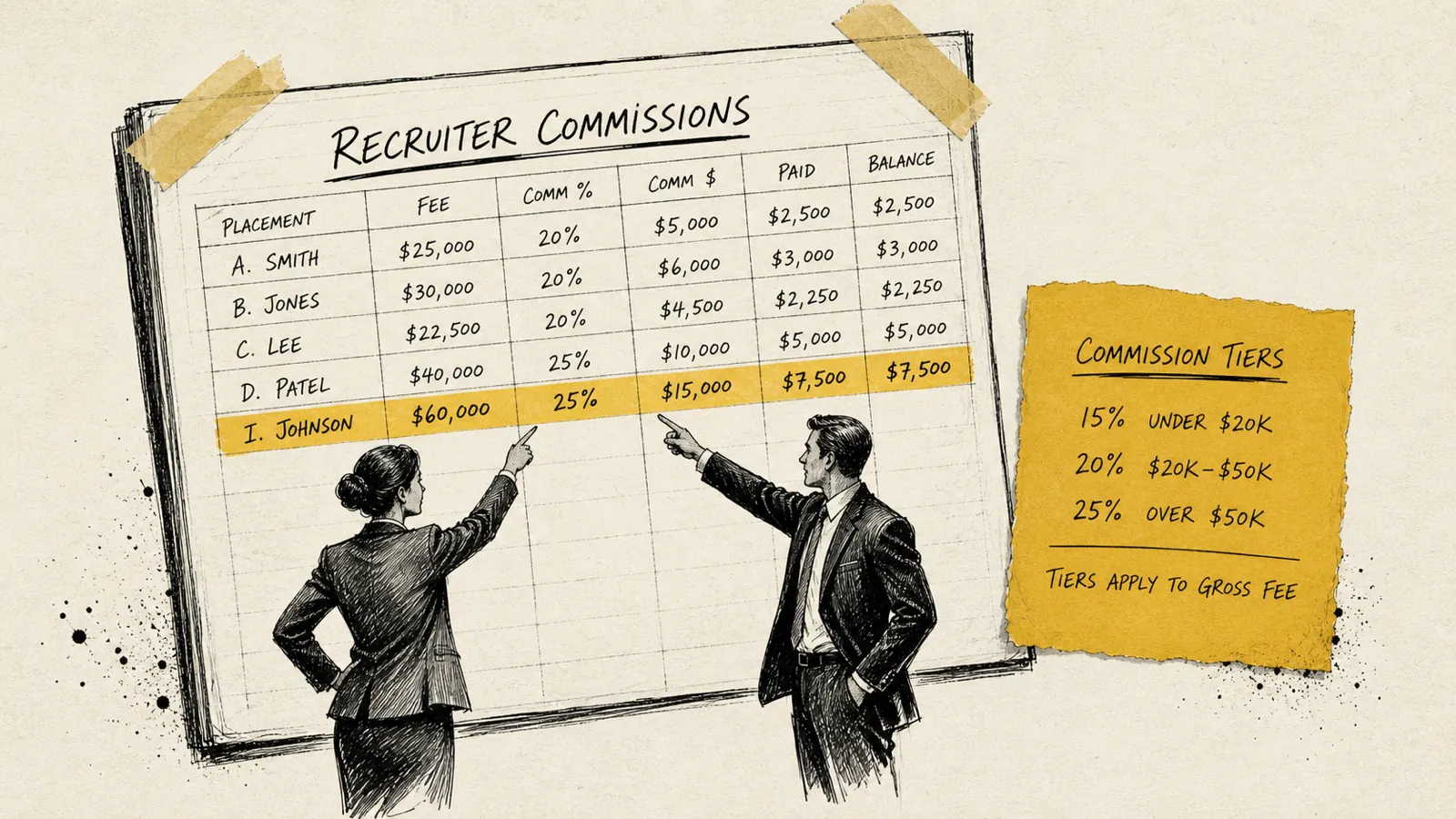
Clear, written commission structures are the foundation of accurate recruiter payout tracking. Every split scenario, tiered threshold, clawback condition, and sourcing credit rule needs to be documented before it becomes relevant to an open deal.
What to document. Commission scenarios and definitions:
- Solo placement
- Commission percentage at each performance tier, draw structure if applicable.
- Split placement (same team)
- Default split ratio, who determines the split, and when it is locked in writing.
- Split placement (cross-team)
- Split ratio, whether team leads participate in the fee, and how placement fees are allocated across cost centers.
- Candidate sourcing credit
- Whether sourcing earns a portion of commission, the percentage, and any qualifying conditions.
- Clawback
- Triggering conditions (e.g., candidate leaves within 90 days), how the commission is recovered, and the timeline for repayment.
- Guarantee period replacement
- Whether the original commission is reversed in full, held in escrow, or partially reduced upon a replacement search.
Practical tip: Write the rule, then walk through three real deals from last quarter and apply it. If the result doesn't match what you actually paid, the rule isn't precise enough yet.
Common mistake: Writing a commission policy that covers the easy cases but leaves edge cases to judgment. Edge cases are exactly where disputes happen.
Expected outcome: A one-to-three page commission policy document that any recruiter (or any new office manager) can read and apply without asking you for clarification.
Step 3: Create a Single Source of Truth for Placement Data
Accurate recruiter commission tracking is impossible if placement data lives in multiple places. Your ATS has one close date, your spreadsheet has another, and the invoice in QuickBooks has a third. Every discrepancy between these systems is a future dispute waiting to happen.
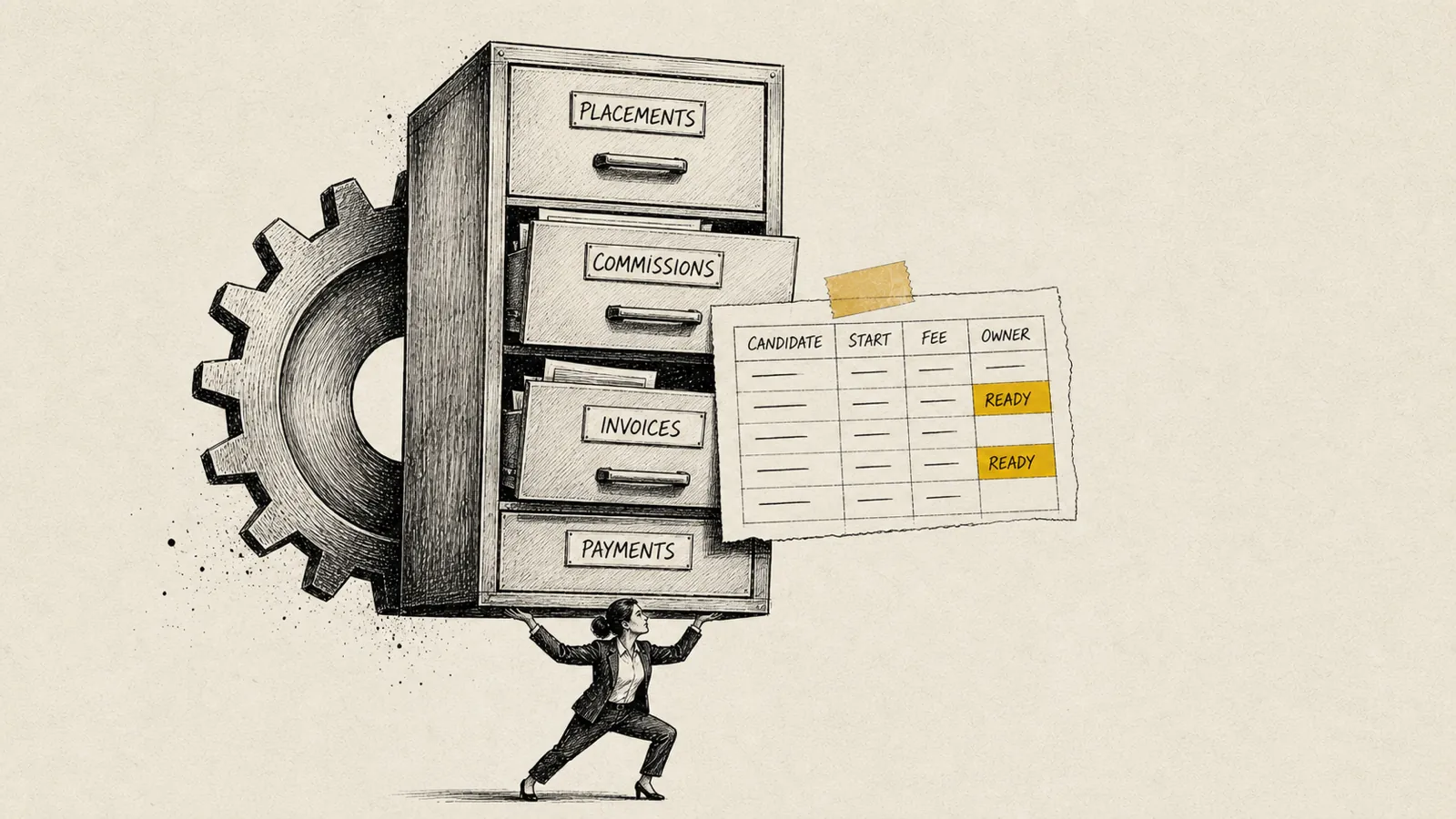
The goal here is simple: one place where every closed placement is recorded, with all the fields that matter for payout calculation.
Minimum data fields per placement record:
- Candidate name
- Client name
- Placement date (offer accepted, not invoice sent)
- Start date
- Placed salary or fee amount
- Gross placement fee
- Recruiter(s) involved and their split percentages
- Guarantee period end date
- Invoice status (issued, collected, outstanding)
- Clawback status if applicable
Many firms use their ATS (Bullhorn, Loxo, JobAdder, Vincere) as the record of placement. That works, but only if the ATS data is actually kept current and complete. If your recruiters are closing deals verbally and updating the ATS three days later, the ATS isn't a source of truth. It's a lagging log.
Common mistake: Treating invoice date and placement date as interchangeable. For commission purposes, most firms pay on placement (or collection), not on invoicing. If your spreadsheet is pulling invoice dates from your accounting system, you may be attributing deals to the wrong pay period.
Expected outcome: One authoritative record of every closed deal that all commission calculations flow from. No more cross-referencing three tabs to figure out which number is right.
Step 4: Build or Adopt a Calculation Engine That Does the Math
This is where most firms either level up or stay stuck. A calculation engine is whatever system takes your placement data and your commission structure and produces a payout number, without you touching a formula manually.
You have two realistic options:
Option A: A Well-Structured Spreadsheet Template
If you're not ready to move off spreadsheets, at minimum you need one that's built correctly. That means:
- Commission rules are entered once in a configuration tab, not hardcoded into individual cells
- Payout calculations reference the configuration tab automatically
- Each pay period is a new sheet that pulls from the master placement log, not a copy-paste of last month's tab
- There's a change log so you know when a formula was modified and by whom
This approach can work for firms with simpler structures, but it requires discipline to maintain and someone with real spreadsheet skill to build it properly.
Option B: Purpose-Built Recruiting Commission Software
For firms with more than eight to ten recruiters, or with tiered commission structures, or with frequent split placements, a dedicated tool takes the manual math out of the process. Platforms like CollectedHQ are built specifically for this. They handle split logic, tiered thresholds, clawback scenarios, and payout reporting without requiring a finance background to operate.
Firms tend to resist the switch until a bad month forces it: a disputed commission, or a formula error that underpaid people and had to be corrected retroactively. After that, the decision is easy.
Common mistake: Building a more complicated spreadsheet instead of graduating from spreadsheets altogether. A more complicated spreadsheet has more ways to break.
Expected outcome: Commission calculations that take minutes instead of hours, with a clear audit trail showing how every number was derived.
Step 5: Give Recruiters Real-Time Visibility Into Their Own Earnings
The fastest way to stop after-hours pay questions is to give your team self-serve access to their own commission data. When a recruiter can open a dashboard at 8pm and see exactly what they've earned, what's pending, and what's been paid, they don't need to message you.
Transparency here isn't just a quality-of-life improvement for your team. It's a retention tool. Recruiters who can clearly see their earnings trajectory stay more engaged. Recruiters who feel like their compensation is a black box start polishing their resumes.
What recruiter-facing visibility should include:
- All closed placements attributed to them in the current period
- Gross fee and their commission amount per deal
- Any pending deals (offered, not yet started)
- Year-to-date earnings and progress toward any tiered thresholds
- Any clawbacks or adjustments, with a plain-language explanation
This doesn't require a sophisticated platform. A filtered view of your placement log shared with each recruiter covers the basics. What matters is that it's current, accurate, and they can access it without asking you.
Common mistake: Sharing a read-only spreadsheet that's only updated at month-end. If it's stale, they'll still message you. They'll just do it with more frustration because they checked the spreadsheet first.
Expected outcome: A drop in inbound commission questions.
Step 6: Establish a Locked Payout Cycle With a Clear Cutoff
One underrated source of tracking chaos is the absence of a hard cutoff date. When placements can be retroactively added or adjusted at any point, every month-end reconciliation becomes a moving target.
A locked payout cycle works like this: at a defined date each month (say, the 25th), all placement records for that period are frozen for payout purposes. Deals that close after the cutoff roll into the next period. No exceptions, unless there's a documented override process.
How to implement it:
- Choose a cutoff date and communicate it to your entire team in writing.
- Define what "closed" means for payout purposes: offer accepted? Start date confirmed? Fee collected? Pick one and stick to it.
- When the cutoff passes, lock the placement records for that period. In a spreadsheet, this means protecting the sheet. In a purpose-built tool, it means marking the period as closed.
- Run payout calculations from the locked data only.
Common mistake: Allowing deals to be backdated into a closed period because a recruiter forgot to log something. One exception trains your team that the cutoff is negotiable, and negotiable cutoffs create chaos.
Expected outcome: Month-end reconciliation becomes a predictable, time-boxed task rather than an open-ended scramble.
Step 7: Document and Communicate Your Dispute Resolution Process
Even with a great system, disputes will occasionally happen. A recruiter will disagree with how a split was calculated. A clawback will feel unfair. A placement will get attributed to the wrong period.
The difference between a dispute that takes 20 minutes to resolve and one that festers for three weeks is having a clear, written process for handling it.
A simple dispute resolution process for recruiting firms:
- Recruiter submits the dispute in writing: a simple form or email works fine. They specify the deal, the amount in question, and their understanding of how it should be calculated.
- Owner or finance lead reviews within 48 hours, referencing the commission policy document and the placement record.
- Decision communicated in writing, with a plain-language explanation of how the number was calculated, whether the dispute is upheld or not.
- If upheld, correction is made in the next payout cycle, not as a retroactive adjustment to a closed period, unless the error was material.
Writing this process down accomplishes two things: it gives your team a fair, predictable channel for raising concerns, and it signals that you're confident enough in your system to put the rules in writing.
Common mistake: Handling disputes case-by-case without documentation. This creates inconsistency and the perception that outcomes depend on who asks loudest.
Expected outcome: Fewer disputes overall (because the system is clearer), and faster resolution when disputes do arise. Your team will trust the process even when they don't love the outcome.
Putting It All Together: What a Clean Recruiter Payout System Looks Like
Here's what the full system looks like once all seven steps are in place:
- Every closed placement is logged in one place with consistent, complete data
- Commission rules are written down and applied automatically by your calculation engine
- Recruiters have self-serve access to their own earnings data, updated in real time
- Each pay period has a hard cutoff, after which the data is locked
- Month-end takes a fraction of the time it used to
- When a recruiter has a question about their commission, they check their dashboard, not your Slack
The shift from spreadsheet chaos to a system like this doesn't require a massive technology budget. It requires clarity about your commission rules, discipline about your data, and the willingness to give your team visibility instead of keeping everything in your head.
The firms that resist this shift the longest are usually the ones whose owners are most involved in every payout calculation, not because they enjoy it, but because they've never trusted the system enough to hand it off. Building the right system is how you earn that trust back, from your team and from yourself.
Frequently Asked Questions About Recruiter Payout Tracking
Why do recruiter commission spreadsheets keep breaking?
Spreadsheets break because commission logic changes faster than formulas get updated. A new split arrangement, a clawback scenario, or a tiered threshold adjustment can silently corrupt months of data if the underlying formula isn't rebuilt to match. The more complex your commission structure, the more fragile your spreadsheet becomes.
What is the best tool for tracking recruiter commissions?
Purpose-built platforms like CollectedHQ are designed specifically for recruiting firm commission tracking. They handle split logic, tiered thresholds, and payout reporting without requiring a finance background to operate. For smaller firms with simple structures, a well-architected spreadsheet can work, but it requires more ongoing maintenance and carries more risk of errors.
How do I stop recruiters from asking about their commissions after hours?
Give them a self-serve dashboard with real-time visibility into their own placement earnings. When recruiters can check their own numbers at any time (including pending deals, year-to-date totals, and any adjustments), the after-hours Slack messages stop almost immediately.
When should a recruiting firm switch from spreadsheets to dedicated software?
Introducing a second commission tier is a good moment to reassess. The clearest signal is when you start spending more than two or three hours per month on commission reconciliation, or when you've had a dispute that took longer than a week to resolve.
Do I need an audit trail for recruiter commission calculations?
Yes, and this is one of the most overlooked requirements for growing firms. An audit trail shows exactly how each payout was calculated, when the calculation was run, and whether any adjustments were made and by whom. Without it, a disputed commission becomes a he-said-she-said conversation. With it, you can resolve most disputes in under ten minutes by pulling the calculation history. Purpose-built tools generate this automatically; spreadsheets require you to build and maintain a change log manually.
Can AI tools help with recruiter payout tracking?
AI-assisted tools can help with anomaly detection (flagging commissions that look unusually high or low compared to historical patterns) and with drafting commission policy language. However, AI alone is not a substitute for a structured payout system. The core requirements (a single source of truth, written commission rules, a locked pay cycle) are process and data problems before they're technology problems. Layering AI onto a broken spreadsheet workflow doesn't fix the underlying issues.
Never sweat invoicing or commissions again.