
How to Design a Tiered Commission Plan for Executive Search Firms: A Complete Playbook

Key Takeaways
- A tiered commission plan rewards recruiters with escalating payout percentages as they hit higher billing thresholds. It is the most widely used model in executive search.
- Thresholds, tier percentages, and reset periods (monthly vs. annual) are the three variables that define how your plan feels to your team and costs to your firm.
- Split-placement policies and desk-credit rules are where most commission disputes originate. Document these in writing before your next hire.
- Manual spreadsheet tracking of tiered commissions breaks down fast as headcount grows; automated commission tracking eliminates the constant 'what's my number?' Slack messages.
- The best plans balance upside for top billers with a floor that keeps mid-level producers engaged. A plan that only rewards your top 20% is a retention risk.
It's the last Friday of the month. You've got three invoices that just collected, two split placements from a cross-desk deal your team closed together, and a senior recruiter pinging you on Slack asking what her commission is going to be on a $28,000 fee she closed at 60% of the year. You open the spreadsheet. You scroll. You do the math three different ways because you're not sure which version of the tab is current. Sound familiar?
A well-structured tiered commission plan for executive search is the antidote to that Friday. It's not just a motivational tool. It's an operational one. When the rules are clear, documented, and consistently applied, your team stops asking you what their cut is and starts focusing on closing the next deal.
This guide covers everything: how tiered plans work, how to set thresholds that actually motivate, how to handle splits without blow-ups, and how to stop doing the math by hand. Whether you're building your first formal plan or overhauling one that's creating more confusion than clarity, this is your playbook.

What Is a Tiered Commission Plan and Why Executive Search Firms Use It
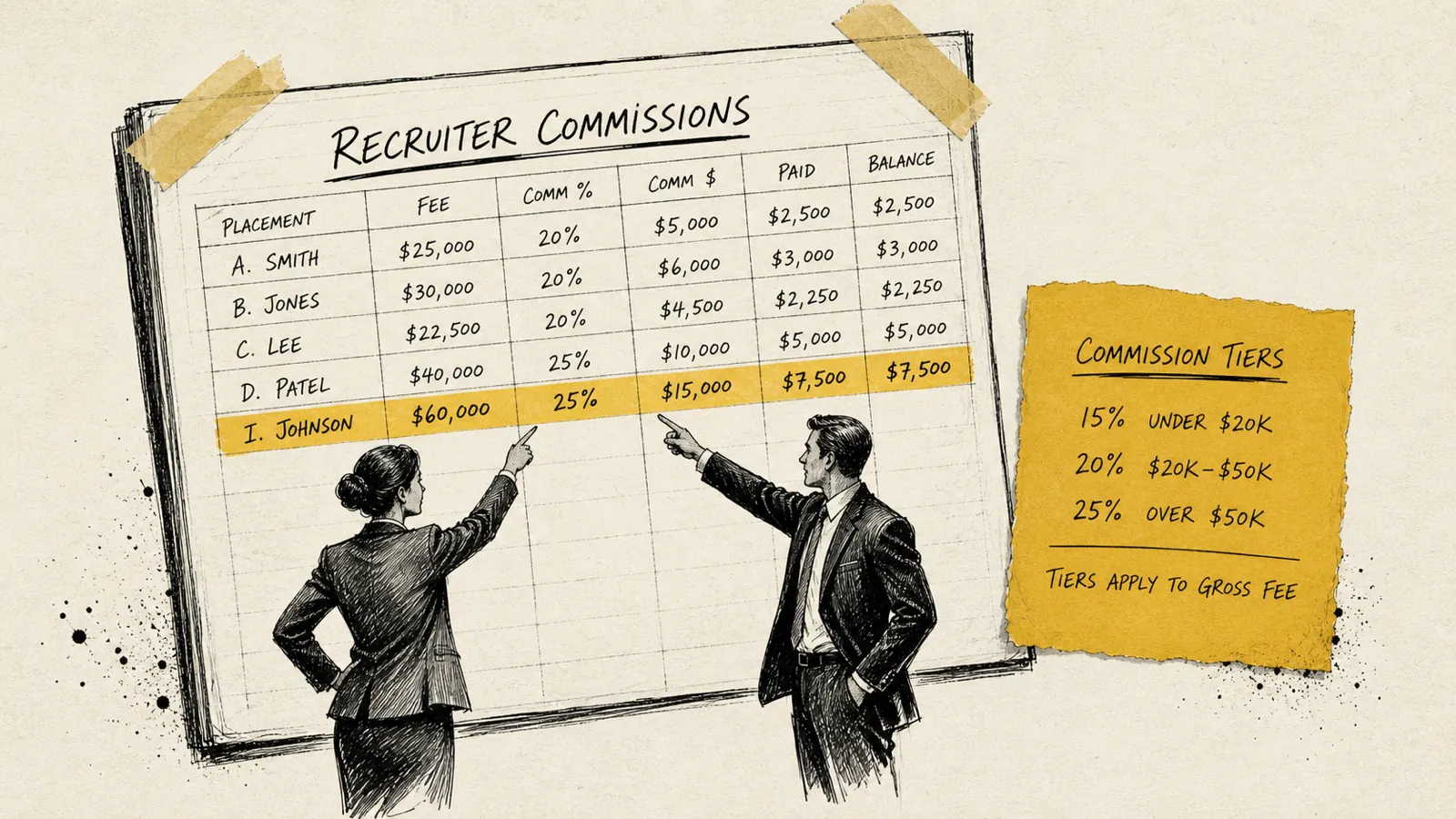
A tiered commission plan pays recruiters an escalating percentage of their billings as they cross predefined revenue thresholds. It's the dominant compensation model in executive search because it aligns recruiter effort with firm profitability: the more a biller produces, the higher their take-home rate, and the more both sides win.
| Tiers | Rate |
|---|---|
| $0–$100,000 | 20% |
| $100,001–$200,000 | 25% |
| $200,001–$350,000 | 30% |
| $350,001 and up | 35% |
Here's the simplest version of how it works. Say your base plan looks like this:
- Tier 1: $0–$100,000 billed
- Recruiter earns 20% of collected fees
- Tier 2: $100,001–$200,000 billed
- Recruiter earns 25% of collected fees
- Tier 3: $200,001–$350,000 billed
- Recruiter earns 30% of collected fees
- Tier 4: $350,001 and above
- Recruiter earns 35% of collected fees
A recruiter who collects $250,000 in fees doesn't earn 30% on all of it. They earn 20% on the first $100K, 25% on the next $100K, and 30% on the final $50K. That incremental structure is the defining feature of a tiered plan, and it's also the source of most of the calculation headaches when you're doing it in a spreadsheet.
The alternative models, flat commission (same rate on all billings) and straight draw-against (salary advanced against future earnings), each have their place, but tiered plans dominate in executive search because they reward your highest producers disproportionately without capping their upside, while still maintaining margin on lower-producing months.
Why Flat Plans Lose High Billers Over Time
A flat 25% commission sounds simple. And it is, until your $500K biller realizes she's earning the same rate as the person who billed $120K last year. Tiered plans create a visible career path built into the compensation structure itself. That visibility matters enormously for retention at the senior level of executive search, where your best people have options.
The Core Variables: Thresholds, Percentages, and Reset Periods
Every tiered commission plan for an executive search firm is defined by three levers: where you set the thresholds, what percentages you assign to each tier, and how often the counter resets. Getting these three things right is the difference between a plan that motivates year-round and one that creates a sprint in December and a slump in January.
Setting Thresholds That Reflect Your Actual Team
Your thresholds should be anchored to real production data, not aspirational benchmarks. Pull your last two years of billing data by recruiter and look at the natural clusters. Where do most of your mid-level producers land? That's where your second tier should begin. Where do your top performers typically break out? That informs your upper tiers.
A common mistake is setting Tier 1 too low. If your entry-level threshold is $50,000 and most of your team is billing $300,000+, the bottom tiers are invisible and irrelevant. The brackets should feel like genuine milestones to the people on your team, not accounting line items.
Retained search firms often see higher per-deal fees with lower volume, which shifts threshold placement accordingly.
Choosing Tier Percentages That Protect Margin
The spread between your lowest and highest tier rates is a design decision. A plan that runs from 20% at the bottom to 35% at the top is one shape it can take. Going higher than 40% at the top end can erode margin depending on your overhead structure, especially if your firm carries significant support staff, technology costs, or sourcing subscriptions like LinkedIn Recruiter or Bullhorn.
Before finalizing percentages, model your gross margin at each tier. At a 35% recruiter payout on a $25,000 fee, the firm retains $16,250. After allocating overhead, what's left? That math needs to work at scale before you publish the plan.
Monthly vs. Annual Reset Periods
Annual resets reward consistency and create compounding motivation as the year progresses. Once a recruiter clears Tier 2 in April, they're billing at the Tier 2 rate for the rest of the year, which creates real urgency to get there early. Monthly resets are simpler to administer and feel more immediately responsive to effort, but they mean a strong January doesn't help you in February. Reset cadence is one of the decisions the six-plan comp teardown reads straight out of real plan documents, next to tier mechanics and the payout trigger.
Most executive search firms with stable, experienced teams use annual resets. Firms with higher turnover or newer billers sometimes prefer quarterly resets as a middle ground: long enough to reward a strong run, short enough that a bad quarter doesn't haunt someone for the rest of the year.
How to Handle Split Placements Without Creating Drama
Split commissions, where two or more recruiters share credit on a single placement, are one of the most common sources of disputes in executive search firms. The deal might involve one recruiter owning the client relationship and another sourcing the candidate. Or a senior recruiter who brought in the retainer and a junior who did the legwork. Without a clear written policy, these situations become arguments.
A strong split policy answers four questions upfront:
- How is credit divided by default? Many firms default to a 50/50 split unless the parties agree otherwise in writing before the deal closes.
- Does split credit count toward individual tier thresholds? If a recruiter gets 50% credit on a $30,000 fee, does $15,000 count toward their annual billing total for tier purposes? Most firms say yes: half credit, half threshold progress.
- Who gets the client-side credit vs. the candidate-side credit? In retained search, these are sometimes separated, with different commission rates applying to business development vs. fulfillment roles.
- What happens if there's a dispute after the fact? Name a single decision-maker (usually the firm owner or a practice group leader) whose call is final.
The cleaner your split policy is before a deal closes, the less time you spend mediating after. Put it in your offer letters, your recruiter handbook, and anywhere else your team goes to understand how they get paid.
Internal vs. External Splits
Some executive search firms participate in split-placement networks, organizations like NPAworldwide or Top Echelon where outside firms share candidates and clients. External splits typically pay out at a lower rate than internal ones, and they may have different tax and invoicing implications. Your commission plan should explicitly address how external split income is credited and at what rate it enters the tier calculation.
Building in Draw Policies and Base Salary Offsets
Not every executive search firm runs a pure commission model. Many offer a base salary or a recoverable draw, an advance on future commissions that gets paid back as placements close. Understanding how your draw structure interacts with your tiered commission plan is essential for avoiding the most painful version of month-end reconciliation.
Recoverable vs. Non-Recoverable Draws
- Recoverable draw
- The firm advances a set amount each month against future commissions. If a recruiter earns $8,000 in commission on a $5,000 draw month, they receive $3,000 net. If they earn $3,000 on a $5,000 draw month, they owe $2,000 in future periods (though enforcement of this debt varies by state and firm policy).
- Non-recoverable draw
- The advance is a guaranteed floor. If commissions don't exceed the draw, the shortfall is not carried forward. This is more generous to the recruiter and reduces the firm's hold over poor performers, but it eliminates a significant source of recruiter anxiety and dispute.
The interaction between draws and tiers matters most at the beginning of a reset period. A recruiter on a $6,000/month non-recoverable draw in January, when their tier counter has just reset to zero, is earning below their tier rate in real terms until their billing climbs. Model this out before promising specific take-home numbers during your recruiting process.
When to Use a Base + Commission Hybrid
For executive search firms targeting VP-level and above, where deal cycles can run three to six months, a base salary plus commission hybrid often makes more sense than a pure commission model. The base covers a recruiter's cost of living through the long stretches between closings; the commission tiers provide upside motivation. The tradeoff is higher fixed overhead, which means you need clarity on your breakeven billing per head before rolling this model out.
Commission Plan Design for Different Executive Search Models
The right tiered commission structure isn't identical across all executive search business models. A contingency firm, a retained search firm, and a hybrid container firm each have different fee structures, deal cycle lengths, and margin profiles, and those differences should shape the plan.
Contingency Search Commission Plans
Contingency search, where fees are paid only on successful placement, has the most variable income curve of any search model. Commission tiers work well here because they create motivation during the dry spells and reward big months proportionally. The main design consideration is setting thresholds that account for seasonality; Q1 and Q4 billing patterns often look very different, and annual resets handle this more gracefully than monthly ones.
Retained Search Commission Plans
Retained search fees are typically paid in installments: one-third on engagement, one-third at presentation of candidates, one-third on placement. Your commission plan needs to define at which point billing credit is recognized. Most retained search firms recognize revenue (and commission credit) when each tranche is collected, not when the engagement is signed. This prevents overpaying commission on work that ultimately doesn't close. It also means the back office for an executive search firm has to track each installment to its own trigger event, because the commission on a retained search cannot settle until the last one resolves.
Container (Engaged Contingency) Plans
Container arrangements, where an upfront engagement fee is paid but the balance is contingency, require a hybrid approach to commission recognition. The upfront fee is often credited immediately; the back-end fee is credited on collection. Make sure your plan spells out how each component is categorized for tier-threshold purposes.
The Tiered Commission Plan Math: Real Examples
Abstract plan design is only useful if you can run the actual numbers. Here's how the math works in practice, and why it matters that you get it right every single time.
Let's use this four-tier plan for our examples:
- Tier 1: $0–$150,000
- 22% commission rate
- Tier 2: $150,001–$300,000
- 27% commission rate
- Tier 3: $300,001–$500,000
- 32% commission rate
- Tier 4: $500,001+
- 37% commission rate
Scenario A: Mid-year billing of $220,000:
- First $150,000 at 22% = $33,000
- Next $70,000 at 27% = $18,900
- Total commission: $51,900
Scenario B: Top biller at $480,000:
- First $150,000 at 22% = $33,000
- Next $150,000 at 27% = $40,500
- Next $180,000 at 32% = $57,600
- Total commission: $131,100
Notice that in Scenario B, the effective commission rate is about 27.3%, not 32%, even though the recruiter is in Tier 3. This is the most common misunderstanding recruiters have about tiered plans, and it's worth explaining clearly during onboarding so you're not fielding surprised reactions when the actual check is smaller than someone expected.
For a deeper look at building the formulas that calculate these numbers automatically, see our guide on How to Build a Commission Calculator for Your Recruiting Firm (With Examples and Formulas). It walks through the exact spreadsheet logic and formula structure you need.
Documenting and Communicating Your Plan to Recruiters
A commission plan that lives only in your head (or in an unlabeled spreadsheet tab) is a liability. Every time a recruiter asks what their commission will be on a deal, you're burning time you don't have and creating an opportunity for a misunderstanding. The solution is a written commission plan document that your team can access without asking you.
Your written plan should include, at minimum:
- Tier thresholds and percentages: in plain language with worked examples, not just a rate chart
- Reset period: annual, quarterly, or monthly, and the exact start/end date
- Revenue recognition policy: when is a fee "earned" for commission purposes? On invoice? On collection?
- Split policy: how credits are divided on internal and external splits
- Draw structure: if applicable, whether it's recoverable or not and how it interacts with tier progress
- Guarantee clawback policy: if a placed candidate leaves within the guarantee period and the fee is refunded or credited, how is the recruiter's commission handled?
- Amendment process: how much notice will you give before changing the plan, and what billings will be grandfathered under the old structure
More disputes come out of undocumented clawback and split policies than out of any other single gap. It is always something that seemed obvious until the moment it wasn't.
When to Update the Plan
Commission plans should be reviewed at minimum annually, ideally before your fiscal year begins so changes take effect at a natural reset point. If your firm's billing capacity changes significantly (a new practice group, a major client concentration shift, a round of hires), an off-cycle review may be warranted. The key is giving your team at least 30–60 days' notice before any change takes effect, and never retroactively changing how already-earned commissions are calculated.
Common Mistakes That Undermine Executive Search Commission Plans
Even thoughtfully designed plans fail when they're implemented carelessly. Here are the most common structural and operational mistakes executive search firm owners make with tiered commission plans, and how to avoid them.
Mistake 1: Thresholds That Don't Adjust for Seniority
Using the same tier thresholds for a first-year recruiter and a ten-year veteran creates a plan where experienced billers are always in the top tier and new hires never feel the motivational benefit of advancing. Many firms solve this with tiered plans that are role-calibrated: different threshold schedules for Associates, Senior Consultants, and Principals, for example.
Mistake 2: Ignoring the Clawback Question
A candidate placed in September leaves in October within the guarantee period. The client gets a credit. The recruiter already received commission in September. What happens? If your plan doesn't answer this clearly, you're about to have a very uncomfortable conversation. Most firms either claw back the full commission, pro-rate it based on how far into the guarantee period the candidate left, or apply a future commission credit instead of a direct deduction. Any of these can work. The key is that everyone knows the rule before it applies to them.
Mistake 3: Commission Paid on Uncollected Fees
Paying commission on invoiced fees rather than collected fees creates a cash flow problem the moment a client is slow to pay or disputes a charge. Executive search firms almost universally benefit from paying commission on collected revenue. It aligns recruiter incentives with firm cash flow and eliminates the awkward situation of clawing back commission on a bad debt.
Mistake 4: The Spreadsheet That Only You Understand
Manually tracking tiered commissions in a spreadsheet works when you have three or four recruiters and a consistent plan. It starts breaking down as you add headcount, splits, draws, and mid-year plan changes. Those errors cost you time, recruiter trust, and the occasional wrong paycheck.
If you're still doing this manually, building a proper commission calculator is a critical first step. Our guide on How to Build a Commission Calculator for Your Recruiting Firm (With Examples and Formulas) gives you the formulas and structure to do it right, and helps you identify when you've outgrown the spreadsheet approach entirely.
Automating Tiered Commission Tracking for Executive Search Firms
The best commission plan in the industry is only as good as your ability to execute it accurately, every single pay period, without spending your Sunday evening running SUMIF formulas. Automation is not a nice-to-have for growing executive search firms. It's how you reclaim your time and eliminate a category of disputes that should never have existed in the first place.
The goal of automating your tiered commission plan is to give every recruiter three things without them having to ask you:
- Current billing total: what have they collected year-to-date (or period-to-date)?
- Current tier rate: what percentage are they earning right now?
- Distance to next tier: how much more do they need to bill to reach the next rate?
When recruiters can see this in real time, something interesting happens: the motivational function of the tiered plan actually works. People who are $18,000 from the next tier threshold push harder to close it before the reset date. People who just crossed into a new tier feel the win. The plan stops being an abstract policy and starts being a live scoreboard.
What to Look for in a Commission Tracking Tool
Whether you're evaluating purpose-built recruiting commission software or a more general-purpose finance automation platform, look for these capabilities:
- Configurable tier logic: the tool should let you define custom thresholds and rates without requiring a developer
- Collection-based triggers: commission should calculate on collected invoices, not just sent ones
- Split-placement support: ability to divide credit across multiple recruiters with custom allocation percentages
- Reset period configuration: annual, quarterly, or monthly, without manual intervention
- Recruiter-facing dashboards: individual visibility into tier progress eliminates the Slack messages
- ATS and accounting integration: native connections to platforms like Bullhorn, JobAdder, Vincere, or QuickBooks reduce manual data entry
CollectedHQ is purpose-built for exactly this problem: giving executive search firm owners a single place where commission calculations happen automatically, split credits are tracked, and every recruiter can see their numbers without pinging you. The Monday morning 'what did I earn last month?' question becomes something your team answers themselves.
Making Your Commission Plan a Recruiting and Retention Tool
Your tiered commission structure isn't just an internal operational document. It's one of the first things a strong candidate recruiter will ask about when you're trying to hire them away from a competitor. Firms with clear, generous, well-documented commission plans win recruiting conversations. Firms with vague or complicated plans lose them.
When presenting your plan to a prospective hire, lead with the upside at their expected billing level. If they billed $350,000 at their last firm on a 25% flat rate, show them what your tiered plan pays at $350,000, and what it pays at $450,000. Make the math visible. Make the trajectory concrete.
For retention, tier advancement is one of the strongest non-salary levers you have. A recruiter who bills $280,000 and knows that $300,000 means a jump from 27% to 32% has a built-in reason to stay.
Benchmarking Against the Market
Executive search commission rates are not a secret. Competing firms talk to your recruiters, and your recruiters compare notes. While specific firm plans are rarely public, many recruiting industry associations and communities, including the National Association of Personnel Services (NAPS) and various LinkedIn recruiter communities, surface informal benchmarking data regularly.
If your plan is meaningfully below market at the top end, a targeted Tier 4 or Tier 5 rate adjustment is worth modeling before you lose a high performer.
Frequently Asked Questions About Tiered Commission Plans in Executive Search
What commission percentage do executive search firms typically pay recruiters?
There is no single market rate. What a recruiter earns depends on the tier structure, the firm model, and whether the recruiter owns the client relationship as well as filling the role. Set your tiers off your own billing history and model the margin the firm keeps at each tier rather than copying a rate from another firm.
Should commission tiers reset monthly or annually?
Annual resets reward consistency and create stronger year-end motivation. Monthly resets are simpler and feel more immediately responsive to effort. Most executive search firms with experienced, stable teams prefer annual resets. Some use quarterly as a middle ground, especially for newer billers.
How should commission plans handle a bad hire or placement guarantee?
The most common approaches are full clawback (the commission is reversed if the fee is refunded), pro-rated clawback (partial reversal based on how far into the guarantee period the candidate departed), or future credit (the recruiter's next commission payment is reduced by the amount). All three work. What matters is that the policy is documented before the situation arises.
Can tiered commission plans work for a team with both senior and junior recruiters?
Yes. The best approach is role-tiered plans where thresholds are calibrated to expected billing levels by role or experience band. Using the same thresholds for a first-year associate and a ten-year principal means the plan never meaningfully motivates the junior person and provides no challenge to the senior one.
When does it make sense to move away from spreadsheets for commission tracking?
The signal is operational rather than a headcount number. Once commission questions take up your week, recruiters argue about what counted toward a tier, and you are correcting paychecks after payday, the spreadsheet has stopped doing the job.

Never sweat invoicing or commissions again.