
Commission Management for Staffing Agencies: What Growing Firms Get Wrong and How to Fix It

Key Takeaways
- Most growing recruiting firms don't have a commission problem. They have a process problem that looks like a commission problem.
- Tiered splits and multi-recruiter deals are the two biggest sources of payout errors and team disputes at direct hire and executive search firms.
- Manual spreadsheet tracking creates a trust gap between leadership and recruiters that compounds over time and drives turnover.
- Automating commission calculations reduces month-end reconciliation time and removes most 'did I get paid right?' conversations.
- The right commission tracking system should handle split deals, tiered thresholds, and real-time visibility, not just simple flat-rate math.
It's 9:47 on a Tuesday night and your top biller just sent you a Slack message asking what their commission is going to be on the deal that split between two recruiters and crossed a tier threshold mid-month. You know you have a spreadsheet for this. Somewhere. Staffing agency commission management is one of those operational problems that feels manageable when you have five recruiters and becomes genuinely painful by the time you have fifteen. The gap between those two states isn't headcount. It's deal complexity piling up faster than your process can absorb it. This article breaks down exactly where commission tracking breaks down at growing direct hire and executive search firms, what it actually costs you in recruiter trust and leadership credibility, and what to do about it before it starts costing you your best people.
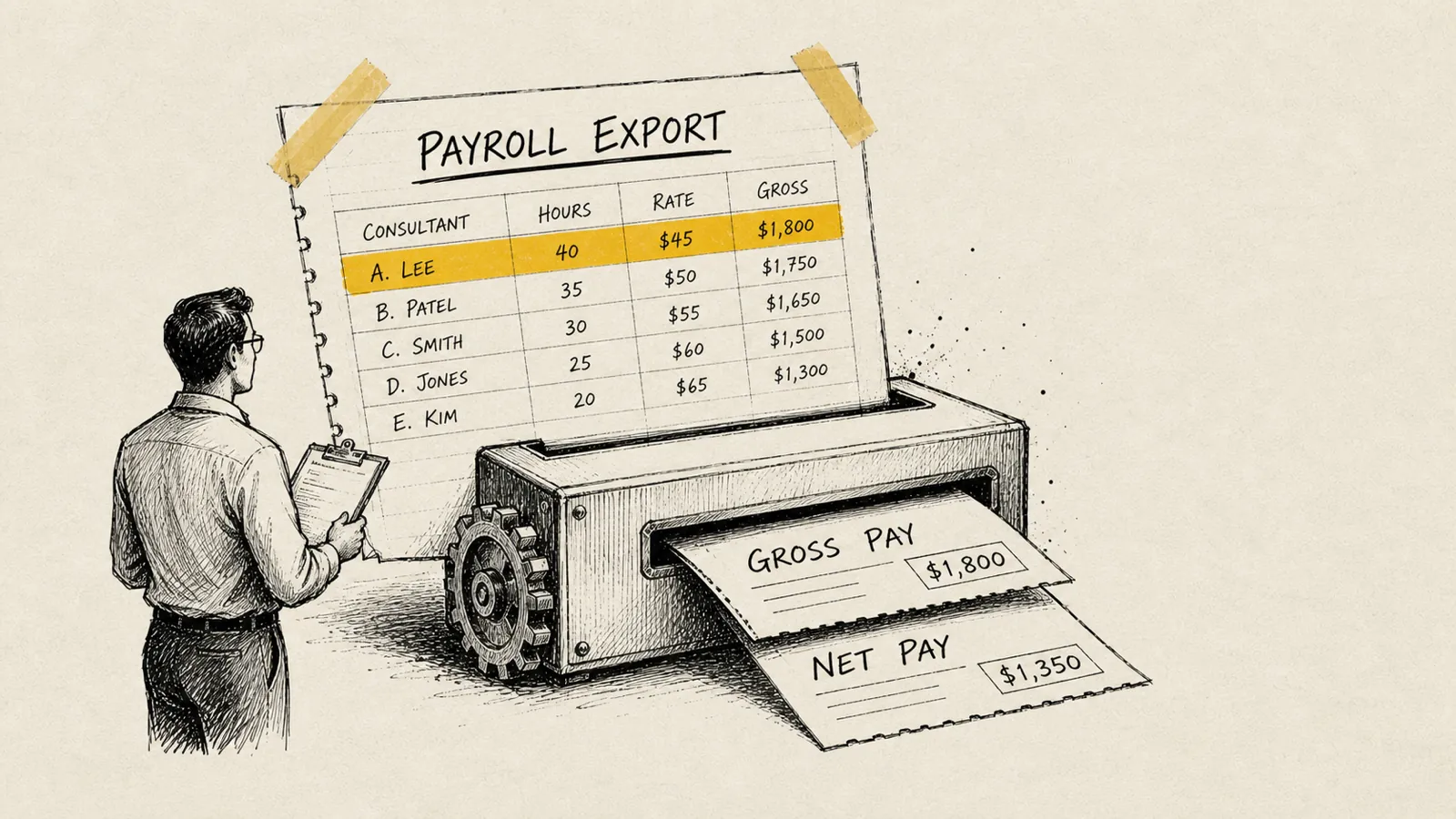
Why Staffing Agency Commission Management Breaks at Scale
The core problem is deceptively simple: the tools most firms use to manage commissions were never built for commission management. Excel and Google Sheets are flexible, familiar, and free. And completely wrong for this job once your firm crosses a certain threshold of complexity.
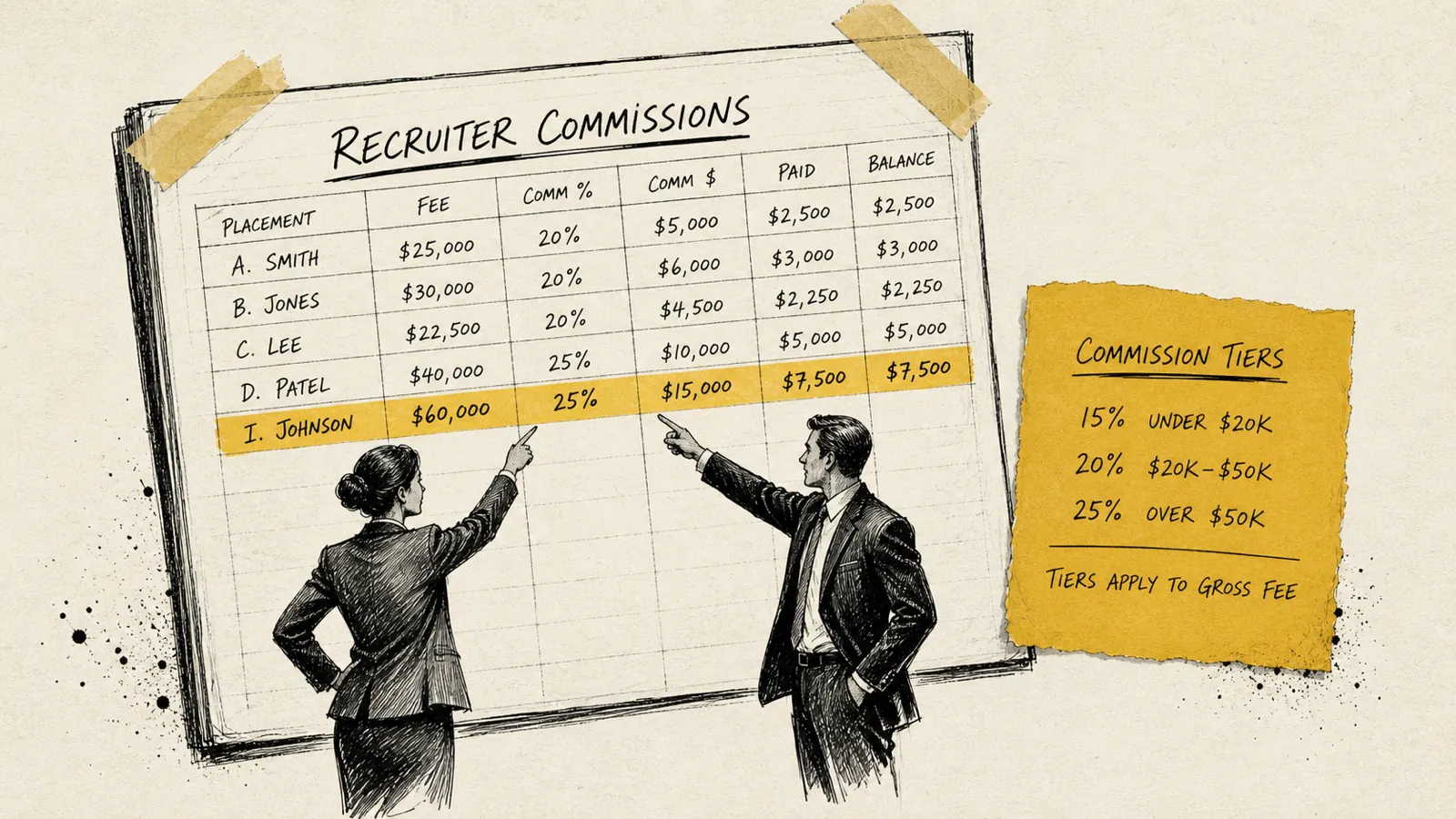
When a firm has a handful of recruiters running straightforward deals at a flat commission rate, a spreadsheet works fine. But the moment you introduce tiered compensation (where a recruiter earns 20% on the first $200K billed and 25% above that), split deals where credit gets divided between a business developer and a recruiter, or any kind of draw against future earnings, you've created a math problem that spreadsheets will get wrong. Not because they can't do the math, but because humans are the ones updating them, and humans make mistakes under time pressure.
The deeper issue is that commission errors aren't just accounting problems. They're trust problems. When a recruiter believes they were underpaid, even if they're wrong, the relationship between that person and leadership takes a hit. And when they're right? That's even worse.
The Three Deal Types That Break Manual Tracking
Not all placements create equal complexity. Commission disputes at direct hire and executive search firms tend to trace back to three specific deal structures that are nearly impossible to track accurately in a manual system at volume.
1. Multi-Recruiter Split Deals
Split deals are common at executive search firms where one person develops the client relationship and another person sources and places the candidate. The billing goes to the firm, but the credit gets divided: sometimes 50/50, sometimes 60/40, sometimes according to a more nuanced agreement that only the two recruiters and the founder fully understand.
The problem in spreadsheet-land is that someone has to manually enter the split ratio, calculate each recruiter's share, and then apply each person's individual tier rate to their portion of the deal. If the billing for that deal comes in after the monthly spreadsheet was last updated, the whole calculation has to be redone. And if one recruiter was mid-tier and the other was above-threshold? Now you have four separate calculations for a single placement.
2. Tiered Threshold Deals
Tiered compensation is one of the most effective recruiting incentive structures available. It rewards top billers without inflating base salaries. But it is extraordinarily difficult to track manually. The challenge is that tiers are cumulative, which means you have to know exactly where every recruiter stands in their billing cycle at any given moment to calculate the right rate on a new deal.
When you're managing this in a spreadsheet, someone (usually you) has to manually sum each recruiter's year-to-date or quarter-to-date billing before applying the correct marginal rate to a new placement. Do this wrong once and you've either overpaid or underpaid. Either way, you're spending thirty minutes on a Tuesday night reconciling it with a recruiter who has already done their own math and come to a different answer.
3. Retroactive Deal Changes
In direct hire, deals change after the fact. Candidates return a signing bonus and the fee gets refunded. A retained search pays in three installments. A guarantee clause gets triggered three months after placement and a partial refund goes back to the client. Every one of these retroactive changes has a downstream effect on commission calculations that ripples back through a spreadsheet in ways that are easy to miss and hard to audit.
The Real Cost: It's Not Just the Math Errors
Firms tend to focus on the financial cost of commission errors: the overpayments, the underpayments, the time spent reconciling. Those costs are real. But the less visible cost is what happens to your team's confidence in the system.
Turnover tracks with visibility. Recruiters leave firms where they can't see their own earnings clearly until payday, and then have to argue about the number when it doesn't match what they expected.
That's the trust gap. Recruiters are running their own mental math on every deal they close. If your system gives them a different answer than their mental math, even if your system is correct, the default assumption is that the system is wrong. Without an audit trail, you can't prove otherwise quickly. And a drawn-out commission dispute is a recruiting firm's version of a performance review going sideways.
This is also where the after-hours pay questions come from. Recruiters aren't sending you Slack messages at 10 PM because they're difficult. They're doing it because they don't have access to real-time information about their own compensation, so they're asking the one person who does.
What Effective Staffing Agency Commission Management Actually Looks Like
Effective commission management at a recruiting firm has three properties: it's accurate, it's visible, and it's auditable. Every commission system (spreadsheet or software) should be evaluated against those three criteria.
- Accurate
- The calculations are correct every time, including for split deals, tiered thresholds, and retroactive adjustments. Accuracy requires either a human doing careful, time-intensive work on every deal, or a system that does the math automatically based on rules you've defined.
- Visible
- Recruiters can see their current earnings, their progress toward tier thresholds, and what their commission will be on a deal they're about to close, before payday. Visibility is what eliminates the 10 PM Slack messages. When recruiters can answer their own questions without asking you, you get your evenings back.
- Auditable
- When a dispute arises, there's a clear paper trail: what deal, what fee, what split ratio, what tier rate, what payout. An auditable system lets you resolve disputes in minutes instead of hours because the data is there, timestamped, and traceable.
Most spreadsheet setups can achieve accuracy with enough careful attention. Very few can achieve all three. Visibility is almost impossible in a spreadsheet unless you're rebuilding a personal dashboard for every recruiter, every month. And auditability in a spreadsheet depends entirely on how disciplined the person maintaining it has been about version control, which, in practice, is usually not very disciplined at all.
How to Audit Your Current Commission Process Right Now
Before you decide whether you need new tools or just tighter processes, it's worth running a quick audit of your current setup. This doesn't need to be formal. It just needs to be honest.
- Pull your last three months of commission payouts. Look specifically for split deals. Did any recruiter receive a different amount than what was originally communicated? If yes, why, and was it corrected?
- Check your tier application. For any recruiter who crossed a billing threshold during a pay period, verify that the correct marginal rate was applied to the portion of their billing above the threshold, not their entire monthly billing at the new rate.
- Ask your recruiters. This one takes some courage. Ask two or three of your top billers whether they feel confident that their commission statements are accurate. Listen to the hesitation, not just the words.
- Time yourself on one complex deal. Pick the most complicated deal from last month (split, tiered, or adjusted) and time how long it takes you to explain the calculation to the recruiter involved. If it's more than ten minutes, that's a system problem.
- Count your dispute emails or messages. How many commission questions did you field last month outside of your regular payroll communication? Three or more is a signal. Ten or more is a fire.
When to Move from Spreadsheets to Dedicated Commission Tracking Software
The right time to move from manual spreadsheet tracking to dedicated commission tracking software is earlier than most firm owners think. And the trigger isn't firm size, it's deal complexity.
A firm with five recruiters running clean, flat-rate, single-recruiter deals can probably manage in a well-maintained spreadsheet. A firm with eight recruiters where half the deals are split and three recruiters are on tiered comp plans cannot, at least not without someone spending serious time every month keeping the spreadsheet accurate.
Here's a practical threshold: if you or your ops person is spending more than three hours per month on commission reconciliation, or if you're fielding more than a handful of commission questions per pay period, you have outgrown the spreadsheet.
For a deeper look at the mechanics of manual tracking errors and how to address them before making a software investment, How to Track Recruiter Payouts Without Spreadsheet Errors (And Stop After-Hours Pay Questions) covers that ground in detail. It's worth reading alongside this article as part of our broader Commission Tracking Software & Tools pillar.
What to Look for in Commission Tracking Software for Recruiting Firms
Not all commission tracking platforms are built for the nuances of direct hire and executive search. Many tools designed for sales commission management assume a relatively simple deal structure: single rep, flat percentage, paid on close. That model fits the simplest deals at a recruiting firm and misses the complexity entirely on the rest.
When evaluating tools for staffing agency commission management, prioritize these capabilities:
- Native split deal support. The system should allow you to define split ratios at the deal level and apply each recruiter's individual tier rate to their portion of the deal, not the full deal amount.
- Configurable tiered thresholds. You need to be able to define thresholds by time period (monthly, quarterly, annual), by billing amount, and apply different rates per tier without manual calculation.
- Recruiter-facing visibility. The system should give individual recruiters access to their own earnings dashboard so they can see current totals, projected payouts, and progress toward thresholds without asking you.
- Audit trail and dispute resolution tools. Every calculation should be traceable. When a recruiter questions a payout, you should be able to show them the exact inputs that produced the number.
- Integration with your ATS and billing system. Manual data entry between systems is where errors re-enter the picture. Look for integrations with platforms like Bullhorn, JobAdder, or your billing and invoicing workflow.
- Retroactive adjustment handling. Guarantee clawbacks, partial refunds, and installment-based retained fees should be handled without breaking the historical record of what was already calculated and paid.
Generic sales commission tools like Spiff, CaptivateIQ, or Xactly can work for simpler models, but they often require significant configuration to handle recruiting-specific deal structures. Recruiting-specific platforms or finance operations services built for the industry (like what we've built at CollectedHQ) close that gap by starting from the right assumptions about how direct hire and executive search deals actually work.
Making the Transition Without Breaking Recruiter Trust
Switching from a spreadsheet-based system to software isn't just a technical project. It's a communication project. Your recruiters have a relationship with the current system, even if it's a frustrating one. Any change to how commissions are calculated or communicated needs to be introduced carefully.
A few principles that make the transition smoother:
- Run parallel calculations for at least one pay period. Keep your old spreadsheet running alongside the new system and compare outputs before you fully cut over. If there are discrepancies, you want to find them before your recruiters do.
- Show your work on the first payout under the new system. Send each recruiter a breakdown of their commission statement that shows the deal, the fee, the split ratio (if applicable), the tier rate applied, and the final number. Even if you plan to let the system handle this going forward, doing it manually once builds confidence.
- Set expectations about the visibility feature explicitly. Tell your team that starting next month, they'll be able to see their own earnings in real time. Frame it as a benefit, because it is. Most recruiters who've dealt with opacity in their commission reporting will welcome this.
- Have a clear dispute process in place from day one. Even with a great system, questions will come up. Define a process: how a recruiter flags a concern, who reviews it, and what the turnaround time is. Write it down and share it with the team.
What to do about staffing agency commission management
Commission management is one of those operational areas where the cost of doing it badly is almost always higher than the cost of doing it right. It just shows up in less obvious ways. Recruiter turnover, team morale, leadership credibility, and the hours you personally spend answering compensation questions at night are all real costs that don't show up in a simple accounting of overpayments and corrections.
The firms that get this right don't necessarily have more complicated systems. They have systems (whether a tightly managed spreadsheet process or purpose-built software) that are accurate, visible to the people being paid, and auditable when something needs to be verified. That combination is what earns trust, and trust is what keeps your best billers on the floor and not on LinkedIn looking for firms that pay them more clearly.
If you're still building out your overall approach to tracking recruiter earnings, start with the fundamentals. Our guide on recruiter payout tracking walks through the specific spreadsheet failure points and what to put in place before making any software decisions. Think of that as the foundation. This article is the architecture on top of it.
Commission management doesn't have to be the part of running a recruiting firm that keeps you up at night. It just needs to be treated as the operational priority it actually is.
Frequently Asked Questions
- When should a staffing agency move from spreadsheets to commission tracking software?
- The trigger isn't firm size. It's deal complexity. If you're spending more than three hours per month on commission reconciliation, or fielding more than a handful of pay questions per period, you have outgrown the spreadsheet. Split deals and tiered comp plans are what push most firms past it.
- What are the most common commission errors at recruiting firms?
- Split deal math errors and tier threshold miscalculations drive most payout disputes at direct hire and executive search firms. Manual entry mistakes and retroactive deal changes, such as guarantee clawbacks or installment fee adjustments, account for the rest.
- What should staffing agency commission tracking software include?
- At minimum: native split deal support with per-recruiter tier application, configurable tiered thresholds by time period, recruiter-facing earnings dashboards for real-time visibility, a full audit trail for dispute resolution, ATS and billing integration, and retroactive adjustment handling for guarantees and installment-based retained fees.
- How do tiered commissions work at recruiting firms?
- Tiered commissions reward top billers with higher percentage rates after hitting billing thresholds: for example, 20% on the first $200K billed and 25% above that. The challenge is that tiers are cumulative, requiring accurate year-to-date or quarter-to-date billing totals before the correct marginal rate can be applied to each new deal. This is where manual systems most often fail.
- How do you handle split deal commissions at a staffing agency?
- A split deal should have the gross fee divided by the agreed split ratio first, then each recruiter's individual tier rate applied to their portion, not the full fee amount. The most common error in manual systems is applying a blended or incorrect tier rate to the entire deal rather than calculating each recruiter's share independently.
- Why do recruiters lose trust in commission systems?
- The root cause is opacity. When recruiters can't see their own earnings in real time, they calculate their expected commission independently. Any discrepancy, even a correct one, defaults to distrust of the system. Real-time dashboards let recruiters verify the math themselves before payday.
Never sweat invoicing or commissions again.