
Split Commission in Recruiting: How to Structure, Track, and Pay Out Multi-Recruiter Deals Fairly

Key Takeaways
- Split commission recruiting deals occur when two or more recruiters share credit (and payout) on a single placement, either internally or with an external firm.
- The most common internal split is 50/50 between a business developer and a recruiter, but tiered and weighted splits are increasingly used to reflect actual contribution.
- Undocumented splits are a common source of recruiter commission disputes. Every deal with multiple contributors should have a signed split agreement before work begins.
- Tracking split commissions in spreadsheets works at 1–3 recruiters but breaks down fast as your team grows; purpose-built commission tracking software eliminates month-end reconciliation errors.
- A clear, written split commission policy, applied consistently, reduces team conflict, improves recruiter retention, and makes your financials audit-ready.
It's the last Friday of the month. You're trying to close out commissions before payroll runs Monday morning. Your lead recruiter sends a Slack message at 4:47 PM asking why her split on a deal looks wrong. Your BD guy says he was promised 60% because he managed the client relationship. The candidate's previous recruiter, the one who left three months ago, technically introduced the lead. And your spreadsheet has three different versions of the deal logged across two tabs.
If that scenario feels painfully familiar, you're not alone. Split commission tracking is one of the most common operational headaches at recruiting firms, and it's almost always a policy problem before it's a math problem.
This guide covers everything you need to know about split commission recruiting: what it is, the most common structures used by direct hire and executive search firms, how to document deals so disputes don't happen, and what your tracking system needs to handle as your team grows.
What Is Split Commission in Recruiting?
Split commission in recruiting occurs when two or more recruiters (or two separate firms) share the fee earned on a single placement. Instead of one person collecting the full commission, the payout is divided based on each party's contribution to closing the deal.
Splits happen in two distinct contexts:
- Internal splits: between recruiters on the same team (typically a business developer who owns the client and a recruiter who sourced and placed the candidate)
- External splits: between two separate recruiting firms that exchange job orders or candidates, often facilitated through split placement networks like NPA Worldwide, Top Echelon, or informal referral arrangements
Both types require the same foundational elements: a clear agreement on percentages before work begins, a documented record of the deal structure, and a reliable way to calculate each person's payout when the invoice is collected.
Why Split Deals Exist in the First Place
Recruiting is fundamentally a two-sided marketplace. One recruiter might have the client relationship but not the right candidate pipeline. Another might have the perfect candidate but no open role to present them to. Splits let your team (or your network) bridge that gap without leaving money on the table.
Done well, split placements increase your firm's total revenue. Done poorly, they generate more internal conflict than almost any other operational issue in a recruiting firm. Split disputes are a retention problem as much as an accounting one.
The Most Common Split Commission Structures in Recruiting
There is no universal standard, but most direct hire and executive search firms use some variation of these five structures. Understanding each one, including where they break down, is the first step toward choosing what works for your team.
1. The 50/50 Internal Split
The simplest and most widely used internal structure. The business developer (the recruiter who owns the client relationship and brought in the job order) receives 50% of the placement commission. The delivery recruiter (who sourced, screened, and placed the candidate) receives the other 50%.
When it works: Teams where BD and delivery roles are clearly separate, and both sides contribute roughly equal effort per deal.
Where it breaks down: When the same recruiter did both sides (they opened the account AND placed the candidate) and now you're paying them 50% of what they'd get for a solo deal. That creates a perverse incentive to avoid collaboration.
2. Weighted Splits Based on Contribution
Instead of a fixed 50/50, weighted splits assign commission percentages based on each recruiter's actual contribution to the deal. Common breakdowns include 60/40, 70/30, or even 80/20 when one side did the heavy lifting.
- Client sourced by BD, candidate by delivery
- BD Recruiter: 50%, Delivery Recruiter: 50%
- BD managed client AND negotiated offer
- BD Recruiter: 60%, Delivery Recruiter: 40%
- Delivery recruiter also sourced the role
- BD Recruiter: 30%, Delivery Recruiter: 70%
- External referral (partner firm)
- Job-Order Firm: 50%, Partner (Candidate) Firm: 50%
Weighted splits feel fair in theory. In practice, they require a clear pre-deal agreement. Otherwise you end up with exactly the situation described at the top of this article.
3. Three-Way and Multi-Party Splits
These occur when three or more contributors are involved: a sourcer who found the candidate, a recruiter who managed the process, and a BD person who owns the account. Some executive search firms also add a split for a researcher or coordinator who did substantial sourcing work.
Multi-party splits are mathematically straightforward (the percentages just need to add up to 100% of the recruiter's share), but they're administratively complex. Every additional party is another person who can dispute the math at month-end.
Practical rule: If a deal has more than three commission recipients, your policy and your tracking system need to handle it explicitly, or you'll create a reconciliation nightmare.
4. External Split Placements (Firm-to-Firm)
When two separate firms collaborate, the standard is typically 50/50 of the placement fee: one firm holds the job order, the other provides the candidate. The job-order firm invoices the client for the full fee, then pays the candidate-source firm their 50% after collection.
Key nuances for external splits:
- The invoicing firm is responsible for collecting, and carries the collection risk
- Some networks specify a 60/40 split favoring the job-order side to compensate for that risk
- Guarantee periods and refund policies need to be negotiated between firms before the deal is sent, not after
- Payouts to external partners should follow the same payment timing as your internal commissions. Paying out before the invoice is collected is a cash flow mistake
5. Tiered Commission Plans With Embedded Splits
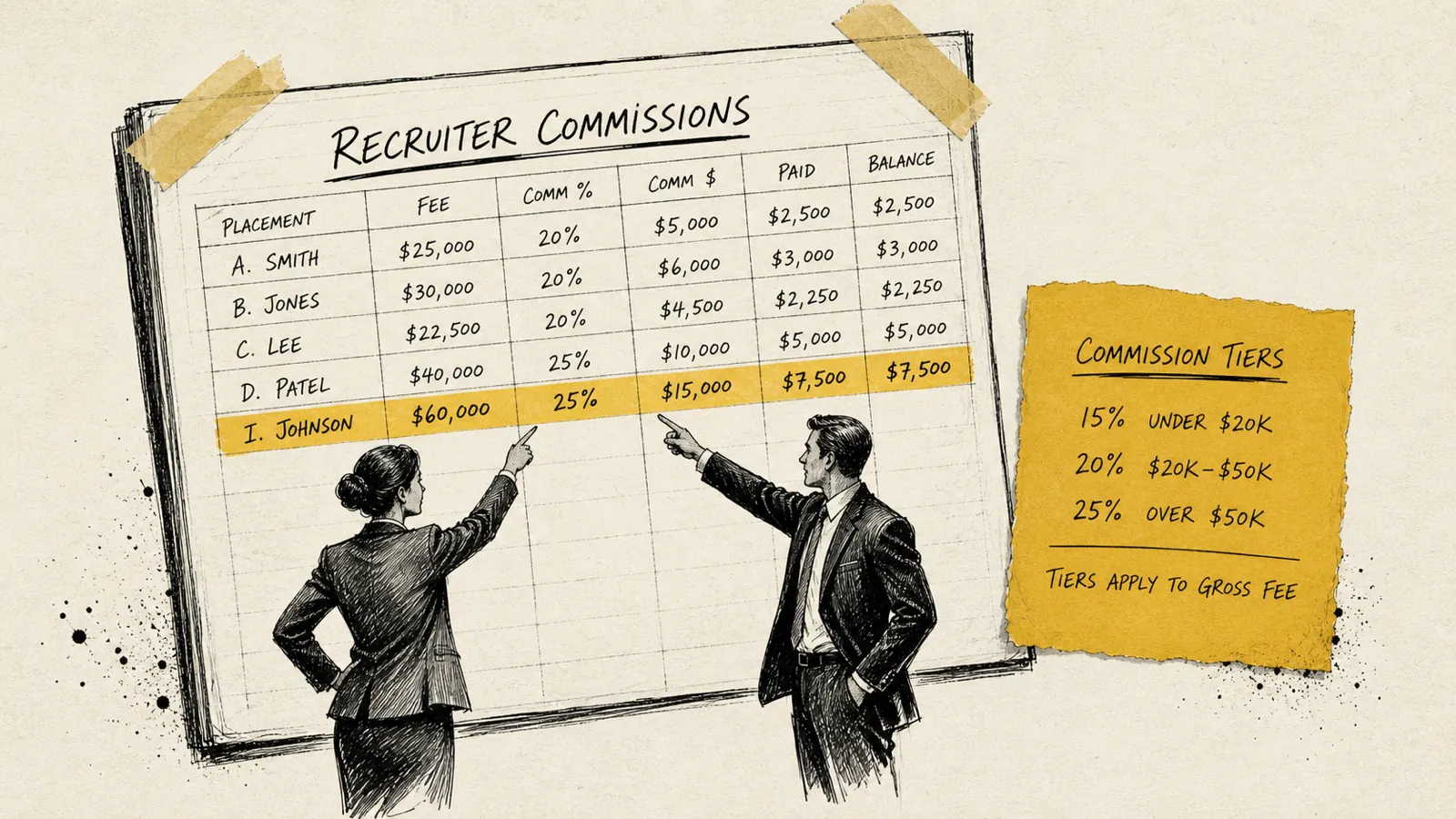
Many growing firms layer split structures on top of individual tiered commission plans. A recruiter might earn 10% of collected fees on their first $100K of billings, 12% on the next $100K, and 15% above that, with splits calculated against those individual percentages.
This is where spreadsheet tracking starts to collapse entirely. You're not just calculating a split percentage; you're calculating each recruiter's current tier position, applying the right rate, and then allocating the split, all while the month is still open and new deals are coming in.
How to Structure a Fair Split Commission Policy

A split commission policy is not a suggestion. It's a contract between your firm and every recruiter on your team. The best policies are short, unambiguous, and consistent.
Here's what every split commission policy needs to cover:
Define the Roles That Qualify for Split Credit
Name the roles explicitly: Business Developer, Delivery Recruiter, Sourcer, Researcher, Account Manager. If a role isn't defined in your policy, someone will eventually claim credit for it.
Also define what each role must have done to qualify. "Introducing a candidate" shouldn't earn the same split credit as "managing the candidate through a six-week interview process." Specificity prevents arguments.
Set Default Split Percentages
Establish a default split for the most common deal type (usually 50/50 internal) and document what triggers a deviation. If your BD person handled the kickoff, weekly client calls, offer negotiation, and the reference checks, maybe the default shifts to 60/40. Say so in writing.
Require a Split Agreement Before Work Begins
This is the rule that eliminates the most disputes. No split deal should go to work without a written split agreement signed (or at minimum confirmed in writing via email) by all parties.
The agreement doesn't need to be a formal legal document. A deal memo or even a structured Slack message in a dedicated channel can work, as long as it records:
- The job order or client name
- The names of all contributing recruiters
- Each person's percentage
- The date agreed
If you're using a CRM like Bullhorn, Vincere, or JobAdder, you should log the split there as well so it's attached to the deal record, not sitting in someone's email thread.
Specify When Commissions Are Earned vs. Paid
This is a distinction that many recruiting firms handle vaguely, and it causes real pain. Be explicit:
- Commission is earned when the placement is made and the client accepts the candidate (or when the invoice is generated. Your choice, but pick one)
- Commission is paid when the invoice is collected (or on a defined schedule after earned)
- Chargebacks (when a guarantee is triggered) should reduce both sides of the split proportionally, not fall entirely on one recruiter
Address Edge Cases Explicitly
What happens if the deal falls through after the split agreement is signed but before placement? What if a recruiter leaves the firm mid-process? Do they still receive their split? What if a client is poached from one recruiter by another internal team member?
You don't need to anticipate every scenario, but the more edge cases you document, the fewer judgment calls you'll be making at 4:47 PM on a Friday.
Tracking Split Commissions: Spreadsheets vs. Purpose-Built Software
Let's be direct about this: spreadsheets are adequate for tracking split commissions when you have fewer than three recruiters and a handful of deals per month. Beyond that threshold, the error rate climbs fast and the time cost becomes significant.
The Real Cost of Spreadsheet Commission Tracking
Spreadsheet-based commission tracking has a few consistent failure modes that show up in firms of all sizes:
- Version control errors: someone updates the wrong tab, or two people edit simultaneously and one version overwrites the other
- Tier calculation mistakes: applying the wrong commission rate because a recruiter crossed a billing threshold mid-month and no one updated the formula
- Split percentage drift: the deal memo says 60/40 but the spreadsheet was set up as 50/50 and nobody caught it until the recruiter checked her pay stub
- Collection lag confusion: the invoice went out but payment hasn't come in, so it's unclear whether to include the deal in this month's commissions or next month's
Each of these errors, individually, is recoverable. But when they compound across a 10-person team running 30+ placements a month, you're spending hours every month reconciling instead of growing your business.
What Purpose-Built Commission Tracking Software Does Differently
The best commission tracking tools for recruiting firms do a few things spreadsheets can't:
- Attach split agreements to deal records so the percentage is locked at the time of agreement, not recalculated at month-end
- Automate tier calculations in real time, so as a recruiter's billings accumulate, their rate adjusts automatically
- Flag unallocated splits: if a deal closes without a complete split assignment, the system flags it rather than letting it fall through
- Generate recruiter-facing commission statements that answer the "what's my commission on this deal?" question before it becomes a Slack message to you
- Integrate with your invoicing or accounting system (QuickBooks, Xero, or similar) so commission calculations are tied to actual collected cash, not just open invoices
Tools like CollectedHQ are built specifically for this workflow, connecting your invoicing data, your commission plan structure, and your split deal records into a single source of truth your whole team can reference.
The Minimum Viable Tracking Setup for Growing Firms
If you're not ready to implement dedicated commission software yet, here's the minimum infrastructure that keeps split commission tracking manageable:
- CRM (Bullhorn, Vincere, JobAdder)
- Purpose: Deal records: log split percentages per deal at time of agreement and attach to the job order record
- Google Sheets or Excel
- Purpose: Commission calculations: apply rates, tiers, and split math monthly; use locked formula cells to prevent accidental edits
- QuickBooks or Xero
- Purpose: Invoice tracking: confirm which invoices have been collected before paying commissions; never pay on un-collected invoices
- Shared Slack channel or email thread
- Purpose: Split agreements: timestamped written record of agreed percentages; name the channel something obvious like #split-deal-agreements
This four-tool stack won't eliminate all errors, but it creates enough structure that most disputes can be resolved by pointing to a documented record rather than arguing about memory.
Paying Out Split Commissions: Timing, Mechanics, and Common Mistakes
Getting the structure and tracking right means nothing if the payout process introduces new errors. Here's how the best-run recruiting firms handle split commission payouts.
Pay on Collection, Not on Invoice
The standard practice in direct hire and executive search is to pay commissions when the client's invoice is collected, not when it's generated. This protects your cash flow and prevents the awkward situation of having paid out a commission on a deal where the client later disputes the fee or triggers the guarantee refund.
Communicate this clearly in your offer letters and commission policy documents. Recruiters should know exactly when to expect payment relative to invoice date. Many firms use a net-30 rule after collection: commissions collected by the 15th of the month are paid with that month's payroll; collections after the 15th roll into the following month.
Handle Guarantee Chargebacks Proportionally
When a placed candidate leaves during the guarantee period and you issue a refund or replacement, the commission chargeback should be split the same way the original commission was. If the deal was 60/40, the chargeback is 60/40. Applying the full chargeback to one side of a split is a fast way to destroy trust on your team.
Generate Transparent Commission Statements
Every recruiter should be able to see, at any point in the month, exactly how their commissions are calculating, including any split deals and how the percentages were applied.
When your team has visibility into their own numbers, they stop Slacking you about it. That's the goal.
Separate External Partner Payouts From Internal Commissions
When you owe a split to an external firm, that payment is a vendor payable, not an internal payroll line. It should flow through your accounts payable process, tracked separately from your internal commission register. This matters for both your financial reporting and your tax treatment.
Preventing Split Commission Disputes Before They Start
Disputes almost never happen because someone was acting in bad faith. They happen because the agreement was ambiguous from the start.
The following practices reduce disputes:
Log Splits in Your CRM at Deal Creation
The moment a job order is opened as a split deal, the split percentages should be entered in your CRM, not discussed verbally and entered later. Most major recruiting CRMs allow you to attach recruiter assignments with percentage weights directly to job orders. Use that feature religiously.
Create a "Split Deal" Review Step in Your Pipeline
Add a checkpoint in your deal workflow (whether that's in Bullhorn, Vincere, or a simple checklist) that requires split documentation to be complete before a job order moves to active sourcing. Make the split agreement a prerequisite, not an afterthought.
Debrief on Disputed Deals Individually, Not in Group Settings
When a split dispute does arise, resolve it in a one-on-one conversation with each party before bringing everyone together. Group settings escalate quickly. Understand each person's understanding of the agreement first, then reconcile, ideally by pointing to the written record rather than making a judgment call.
Review Your Split Policy Annually
As your firm grows and your deal types evolve, your policy should evolve with it. An annual review (where you look at disputes from the past year, identify patterns, and update the policy to close gaps) keeps your framework current and signals to your team that you're managing this proactively.
Split Commission Structures for Different Firm Types
Not all recruiting firms are structured the same way, and your split commission approach should reflect your business model.
Full-Desk Firms
In a full-desk model, individual recruiters own both the client relationship and the candidate pipeline. True splits are less common because most deals are solo placements. When splits do occur (usually because a recruiter needs a colleague's specialized candidate or client), a simple 50/50 or 60/40 policy is usually sufficient.
The risk for full-desk firms is that informal split agreements grow in number without ever being formally codified. Before long, you have eight different verbal arrangements and no policy to enforce.
Split-Desk (BD + Delivery) Firms
This is where split commission structures matter most. Your BD team brings in job orders; your delivery team fills them. Every placement is a split placement by design. Your policy needs to be airtight, and your tracking system needs to handle volume, because you'll have as many split deals as you have placements.
Split-desk firms should treat commission tracking infrastructure as a core operational investment, not an optional tool.
Executive Search Firms With Researchers
Executive search firms often have a third contributor: a researcher or sourcer who does the deep market mapping and long-list development. This person's contribution is real and significant. Excluding them from split credit often leads to researcher turnover. Consider a structured three-way split that formally recognizes the research function.
A common executive search structure: 40% BD / 40% Delivery / 20% Research. Adjust based on the relative contribution at your firm, but get the percentages in writing before the search begins.
Networks and Alliance Members
If your firm participates in a split placement network like Top Echelon or NPA Worldwide, you're already operating in an external split framework. The network typically sets the default split terms (often 50/50, sometimes 60/40), and your job is to ensure your internal accounting processes can handle the inbound and outbound split payments cleanly, including tracking which deals originated externally for financial reporting purposes.
AI-Assisted Commission Tracking: What's Changing in 2026
Commission tracking for recruiting firms is evolving quickly. Heading into 2026, the most notable development is the integration of AI-assisted automation into commission calculation workflows. This is worth understanding even if you're not ready to adopt it yet.
What AI-Assisted Tools Can Now Handle
The most capable commission tracking platforms are beginning to use AI in three specific ways that directly affect split commission management:
- Anomaly detection: flagging commission calculations that deviate from historical patterns or policy rules before they reach payroll (e.g., a deal recorded at 70/30 when your policy defaults to 50/50 and no override is documented)
- Natural language agreement parsing: some tools can now read a Slack message or email thread and extract split agreement details automatically, reducing manual data entry errors
- Predictive cash flow modeling: projecting expected commission payouts based on deals in progress, factoring in collection probability by client aging data
These capabilities are still maturing, and most small-to-midsize recruiting firms don't yet need them. But understanding the direction of the market helps you make smarter decisions about which tracking infrastructure to invest in today.
What AI Cannot Replace
No software, AI-powered or otherwise, can replace the human judgment required to set your split policy and enforce it consistently. The tools are only as good as the rules you put into them. If your policy is ambiguous, an AI tool will just calculate the ambiguous outcome faster.
The best-run recruiting firms in 2026 are combining cleaner policy documentation with better software, not substituting one for the other.
Building a Commission Culture That Supports Collaboration
The mechanics of split commission tracking matter. But the culture that surrounds your commission policy matters just as much.
Recruiters are competitive by nature. It's part of what makes them effective. But unmanaged, that competitive instinct creates hoarding behavior: recruiters who refuse to share candidates or job orders because they don't trust the split will be honored fairly. That behavior costs your firm placements and revenue.
The antidote is consistency and transparency. When your team sees that split agreements are honored exactly as written, every time, without exceptions, they start to trust the system. And when they trust the system, they collaborate. That collaboration compounds directly into more placements and higher revenue.
Recognize Collaboration Publicly
Call out successful split placements in your team meetings. Name both the BD recruiter and the delivery recruiter. This signals that collaboration is valued, not just tolerated, and reinforces the cultural norm you're trying to build.
Avoid Policies That Inadvertently Punish Splits
Be careful about leaderboard structures or contests that only rank solo production. If a recruiter's split deals don't count toward their contest standing, you've created a financial incentive to avoid collaboration. Either include split credits proportionally in your rankings or run separate recognition for collaborative placements.
Frequently Asked Questions About Split Commission in Recruiting
What is the standard split commission percentage in recruiting?
The most common internal split is 50/50 between the recruiter who sourced the job order and the recruiter who placed the candidate. External splits between two firms also typically default to 50/50, though some arrangements use 60/40 in favor of the job-order side. Weighted splits (60/40, 70/30) are used when one party's contribution is demonstrably larger. Your policy should define the default and document the criteria that trigger a deviation.
Can a recruiter claim a split on a deal they didn't help close?
Only if the split agreement was documented at the time they were assigned. This is why pre-deal split documentation is so important. It defines who is in the deal and at what percentage before the work begins. Without documentation, a recruiter who introduced a candidate months ago but wasn't involved in the close has a much weaker claim. Your policy should state this explicitly so the expectation is clear from day one.
How do you handle split commissions when a recruiter leaves the firm?
This depends on your commission policy and any employment agreements in place. The standard approach: if the deal closed and the invoice was collected before the recruiter's departure, they are owed their split. If the deal was still in-process at departure, your policy should define whether they retain any portion of the split or forfeit it. This should be written into your offer letters, not decided after the fact. Consulting an employment attorney when drafting this language is worth the cost.
Do split commissions affect recruiter tier calculations?
Yes, and this is one of the trickiest calculation problems in recruiting commission management. The question is whether a recruiter's split credit (say, 50% of a $30K fee = $15K) counts toward their billing total for tier advancement purposes at $15K or $30K. Most firms count the actual split amount ($15K), but you must define this explicitly in your policy or you'll have a dispute the first time a recruiter crosses a tier threshold on a split deal.
What's the difference between a split placement and a referral fee?
A split placement involves active collaboration: both sides work the deal simultaneously. A referral fee is typically paid for a warm introduction or a lead that one party passes to another, with the receiving party doing all the subsequent work. Referral fees are usually smaller and are paid after collection. Both should be documented in writing, but they're structured and tracked differently, and mixing them up in your accounting creates reporting problems.
What should a split commission agreement include at minimum?
At minimum, a valid split commission agreement should include: the client or job order name, the names of all contributing recruiters or firms, each party's agreed percentage, the date the agreement was made, and a clear statement of what each party's role is in the deal. It doesn't need to be a formal legal contract (a timestamped email confirmation or a CRM-logged record is sufficient for most firms), but all parties must acknowledge it in writing before work begins.
How do split commissions work in split placement networks?
In networks like Top Echelon or NPA Worldwide, the job-order firm (the "exporter") posts a role to the network and accepts candidate submissions from other member firms ("importers"). When a placement is made, the fee is split, typically 50/50, with the job-order firm invoicing the client and then paying the candidate-source firm after collection. The network usually sets default terms, but firms can negotiate custom arrangements. Your internal accounting needs to track these as vendor payables, not internal payroll.
What to do about split commission recruiting
Split commission recruiting is not inherently complicated. A deal comes in, multiple people contribute, everyone gets paid their fair share. The complexity comes from ambiguity: verbal agreements, undefined roles, spreadsheets that drift from the source of truth, and policies that don't address edge cases.
Fix the ambiguity, and you fix most of the problems.
That means a written policy your team has actually read, split agreements logged in your CRM at the time of deal creation, a tracking system that calculates commissions from collected cash rather than assumptions, and commission statements your recruiters can access without having to ask you.
When your split commission system runs cleanly, something useful happens: your team stops thinking about whether they'll get paid fairly and starts focusing on collaborating to close more deals. That's the outcome worth building toward.
If you're still running commissions out of a spreadsheet and spending real hours every month reconciling splits, it's worth looking at what a purpose-built solution could save you, both in time and in team trust. CollectedHQ was built specifically for recruiting firms in this position.
Never sweat invoicing or commissions again.