
Back office operations for executive search firms
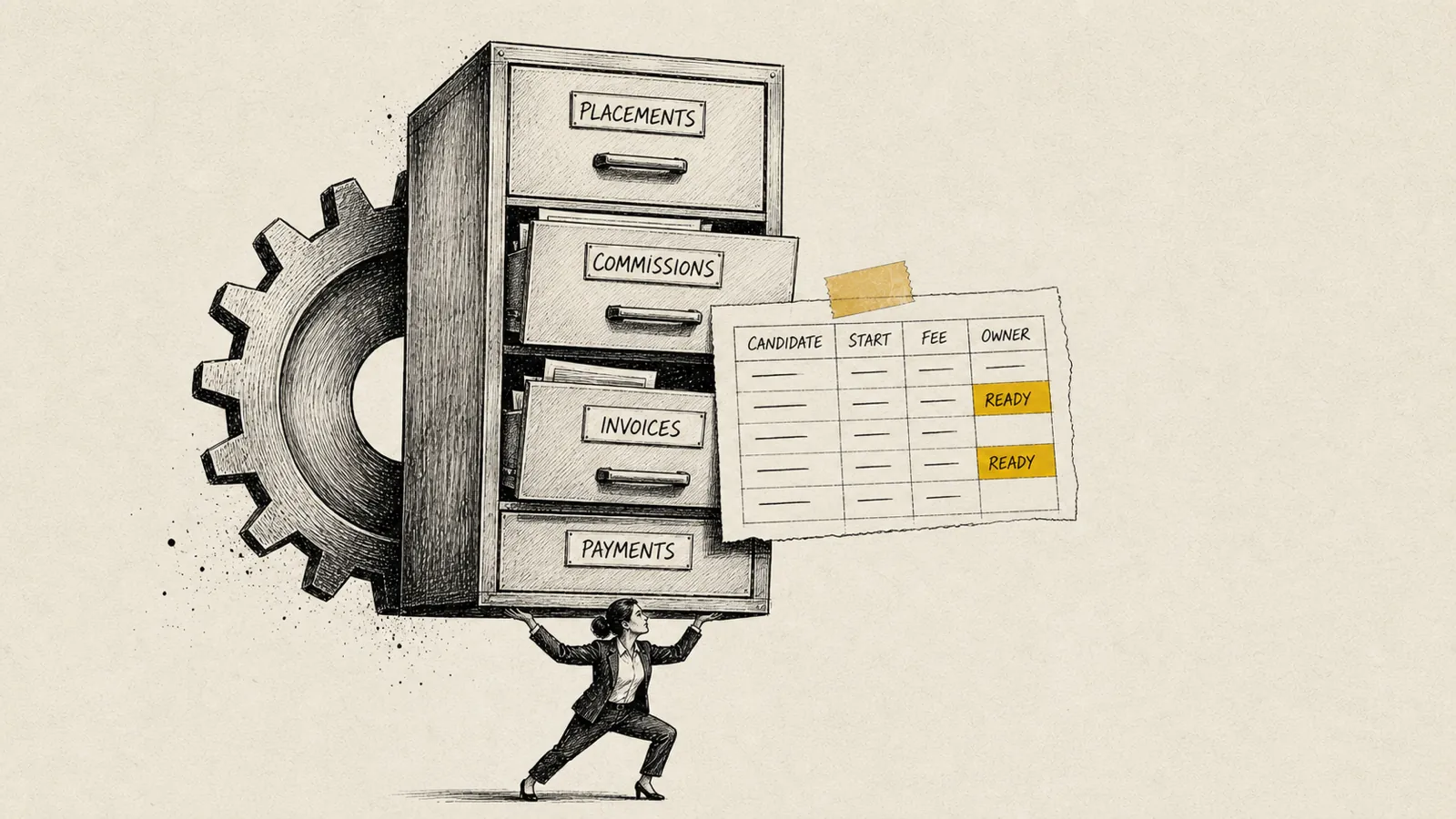
An executive search firm's back office is not a contingency back office with bigger numbers in it. Billing in installments changes the shape of the work: one engagement produces several invoices that fire on different events, months apart, and only one of those events has anybody present for it. The firm carries three clocks per search instead of one, and the commission on the whole engagement cannot be settled until the last of them closes.
That structure is the reason search firm owners describe the money side as heavy without being able to point at what is heavy about it. Nothing in it is difficult. There is simply more state to hold, and the system that holds it is usually a spreadsheet and somebody's memory.
What makes a retained back office different from a contingency one?
Contingency work has one trigger event, one invoice, one payment clock, and one commission calculation. Retained and container work multiplies each of those by the number of installments, and the installments are not evenly spaced or evenly triggered.
The first installment fires on signature, which is an event with ceremony attached. Somebody signs something, somebody is pleased about it, and the invoice goes out because the moment is visible. Later installments fire on milestones: a shortlist delivered, a slate presented, a candidate starting. Those are working days, not occasions. An event nobody attends produces no task, and an invoice that produces no task is an invoice that goes out late.
The effect compounds across a book of open searches. Six live engagements at different stages is eighteen potential invoices in various states, of which some are sent, some are paid, some are due next week, and some are waiting on a milestone that was hit last Thursday without anyone recording it.
The middle installment is where the money sits
Watching a retained engagement convert to cash makes the pattern obvious. The figures below are an illustration, not data from any firm.
| Installment | Trigger event | Trigger date | Invoiced | Cash in | Days from trigger |
|---|---|---|---|---|---|
| 1 of 3, $50,000 | Engagement signed | Jan 6 | Jan 6 | Feb 12 | 37 |
| 2 of 3, $50,000 | Shortlist delivered | Feb 20 | Mar 6 | Apr 12 | 51 |
| 3 of 3, $50,000 | Candidate start date | Apr 27 | May 8 | Jun 14 | 48 |
Same client, same terms, same collections effort on all three. The second installment took 14 days longer than the first to reach an invoice, and every day of that came before any document existed. Nothing in the firm's accounting system was aging during it, because nothing had been issued.
By the time the third invoice goes out in May, the firm is sending a new bill to a client that may still have an older one open. That weakens the position on both documents at once, and it is a self-inflicted problem created two months earlier by a milestone that produced no paperwork. The general version of this, including how to measure the gap on your own engagements, is in time to cash for recruiting firms.
What the installment model does to commission
Every commission plan has to decide what event releases the payout: the invoice going out, the invoice being paid, or the guarantee period clearing. On contingency work that is one decision applied once per placement. On a three-installment engagement it applies three times, on three different dates, to three partial amounts.
Firms usually resolve this in one of two ways. Either the recruiter is paid pro rata as each installment is collected, which is fair and produces three small calculations per search plus a reconciliation at the end, or the recruiter is paid once when the engagement completes, which is simple to compute and means the person who sourced the candidate waits from January to June to be paid on work they finished in April.
Neither is wrong. What causes the argument is choosing one and administering the other, which is what happens when the plan document says one thing and the spreadsheet does whatever was easiest in the month it was built. The decision itself, and who carries the risk under each trigger, is covered in the recruiter commission plans guide.
Splits make it heavier again. Executive search work is frequently a researcher and a lead consultant on the same engagement, sometimes with a third party who introduced the client, and each installment has to be divided the same way the last one was. A split that is stored as a percentage in somebody's head reconciles correctly twice and then does not.
Guarantees sit on money you have already collected
A guarantee on contingency work is a claim against a fee that arrived in one piece. On retained work the obligation attaches to money collected across several months, some of it long since spent, and the replacement search consumes capacity the firm has already booked against other work.
The practical consequences are worth being explicit about before an agreement is signed rather than after a candidate leaves. Does a replacement restart the installment schedule, and if so does the client pay anything further. Is the recruiter's commission on installments one and two clawed back, held, or left alone. Does the guarantee run from the start date regardless of when the final invoice was issued, which it almost always does, meaning a late third invoice shortens the window in which the cash is in hand before the obligation ends. The falloff prevention playbook covers keeping the placement alive through that window.
What to fix first
Take the last five completed engagements and write down, for each installment, the date the milestone was hit and the date the invoice went out. Fifteen rows. The gap on installments two and later is the number that matters, and on most books it is the largest single block of delay in the whole cash cycle.
If that gap is large, chasing clients harder will not close it. The fix is to make the milestone produce a task the way a signature already does. Attach the invoice trigger to the deliverable in the engagement agreement, so that sending the shortlist and raising the invoice are one action rather than two, the second of which depends on somebody remembering.
The wider set of finance decisions for a search firm, including how to hold retained fees in the accounts before they are earned, is in the finance operations playbook for executive search firms, and the money path from placement to bank is in how recruiting firms invoice and collect.
Frequently asked questions
How is billing different for retained search than contingency?
A retained engagement is billed in installments against milestones rather than once on a placement, so a single search produces several invoices that fire on different dates. Each installment carries its own payment clock, and the commission on the engagement cannot be settled until the last one is resolved.
When should an executive search firm invoice the second installment?
On the day the milestone in the engagement agreement is met, which for most firms is the shortlist or slate delivery. The delay that costs firms the most is the gap between hitting that milestone and issuing the invoice, because it happens before any document exists and therefore appears in no aging report.
How do you pay commission on a retained search?
Either pro rata as each installment is collected, or in one amount when the engagement completes. Both are defensible. What causes arguments is choosing one in the plan document and administering the other in the spreadsheet, which is where most commission disputes at search firms start.
What happens to a retained fee if the placement falls off?
That depends entirely on what the engagement agreement says, which is why it is worth deciding in advance whether a replacement restarts the installment schedule, whether any further fee is due, and whether commission already paid on earlier installments is clawed back or held. The guarantee period itself typically runs from the candidate's start date and does not move if your final invoice went out late.
Does a search firm need different software than a contingency agency?
It needs to handle the same objects, placements, invoices, commissions, in a structure where one engagement maps to several invoices and several partial commission events rather than one of each. Tools built around a single fee per placement can be made to work, and the workaround is usually a spreadsheet holding the installment schedule alongside them.
Never sweat invoicing or commissions again.