
Back office operations for contingency recruiting firms
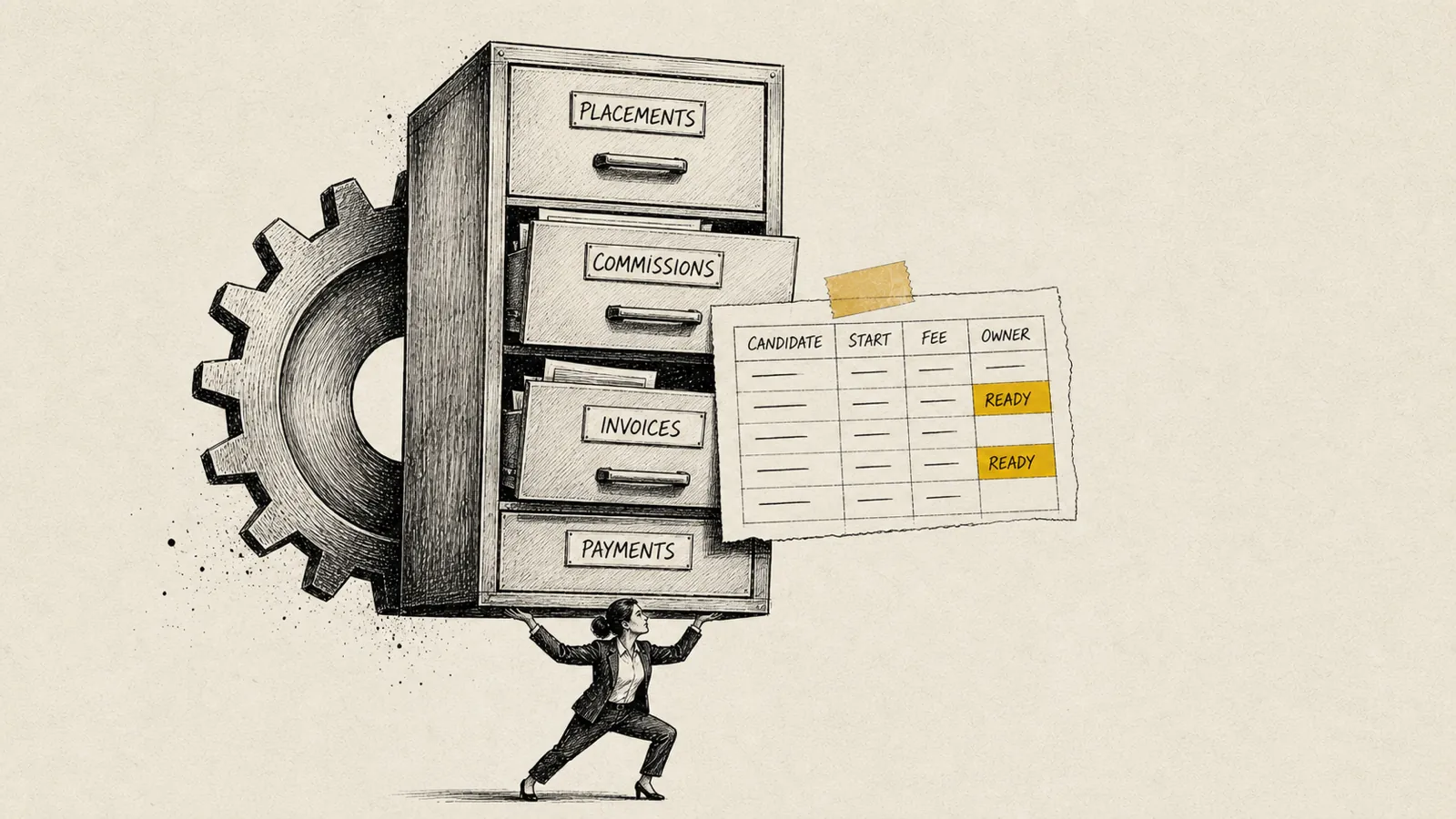
A contingency firm's money operation has exactly one revenue event per placement, and four separate things hang off it: when the invoice goes out, when the cash arrives, when the recruiter gets paid, and what happens if the placement does not stick. On retained work those four are spread across installments. Here they are stacked on one fee, which means a delay or a mistake in any one of them has nowhere to be absorbed.
That stacking, not the fee percentage, is what makes a contingency firm's back office worth designing deliberately. The retained equivalent has more invoices and more milestones. This one has fewer moving parts and no slack.
The payment clock does not start on the start date
Net 30 runs from the date on the invoice, not from the day the candidate starts, so every day between the two is a day of credit you gave the client for nothing. Most firms know their terms and very few measure that gap, because it sits inside their own operation rather than the client's.
Run one placement out on a calendar. A candidate starts on 1 September. Somebody notices a week later and raises the invoice on 8 September. Net 30 makes it due on 8 October. The client pays a week after that, on 15 October.
| Event | Date | Days elapsed | Whose delay |
|---|---|---|---|
| Candidate starts | 1 September | 0 | Nobody's |
| Invoice raised and sent | 8 September | 7 | Yours |
| Invoice due on net 30 | 8 October | 37 | Agreed |
| Payment received | 15 October | 44 | The client's |
Forty-four days from the event that earned the fee to the money landing, and seven of them were a gift. They are also the only seven you fully control. Negotiating net 15 is a conversation with a client. Invoicing on the start date instead of the following Tuesday is a calendar reminder. The time to cash guide breaks down the whole clock, and this is the segment nearly every firm can fix this month.
What one placement actually costs you in back-office time
The money cost of administering a single placement is small, and the fact that it sits on the critical path to cash is what makes it expensive. Worth separating those two, because firms usually assume the opposite.
Run the arithmetic on your own minutes. For illustration: 20 minutes raising and sending the invoice, 25 across two chase cycles, 15 calculating and recording the commission, 10 reconciling the payment when it lands. That is 70 minutes per placement, about $88 at a loaded $75 an hour, roughly $4,200 across 48 placements a year.
Against a book of 48 fees that is a rounding error, and nobody should reorganise an operation to save it. The number that matters is the seven days in the table above. This admin is cheap and it also sits between a start date and an invoice date, which converts it directly into working capital. Two firms with the same cost line and a week between their invoicing habits have different bank balances.
Commission usually leaves before the fee arrives
If your plan pays commission when the invoice goes out, you are funding the recruiter's earnings for the whole length of the client's payment terms, out of your own cash. On one placement that is a cash-flow curiosity. On a book it is a standing position that never unwinds while you keep placing.
On a $90,000 salary at a 22% fee the invoice is $19,800, and a recruiter on 22% of fee earns $4,356. Using the calendar above, that money leaves on day 8 and returns on day 44, so every placement funds $4,356 for 36 days. A firm doing four placements a month carries roughly $21,000 of paid-out commission against fees it has not collected, permanently.
| Payout trigger | Days you fund the commission | What it costs you |
|---|---|---|
| Invoice sent | About 36 | Roughly $21,000 standing, at 4 placements a month |
| Invoice paid | 0 | Nothing, and recruiters wait on a client they cannot chase |
| Guarantee cleared | 0 | Nothing, and the delay is long enough to affect hiring |
None of the three is wrong. Paying on invoice sent buys recruiter goodwill with your own working capital, and that can be a deliberate choice. It stops being a choice when nobody has worked out what it costs. Set the trigger explicitly in the plan document rather than inheriting it, and see the commission plans guide for how the trigger interacts with tiers and splits.
A falloff reverses a fee you have already spent
The refund is a wire and the clawback is a journal entry, and that asymmetry is the real cost of a falloff at a contingency firm. The guarantee obligation itself is well understood. What gets missed is that by the time it triggers, the fee has usually been collected, the commission has usually been paid, and both have usually been spent.
Take the same $19,800 fee on a 90-day guarantee, with a candidate who resigns on day 60. The fee arrived on day 44. The commission left on day 8. If the client wants cash back rather than a replacement, you send $19,800 you no longer hold while recovering $4,356 from a recruiter whose next commission run may be a month away and may not cover it. One side of that reversal moves immediately and the other moves when it can.
Two decisions take most of the sting out, and both get made before a placement rather than after a resignation. Offer replacement as the primary remedy with a refund as the fallback, since a replacement costs delivery time rather than cash. Then set the payout trigger with the guarantee in mind, which is covered in how long a placement guarantee should be. Keeping the placement alive in the first place is the falloff prevention playbook.
What to fix first
Measure the gap between your start dates and your invoice dates on the last twenty placements. It is one query, it takes an afternoon, and it is the only number on this page you can act on without asking a client or a recruiter for anything.
- Close the start-to-invoice gap. Trigger the invoice off the placement record's start date rather than off somebody remembering. Every day removed is a day of terms recovered at no cost.
- State the payout trigger in writing. Invoice sent, invoice paid, or guarantee cleared. Pick one, put it in the plan document, and know what the choice costs in funded commission.
- Put the guarantee remedy in the fee agreement. Replacement first, refund as the fallback, with the window and the conditions written down before you need them.
- Track fees invoiced but not collected, weekly. On a single-event revenue model this list is short enough to read line by line, which makes it the cheapest early warning you have.
None of that is software. It is four decisions, and the reporting layer that makes them visible is covered in the recruiting firm mid office, along with how invoicing, commissions and collections fit together once a firm outgrows running it on spreadsheets. How the invoice itself gets raised and chased is in the invoicing and collections guide.
Frequently asked questions
When should a contingency firm invoice a placement?
On the start date, triggered off the placement record rather than off somebody remembering. Terms run from the invoice date, so a week between the start and the invoice is a week of free credit handed to the client. Invoicing on offer acceptance is earlier still where the fee agreement allows it, at the cost of more credit notes when a candidate never starts.
Should commission be paid when the invoice is sent or when it is paid?
Both are defensible and they cost different amounts. Paying on invoice sent funds the recruiter's earnings across the client's whole payment terms out of your cash, which at four placements a month is a standing position in the tens of thousands. Paying on invoice paid costs nothing and asks recruiters to wait on a client they cannot chase. Pick one deliberately and write it into the plan document.
What happens to commission already paid when a placement falls off?
You recover it as a clawback against future commission, at the speed of your next few commission runs. A refund to the client moves at the speed of a bank transfer. That mismatch is the part worth planning for, because a recruiter having a thin quarter can carry a negative balance for longer than the guarantee period itself.
Is a refund or a replacement the better guarantee remedy?
Replacement as the primary remedy, with a refund as the fallback if you cannot fill within an agreed window. A replacement costs delivery time. A refund costs cash you have collected, probably banked, and partly paid out as commission. Writing replacement first into the fee agreement is a one-line change that reduces what a falloff does to your bank balance.
How do you tell whether slow cash is the client's fault or yours?
Measure the two segments separately. Start date to invoice date is yours. Invoice date to payment date is the client's, against agreed terms. Firms usually assume the second is the problem and often find the first is a week that costs nothing to remove. Pull the last twenty placements and compare the columns before renegotiating anything.
Never sweat invoicing or commissions again.