
Recruiter Commission Plans: The Complete Guide for Firm Owners

A recruiter commission plan decides four things: what percentage a recruiter earns, what that percentage is calculated on, when the money actually moves, and what happens if the placement comes apart. Most plans are explicit about the first and vague about the other three. That is where the arguments come from.
This is the hub for everything we publish on recruiter compensation. It covers the plan structures, the rate ranges, the payout trigger, draws, splits, clawbacks, and how the whole thing should change as you go from two recruiters to twenty. If you are writing a plan from scratch or rewriting one that keeps causing Friday afternoon disagreements, start here.
What does a commission plan actually have to decide?
Every workable plan answers five questions in writing: the rate, the base it is calculated on, the trigger that releases payment, the treatment of splits, and what happens on a falloff. A plan that answers only the first one is just a number with a signature under it. The other four are where the money and the disputes live.
The base is the one people skip. "Twenty percent" of what? Of the gross fee, of the fee after a house allocation, of the fee net of any discount you gave the client, of cash actually collected? Two firms paying "20%" can pay meaningfully different amounts on the same placement. Write the base down before you write the rate.
The trigger is the one that decides who carries risk, and it gets its own section below because almost nobody writes about it.
When does commission tracking actually become a problem?
Not at a headcount. At the point where somebody is spending real hours every month reconciling what was billed against what was earned. That can happen at two recruiters or at twenty, and it depends far more on how many exceptions your plans contain than on how many people are on the team.
I used to say the pain starts at five recruiters. I told a room of firm owners exactly that. Then a two-recruiter firm changed my mind. The owner had one admin holding the whole thing together, juggling commission tracking across a stack of spreadsheets, with invoicing as its own separate mess alongside it. The master spreadsheet was so fragile nobody would touch it. Every time the owner asked for an update, the admin built a fresh copy instead of editing the old one.
Her line was the one that stuck with me: "I don't even have clarity into our own plans." Two recruiters on staff, and a full-time person carrying the load of tracking what they had earned and what had been billed.
Her own math was that the software cost less than the person, with less room for error, and she planned to move that admin onto work that actually grows the firm. I had been counting recruiters. I should have been counting the hours somebody spends reconciling.
So the honest test is not "how many recruiters do I have." It is: if I asked today what each recruiter has earned year to date, how long would it take to get an answer, and would I trust it?
What are the main commission plan structures?
Five structures cover almost everything in direct-hire recruiting: flat percentage, tiered, threshold or gross-margin based, draw plus commission, and split arrangements layered on top of any of the others. Most firms end up running a combination rather than a pure form.
| Structure | How it works | Best for | Where it breaks |
|---|---|---|---|
| Flat percentage | One rate on every placement, regardless of volume | Small teams, simple books, firms that value predictability | No incentive to push late in the year, and strong billers feel underpaid |
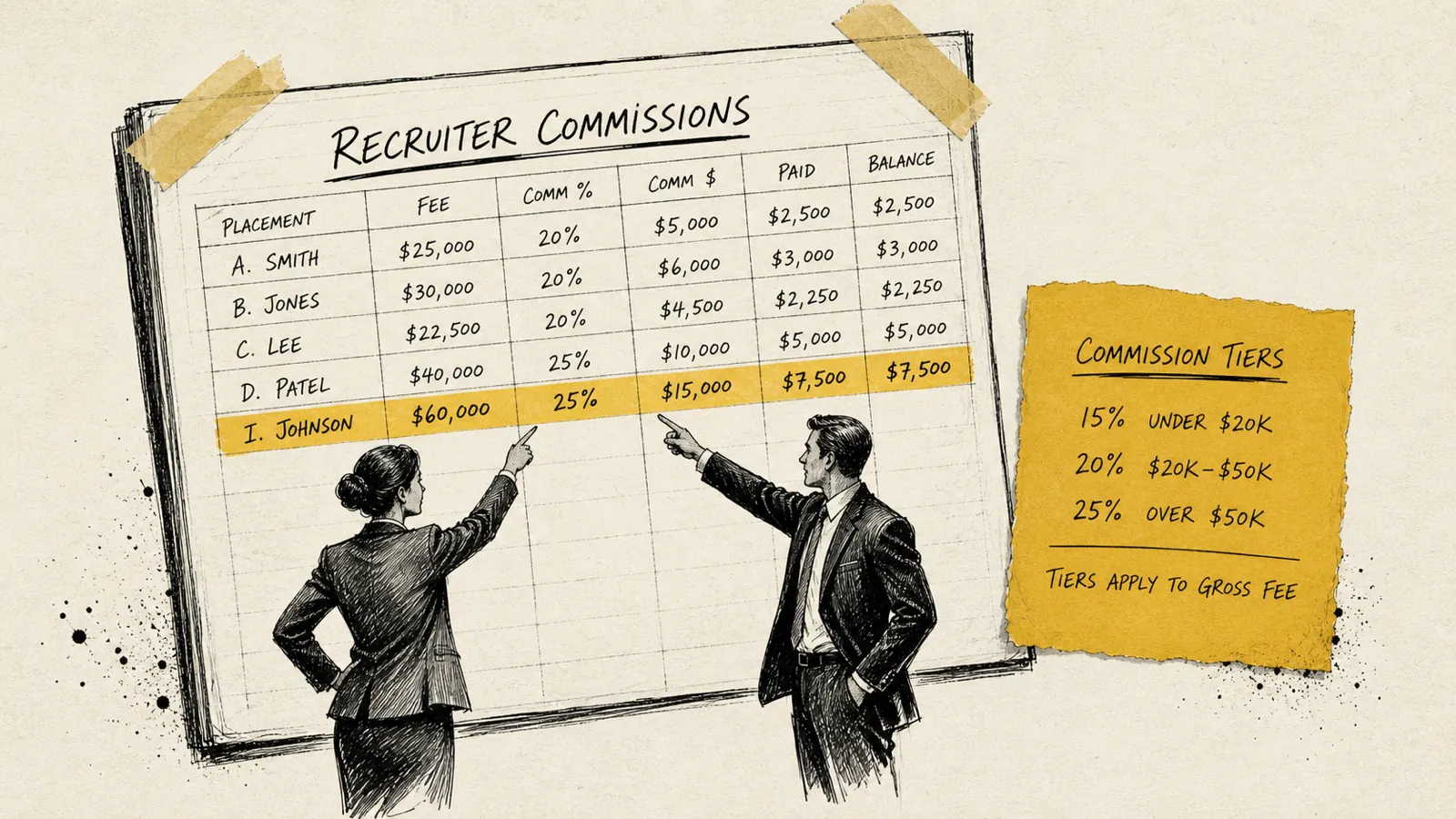
| Tiered | Rate steps up as cumulative billings cross thresholds, applied either to billings above the threshold (marginal) or to everything from dollar one (retroactive) | Teams where you want top billers pushing through Q4 | One retroactive edit to an old deal reshuffles every later deal's tier |
| Threshold / margin-based | Recruiter earns nothing until billings cover a defined cost base, then a higher rate above it | Firms carrying high base salaries or heavy delivery cost | Feels punitive during ramp, and needs an honest cost number to be credible |
| Draw plus commission | Guaranteed periodic advance, recouped against commission earned | New hires, ramping desks, seasonal cash smoothing | Balances carried across periods are the single most common tracking error |
| Splits | Two or more people share one placement's commission by agreed percentages | Any firm separating sourcing from account management | Undefined split rules before the deal, then renegotiation after it |
Tiered plans are the most common upgrade from flat, and there are two ways to apply the higher rate once a recruiter crosses a threshold. Marginal: the new rate applies only to billings inside the new bracket, the way tax brackets work. Retroactive: the new rate applies to everything billed that year, from the first dollar. Neither is wrong, and the plan document has to say which one you mean.
Marginal is cheaper for the firm and calmer to administer, because crossing a threshold never rewrites a deal that has already been paid. Retroactive is the stronger motivator near the line, and it is also a cliff. The deal that crosses the threshold can be worth more in commission than its own fee, and a falloff that drops a recruiter back below the line reverses commission on every deal that year, not just the one that fell off. Of the six firm comp plans that have been shared with me, five use tiers. Three apply them marginally and two apply them retroactively, so the field is split, and a plan that assumes everyone does it one way is guessing. The teardown of six real comp plans reads out how each one handles the tier question, alongside the reset cadence, the payout trigger and the draw shortfall. Our guide to designing a tiered commission plan works through the marginal math and the edge cases. For shared deals, the complete guide to split commissions covers the arrangements that hold up.
What commission rate should you pay?
Rate and base salary move against each other, which is why a percentage quoted on its own tells you nothing. A recruiter carrying a meaningful base sits at the low end of whatever range you have been quoted. A near-commission-only desk sits at the top. Both can pay the same person the same money at the same production, and they put the risk of a slow quarter in completely different places.
That is the comparison to make when a recruiter tells you a competitor pays 35%. Ask what the base is. A 20% rate on a $70,000 base and a 35% rate on a $30,000 base can land the same person in the same place at the end of the year, and the difference between them is who absorbs a bad quarter.
The second variable is what the recruiter actually does. A full-desk recruiter who wins the client, runs the search, and manages the relationship is worth a materially higher rate than a delivery recruiter working roles somebody else sold. Splitting the rate by function (a business development component and a delivery component) is more defensible than one blended number, and it makes splits easier to price later.
Whatever you land on, run the plan against your own economics before you publish it. Take your average fee, your average placements per recruiter per year, and your fully loaded cost for that seat, and check what the firm keeps at the low, expected, and high end of production. A plan that only works if everyone overperforms is not a plan.
When should commission be paid? The trigger nobody writes down
There are three defensible payout triggers (invoice sent, invoice paid, and guarantee cleared) and choosing among them is the single most consequential decision in the plan, because it decides whether the firm or the recruiter carries the risk of a client who does not pay and a placement that does not stick.
| Trigger | Firm's cash position | Who carries the risk | What it costs you |
|---|---|---|---|
| Invoice sent | Pays out before the money arrives | The firm, entirely | Every non-paying client and every falloff becomes a clawback conversation |
| Invoice paid | Cash in before cash out | Shared: firm still carries falloff risk | Recruiter's payout now depends on your collections, which they do not control |
| Guarantee cleared | Strongest | The recruiter | Three-plus months between placement and payout, and the hardest plan to recruit against |
Most firms that pay early do it because it is what recruiters want to hear in an interview, and then discover the cost the first time a $40,000 fee is written off after the commission on it has already gone out the door. Paying on invoice sent is a real option. Treat it as a financing decision and make it with your cash position in front of you. A survey of 21 owners and leaders at 20 established firms puts 15 of 21 on payment received and one on invoice sent, which is the reverse of the default most writing on recruiter pay assumes.
There is a middle position most firms land on eventually: pay on invoice paid, hold a defined percentage until the guarantee closes, and state both in the plan document. Recruiters accept a holdback they can see coming, and the length of that wait comes down to choosing a guarantee length, which is a decision worth making deliberately rather than inheriting. What they do not accept is a clawback that appears for the first time in a conversation after a placement has already fallen off.
The trigger also has to be compatible with when you invoice. If your invoices go out weeks after the start date, a paid-invoice trigger pushes recruiter payouts a month further out than anyone intended, and you will feel it in retention rather than in cash. Fixing the billing side first is usually the cheaper fix. Our guide to invoicing clients as a recruiting firm covers the trigger events and terms.
How should draws work?
A draw is an advance against future commission, and the only decision that matters is whether it is recoverable (repaid out of later commissions) or non-recoverable, which makes it a guaranteed minimum the recruiter keeps regardless. Both are legitimate. Confusing them is expensive.
A recoverable draw carries a balance. A recruiter drawing $5,000 a month who earns $8,000 in commission nets $3,000 that month. If she earns $3,000, she carries a $2,000 deficit into the next period. Over a slow quarter those deficits compound quietly, and the conversation when someone discovers a five-figure negative balance they did not know about is the worst one in this business.
Three rules make draws survivable. Cap the deficit: decide in advance the point at which the draw is reduced or the arrangement is revisited, rather than letting a balance run indefinitely. Show the balance to the recruiter every single period, in writing, whether or not they ask. And decide in advance what happens to an outstanding balance if the recruiter leaves, because the answer varies by state wage law and is not something to work out after a resignation.
Draws are also the structure most likely to break a spreadsheet, because the balance has to survive tier changes, splits, and clawbacks all at once. Our post on recruiter payout tracking covers the failure modes.
How do you write split rules that hold up?
Define splits by role, in writing, before the deal, not by negotiation after it. The most common workable structure separates the client relationship from the candidate delivery and assigns a fixed percentage to each, so a deal that involves two people has an answer the moment it closes.
A defensible starting frame assigns a share to whoever owns the client relationship, a share to whoever sourced and managed the placed candidate, and, where relevant, a smaller share to whoever ran the search process. The exact percentages matter less than the fact that they are decided in advance and applied consistently. The moment splits become negotiable per deal, every deal becomes a negotiation, and the recruiters who are best at arguing get paid the most.
Two edge cases are worth naming explicitly in the plan document: a candidate placed from someone else's pipeline months later, and a client that one person opened but another now runs. Both come up, both feel unfair to somebody, and both are much easier to settle with a written rule than with a Friday afternoon conversation.
What happens to commission when a placement falls off?
If commission has already been paid, you either claw it back, net it against future earnings, or absorb it, and the plan has to say which, before it happens. The most common approach is netting the amount against the recruiter's next commission run rather than asking for a payment back, which is easier operationally and much easier on the relationship.
The falloff itself is the more solvable problem. A guarantee clause decides what you owe when a placement comes apart; the ninety days before it decide whether it comes apart at all. If your falloff rate is what is driving your clawback conversations, the fix is upstream of the commission plan. The falloff prevention playbook covers the check-in cadence and the warning signs.
Whatever you choose, the clawback rule has to be in the document the recruiter signed. A clawback the recruiter is hearing about for the first time after a falloff is a retention event. Depending on your state, deductions from earned wages are also constrained by law, which is a conversation to have with your counsel while you are drafting the plan rather than while you are enforcing it.
How should the plan change by firm size?
What changes as a firm grows is how much of the plan is written down. The structures that work at two recruiters fail at ten because the exceptions that lived in the owner's head no longer fit there. The rates are rarely the problem.
| Firm size | What usually works | What to add next |
|---|---|---|
| 1–2 recruiters | Flat rate, paid on invoice paid, everything in one document | A written split rule, before you need one |
| 3–5 | Flat or simple two-tier, defined split percentages | A stated payout trigger and a clawback rule |
| 6–10 | Tiered plan, draws for ramping hires, formal splits | Monthly commission statements every recruiter can check themselves |
| 11–25 | Tiered by role, BD and delivery components priced separately | Margin visibility by recruiter and client, not just billings |
| 26+ | Role-based plan families rather than one plan | A single system of record; at this size reconciliation is a full-time job by default |
The exceptions are what scales worst. Every side deal, every one-off guarantee, every "we'll sort that one out later" becomes a permanent line in somebody's spreadsheet. I talked to the founder of a 300-recruiter firm who told me they have every resource available to them and have never solved this. It was a problem at ten recruiters and it was still a problem at three hundred. They tried building custom software, could never get it right, and threw headcount at it instead.
If you are running twenty recruiters on a spreadsheet and it feels like you are the only one who has not figured this out, the firms with more resources than you have not either.
What has to be in the written plan document?
At minimum: the rate, the calculation base, the payout trigger and timing, split rules, draw terms including what happens on departure, clawback treatment, and the process for changing the plan. If any of those live only in conversation, they will eventually be remembered differently by the two people in the conversation.
- Rate and base. The percentage, and precisely what it is a percentage of.
- Tier thresholds, if any. Including whether tiers reset annually and on what date.
- Payout trigger and payment date. "Paid in the commission run following receipt of client payment" beats "paid when the deal is done."
- Split rules by role, with the two edge cases named above.
- Draw terms: amount, recoverable or not, deficit cap, and treatment on departure.
- Clawback treatment, including whether it is netted or repaid.
- What happens to pipeline on departure: deals closed but not yet invoiced, and invoiced but not yet paid.
- How the plan gets changed, with notice, and whether changes apply to in-flight deals.
Commissions are wages, and how and when they can be withheld, deducted, or forfeited is governed by federal and state law: the US Department of Labor's fact sheet on employees paid commissions is the starting point, and state rules vary considerably on deductions and on commissions earned before a departure. Nothing here is legal advice; have your counsel read the plan before recruiters sign it.
A worked example: one recruiter, one year
The numbers below are an illustration to show how the pieces interact, not benchmark data. Substitute your own.
A recruiter on a tiered plan: 30% on the first $200,000 billed, 35% from $200,001 to $400,000, 40% above that. Tiers reset in January. She carries a $4,000 monthly recoverable draw. Payout trigger is invoice paid, with 20% of each commission held until the guarantee clears at 90 days.
She bills $460,000 across the year. Her gross commission is:
- 30% of $200,000 = $60,000
- 35% of $200,000 = $70,000
- 40% of $60,000 = $24,000
- Total: $154,000
That is the marginal design. On a retroactive design the same $460,000 would all earn the top rate: 40% of $460,000, or $184,000. The $30,000 gap is the price of the design choice, which is why the plan has to name it.
Now the parts the rate alone does not tell you. She drew $48,000 across the year, all recouped, so the draw nets to zero against her earnings, but it changed the timing of $48,000 of the firm's cash. The 20% guarantee holdback means roughly $30,800 of her commission sits behind a 90-day gate, which is real money to her and worth explaining before she reads it on a statement.
Then one placement falls off: a $48,000 fee placed in the spring. The instinct is to reverse that deal's commission and move on. Do not trust that number. Her billings for the year are now $412,000, not $460,000, so the entire stack has to be rebuilt: $60,000 plus $70,000 plus 40% of $12,000, or $134,800. Reversing only the one deal's commission would have left her somewhere near $137,000, close enough to look right on a statement, and wrong by a couple of thousand dollars.
On the retroactive design the falloff is bigger news. Her billings drop to $412,000, which sits inside the 40% bracket either way here, so the reversal is 40% of $48,000, or $19,200, the same as on the marginal plan for this particular deal. Move the falloff so it drops her under $400,000 and the retroactive plan reverses the rate on every deal that year, not just the one that fell off. Both designs reach backward. The retroactive one reaches further.
That gap is the whole problem with tracking this by hand. A falloff does not change one row. It changes the tier that every deal after it fell into, and the error is always small enough to survive a glance and large enough to matter.
Why do commission plans break in spreadsheets?
Because commission is a calculation whose inputs keep changing after it has been settled. A fee gets adjusted, a split gets added, a placement falls off, a client pays half. Each of those reaches backwards into deals that were already closed out, and a spreadsheet has no way to recompute the chain without somebody doing it by hand.
The symptoms are consistent across firms: nobody but one person will touch the master file, a new copy gets built rather than the old one edited, recruiters keep their own shadow spreadsheets because they do not trust the official one, and the owner cannot answer "what has this person earned this year" without a two-day project. If two or more of those are true at your firm, fix the record-keeping before you touch the plan.
The related reading here: commission tracking software for recruiting firms and how to build a commission calculator.
Frequently asked questions
What is a typical recruiter commission percentage?
There is no single number that means anything on its own, because the rate and the base salary move against each other. A recruiter carrying a meaningful base is paid a lower percentage than a near-commission-only desk, and the two can take home the same money at the same production. What the recruiter does moves it again: a full desk that wins the client and runs the search is worth more than delivery on roles somebody else sold. A rate quoted without the base salary attached is not comparable to anything.
Should commission be paid on the invoice or on cash collected?
Paying on cash collected protects the firm and is the more common choice as firms grow, but it makes the recruiter's income depend on your collections process, which they cannot influence. If you pay on collection, you owe them a fast, visible collections process. If your invoices routinely go out late, fix that before you move the trigger.
Can you change a commission plan mid-year?
Firms do, and the plan should say how: with notice, and with a stated rule about whether changes apply to deals already in flight. Applying a new rate retroactively to work already done is the fastest way to lose your best biller, and depending on your state it may also run into wage law. Have counsel review any change before it goes out.
How do you handle commission for a recruiter who resigns?
Decide it before it happens, in the plan document: what is owed on deals closed but not invoiced, invoiced but not collected, and inside an open guarantee. State law has a lot to say about commissions earned before a departure, so this is a clause to draft with your counsel rather than to improvise during an exit conversation.
Should small firms use tiered plans?
Usually not at first. Tiers are a motivational tool for a team with enough volume for the brackets to mean something, and they are the structure most likely to be miscalculated by hand. At one or two recruiters, a flat rate with a clearly written payout trigger and a split rule will serve you better than a tier structure nobody can verify.
What is the difference between a recoverable and non-recoverable draw?
A recoverable draw is an advance repaid out of future commissions. If earnings fall short, the shortfall carries forward as a balance the recruiter still owes against future deals. A non-recoverable draw is a guaranteed minimum: the shortfall is forgiven and does not carry. Recoverable is more common for established recruiters, non-recoverable for ramping hires.
Where to start
If you are writing a plan today, do these in order: write down the base before the rate, pick a payout trigger you can actually fund, put the split and clawback rules in the document rather than in your head, and make sure every recruiter can see their own numbers without asking anyone. The last one prevents more disputes than the first three combined.
Collected handles what happens after the placement (commissions, invoicing, and collection) in one system, so a recruiter can see what they have earned without anyone rebuilding a spreadsheet.
Get started free: all features unlocked for your first 5 placements, no credit card required.

Never sweat invoicing or commissions again.