
The Falloff Prevention Playbook for Recruiting Firms

A falloff is a placement that ends inside the guarantee period, which means the fee you already earned turns into a refund, a replacement search, or a write-off. Most firms treat it as a contract problem. It is a cash problem. The guarantee clause decides what you owe; the ninety days before it decides whether you owe anything at all.
This is the playbook for those ninety days: what causes falloffs, when to intervene, what to say, and how the guarantee period should drive your invoicing and your commission payouts. If you run a direct-hire or executive search firm, this is the page to work from.
What is a falloff, and what does it actually cost?
A falloff is a placed candidate who resigns or is terminated before the guarantee period expires. Depending on your fee agreement, you either refund the fee in full, refund it on a sliding scale, or run a replacement search at no additional charge. The direct cost is the fee. The real cost is the fee plus the commission you already paid, plus the second search you now run for free.
Stack those three and a falloff is rarely a one-for-one loss. A fee that comes back out the door takes with it the recruiter commission that was already advanced, the time your team spends on a replacement search that generates no new revenue, and, if the invoice went out late, a collections conversation with a client who now feels justified in not paying at all.
That last one is the failure mode nobody plans for. I wrote about it recently: a placement falls off in month three, and the client suddenly feels strange about paying a $40,000 invoice that went out late. The guarantee window was still open when the invoice finally went. Then the person left. Now the money is owed, collecting it becomes a delicate dance, and at year end it gets written off because the timing was bad. Firms this size bill $40,000 to $80,000 per placement. One write-off is not a rounding error.
The point is that a falloff and a slow invoice compound each other. Fix the falloff rate and you protect the fee. Fix the invoice timing and you protect your position when a falloff happens anyway.
Why do placements fall off?
Falloffs cluster into four causes, and they show up in a predictable order: a counteroffer or competing offer before day one, a start-date or onboarding failure in the first two weeks, a role that does not match what was sold in weeks three through eight, and a manager-fit problem that surfaces after month two. Each has a different intervention and a different window.
The counteroffer is the earliest and the most preventable. It lives entirely between offer acceptance and start date, which is the window most firms stop paying attention to because the deal feels closed. It is not closed. The candidate is still employed somewhere else and is about to have a conversation with a manager who does not want to lose them.
Start-date and onboarding failures are unglamorous and common: no laptop, no manager on day one, no clear first assignment, a start date that slipped twice. A candidate who took a risk to move and then spends week one being ignored starts reading their old employer's messages differently.
Role mismatch shows up in weeks three through eight, once the candidate has done enough of the actual job to compare it to the job description. This is usually a scoping failure at intake: the client described the role they wanted to hire for rather than the role that exists.
Manager fit is the latest and the hardest to reverse. By the time it surfaces, both sides have usually decided privately and are looking for a graceful exit. Your window here is early, when it is still a friction complaint and not a decision.
What does the falloff timeline look like, day by day?
Treat the guarantee period as five distinct phases, each with its own risk and its own touchpoint: offer-to-start, days 1–14, days 15–30, days 31–60, and days 61–90. The intervention that works in one phase does nothing in the next, which is why a single "how's it going?" email at day 30 catches almost nothing.
| Phase | Dominant risk | What you are listening for | Who you contact |
|---|---|---|---|
| Offer to start | Counteroffer, competing offer, cold feet | Slower replies, vague resignation timing, "just waiting on a conversation" | Candidate, twice; hiring manager once |
| Days 1–14 | Onboarding failure | No equipment, no manager time, no first assignment | Candidate day 2 and day 10; hiring manager day 7 |
| Days 15–30 | Role mismatch | "It's a bit different than I expected" | Both, separately, around day 21 and day 30 |
| Days 31–60 | Ramp and expectations gap | Manager describes performance concerns; candidate describes unclear goals | Hiring manager day 45; candidate day 45 |
| Days 61–90 | Manager fit, quiet decision | Short answers from either side, cancelled one-on-ones | Both at day 75, then a close-out at day 90 |
Two rules make this work. Contact both sides, always separately. A candidate will not tell you the manager is the problem on a call the manager is on, and a manager will not tell you the hire was a mistake in front of the hire. And ask a question that has a wrong answer. "How's it going?" gets "good." "What's the thing you'd change about your first two weeks if you could?" gets information.
What should the candidate check-in cadence be?
Five touchpoints across the guarantee: one between acceptance and start, day 2, day 10, day 30, and day 75. The first two are about keeping the placement; the rest are about hearing a problem while it is still a problem and not a resignation.
The between-acceptance-and-start touch is the contact that matters most in the entire process and the one most often skipped. The candidate has resigned or is about to. Ask directly how the resignation conversation went, what their manager said, and whether anything was offered. A candidate who has been counteroffered will usually tell you if you ask plainly; they will almost never volunteer it.
Day 2 is logistics: did the equipment arrive, did they meet their manager, do they know what they are working on this week. These are trivially fixable if you hear about them on day 2 and expensive if you hear about them on day 40.
Day 10 and day 30 are about the gap between the job as sold and the job as experienced. Day 75 is the last useful window before the guarantee closes. If something is going to surface, this is your last chance to broker a fix instead of processing a refund.
What should the hiring-manager check-in cadence be?
Four touchpoints: once before the start date, day 7, day 45, and day 75. Hiring managers rarely call a recruiter to say a new hire is struggling. They wait, and then they act. Your check-ins have to be the thing that surfaces it.
The pre-start contact confirms the start date is still the start date, the manager is actually in the office that week, and someone owns day one. A start date that slips by two weeks is a leading indicator of a falloff, not an administrative detail.
Day 7 and day 45 are the two questions worth asking: "What has surprised you about them so far?" and "If you had to name one thing they need to get better at in the next month, what is it?" The second question is the one that produces a useful answer, because it gives the manager permission to say something critical without escalating it.
Day 75 is a positioning call as much as a check-in. If the manager is unhappy at day 75, you want to know before day 91, and you want to be the person offering a plan rather than the person receiving a refund demand.
What are the early warning signs of a falloff?
The reliable signals are behavioral, not verbal: response times lengthening, a start date that moves more than once, a candidate who goes quiet after being consistently responsive, a hiring manager who stops replying to your check-ins, and any mention of a conversation with the current employer after acceptance.
Ranked roughly by how much they should worry you:
- The candidate mentions their current employer wants to talk. Treat this as an active counteroffer until proven otherwise.
- The start date moves twice. Once is logistics. Twice is ambivalence on one side or the other.
- A previously fast responder goes quiet for more than three days. People who are about to deliver bad news stop replying first.
- The hiring manager stops answering your check-ins. Usually means they have already decided and do not want the conversation.
- The candidate asks a process question about the guarantee or their notice period. They are modelling an exit.
- Vague answers about scope. "Still figuring out what I own" at week six is a scoping failure that will not fix itself.
None of these is proof. All of them are worth a phone call the same day, because the cost of an unnecessary call is fifteen minutes and the cost of a missed one is the fee.
Should your agreement say clawback or replacement?
A replacement guarantee protects your cash and your margin; a full refund protects the client's downside and is easier to sell. Most direct-hire firms land on a replacement guarantee with a refund fallback if no suitable replacement is placed within a defined window. The structure matters less than the fact that it is written down before the placement, not negotiated after the falloff.
The variants you will see across the industry, roughly from most firm-favorable to most client-favorable, are: replacement only; replacement with a credit toward a future search; a sliding-scale refund that decreases with each month worked; and a full refund inside the whole guarantee period. Industry associations covering the recruiting profession, including NPAworldwide's overview of guarantee and refund policies, document a similar spread. There is no single standard, which means yours is a pricing decision rather than a convention you have to follow.
Three clauses do most of the work regardless of which structure you choose:
- Define the start date precisely. The single most common guarantee dispute is a disagreement about when the clock started. Name the trigger (first day physically worked) and put it in writing.
- Name the exclusions. Layoff, role elimination, restructuring, a change in the job's scope, and non-payment of the original invoice are the usual carve-outs. A guarantee that covers the client's own restructuring is not a guarantee, it is a loan.
- Condition the guarantee on payment. If the invoice is unpaid, the guarantee does not run. This one clause removes the incentive to stall an invoice until the guarantee expires.
None of this is legal advice. Guarantee and refund terms interact with contract law in your jurisdiction, and the language itself should be reviewed by your counsel. What is in scope here is the commercial logic behind the choice.
When should you invoice relative to the guarantee period?
Invoice on the start date, not after the guarantee clears. Waiting until the guarantee expires converts a normal receivable into a conditional one and hands the client ninety days of free financing. Worse, it means a falloff arrives before your invoice does, and you are now asking for money for a placement that no longer exists.
This is the trap in the example above. The invoice was late, not because of a policy, but because Friday afternoon belonged to the next search, the way it does every week. By the time it went out, the guarantee window was still open. Then the person left. The lateness did not cause the falloff, but it removed every bit of negotiating power the firm had once the falloff happened.
The sequence that holds up is simple: the placement record triggers the invoice on the start date, the guarantee runs concurrently, and if a falloff occurs you issue a credit or run the replacement against an invoice that is already paid or already aging normally. Collecting first and refunding later is a far stronger position than never having invoiced at all. If your invoicing is currently a manual Friday task, that is the process to fix before you touch anything else. Our guide to how to invoice clients as a recruiting firm walks through the trigger events and terms, and the accounts receivable playbook covers what happens when the invoice ages anyway.
When should you pay commission relative to the guarantee?
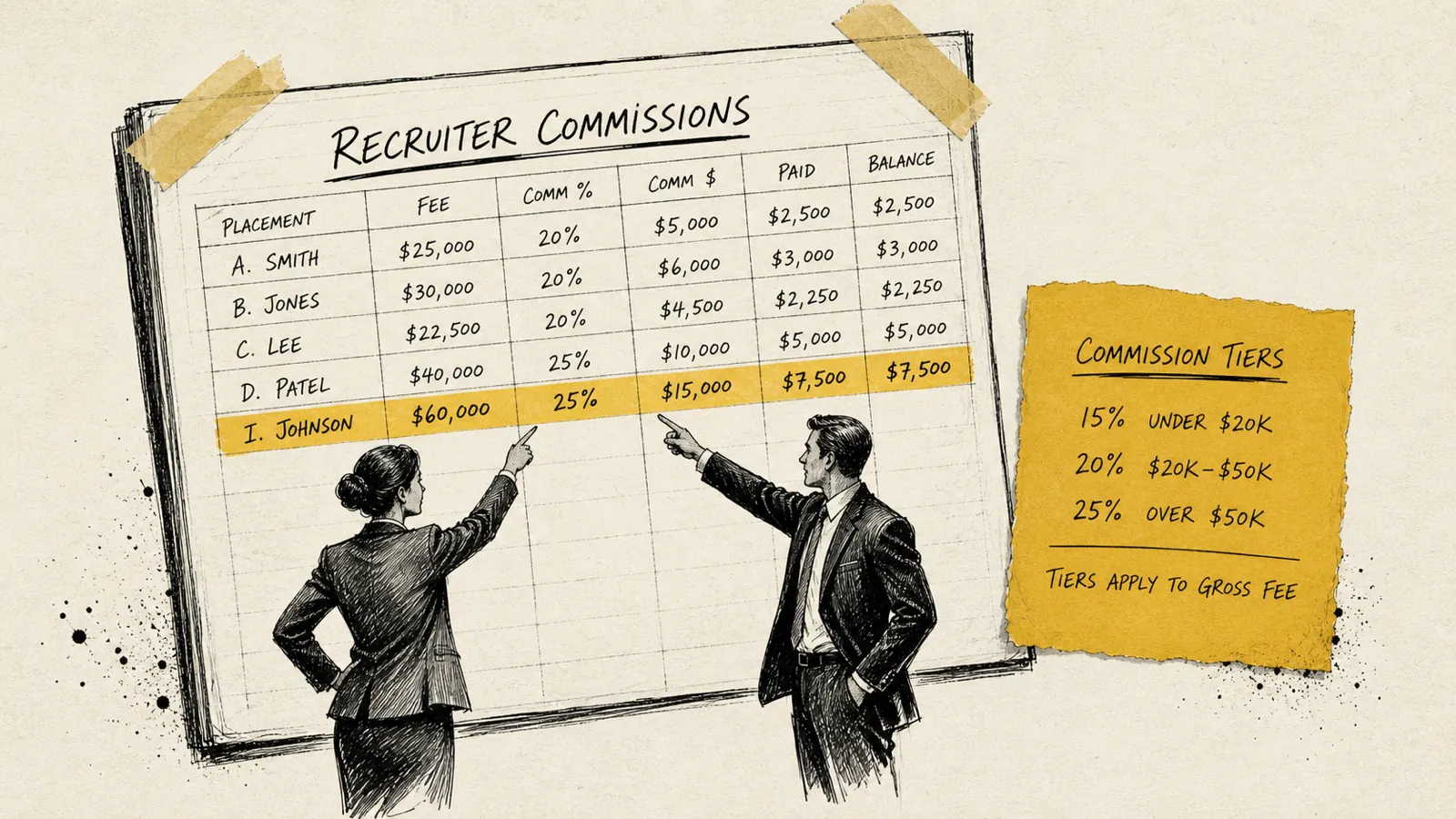
The three common payout triggers are invoice sent, invoice paid, and guarantee cleared, and each moves risk between the firm and the recruiter. Paying on invoice sent is the most recruiter-friendly and the most exposed; paying on guarantee cleared is the safest for the firm and the hardest to recruit against.
| Trigger | Who carries the falloff risk | Trade-off |
|---|---|---|
| Invoice sent | The firm | Fastest payout, best for recruiter retention; every falloff and every non-paying client becomes a clawback conversation |
| Invoice paid | Shared | Cash is in the door before commission goes out; falloff risk remains with the firm until the guarantee closes |
| Guarantee cleared | The recruiter | Effectively no falloff exposure for the firm; the delay between placement and payout can be three months or more, which recruiters feel |
Most firms that pay before the guarantee clears handle the gap with a clawback clause rather than a later trigger. That works, but only if the clawback is written into the commission plan in advance and the recruiter has seen it. A clawback that first appears in a conversation after a falloff is a retention event, not a policy. If you are designing this from scratch, our guide to split commissions covers how the same trigger logic applies when two recruiters share a deal. A falloff on a split is twice the conversation.
The practical compromise many firms land on: pay on invoice paid, hold a defined percentage until the guarantee clears, and state both in the plan document. Recruiters accept a holdback they can see coming.
What does a falloff actually cost? A worked example
Numbers make this concrete. The inputs below are an illustration, not benchmark data. Swap in your own fee, plan, and cost figures.
Take a single placement at the low end of the range I described above:
- Placement fee: $40,000
- Recruiter commission at 20% of fee, paid on invoice sent: $8,000
- Time in the original search: 40 hours
- Loaded cost of that recruiter time at $75/hour: $3,000
If the placement holds, the firm nets $40,000 − $8,000 − $3,000 = $29,000 before overhead.
Now the placement falls off at day 70 and the agreement calls for a replacement search:
- Revenue recognized: $40,000 (retained, because you are replacing rather than refunding)
- Commission already paid on the original placement: $8,000
- Original search cost: $3,000
- Replacement search, another 40 hours: $3,000
- Commission on the replacement placement, if your plan pays it: $8,000
The same $40,000 now nets $18,000, a 38% margin reduction on a fee you kept. And that is the good outcome. Under a full-refund guarantee, the $40,000 goes back out, the $8,000 commission is either clawed back or eaten, and $3,000 of search time is gone: a swing of roughly $32,000 against your year on one deal.
Run that against the cost of the check-ins. Nine touchpoints across ninety days, at fifteen minutes each, is a little over two hours of someone's time per placement. Two hours against a $32,000 downside is the easiest arithmetic in this business, and it is the reason falloff prevention belongs in your operating process rather than in your fee agreement.
What guarantee length should you offer?
Thirty, sixty, and ninety days are the common guarantee lengths in direct-hire recruiting, and the choice is a pricing decision: a longer guarantee is a discount you pay for in risk, so it should buy you something: a higher fee percentage, faster payment terms, or exclusivity.
A ninety-day guarantee offered for free against a thirty-day competitor is not a differentiator, it is a margin giveaway. If a client is choosing between two firms on guarantee length alone, price the difference. If you extend from thirty to ninety days, ask for shorter net terms, a higher percentage, or an exclusive window on the search in return.
The second variable is seniority. Executive placements take longer to show a fit problem than individual-contributor roles, which argues for longer guarantees at the top of the market, and for a correspondingly higher fee to carry the risk. Tiering the guarantee by seniority band is more defensible than offering one length across everything you do, and our guide to how long your placement guarantee should be works through that choice in more detail.
Whatever you choose, the clock definition matters more than the number. Ninety days from a first day physically worked and ninety days from an offer signature are different products.
How do you turn this into a repeatable process?
Falloff prevention fails when it depends on a recruiter remembering. It works when the touchpoints are scheduled off the start date the moment the placement is recorded. The mechanism matters less than whether it fires without anyone deciding to fire it.
A minimum viable version, in the order to build it:
- Record the start date as a field, not as a note. Every downstream date (invoice trigger, guarantee expiry, check-in schedule) derives from it.
- Schedule the nine touchpoints off that date automatically at acceptance, day 2, day 7, day 10, day 21, day 30, day 45, day 75, and day 90, split between candidate and hiring manager as described above.
- Write the questions once. Templated openers with a specific question, not "checking in." The point is a consistent question, so the answers are comparable across placements.
- Log every response against the placement. Two vague answers in a row from the same candidate is a signal you can only see if the previous answer was recorded.
- Give the falloff an owner. One person reviews open guarantee periods weekly and escalates anything that has gone quiet.
- Review falloffs quarterly by cause. If most of yours are counteroffers, the fix is at offer stage. If most are role mismatch, the fix is at intake. These are different problems with the same symptom.
Firms that do this well do not have better luck with candidates. They have a start date in a field and a schedule that fires off it. Everything else in this playbook is downstream of that one habit.
Frequently asked questions
What counts as a falloff versus a normal resignation?
A falloff is a separation inside the guarantee period defined in your fee agreement. A resignation on day 91 of a ninety-day guarantee is a normal resignation and carries no obligation. This is why the start-date definition and the guarantee clock language are worth getting exactly right in the agreement.
Should I still invoice if the candidate falls off before the invoice goes out?
Yes, if your agreement provides for a replacement rather than a refund: the fee is earned and the obligation is to fill the role again. If your agreement is full-refund, invoicing and then immediately crediting is administratively pointless. Either way, the underlying problem is that the invoice was late; fixing the trigger so it fires on the start date removes the question.
Who should own falloff prevention: the recruiter or an ops person?
The recruiter owns the relationship, so they should make the calls. An ops or mid-office owner should own the schedule and the escalation, because the recruiter is by definition working the next search. Splitting it this way is what keeps check-ins from being the thing that slips on a Friday.
Does a longer guarantee reduce falloffs?
No. A guarantee is a commercial term, not an intervention. It changes who absorbs the cost of a falloff, not how likely one is. Check-in cadence, intake quality, and counteroffer management change the likelihood. Guarantee length changes the bill.
How do I handle a falloff caused by the client?
Layoffs, role eliminations, restructurings, and material changes to the job's scope should be named as exclusions in your fee agreement so the guarantee does not apply. If they are not named, you are negotiating after the fact from a weak position. Add the carve-outs to your standard agreement now rather than to the next one.
What should I do at day 90?
Close the loop deliberately. A short note to both sides confirming the placement is settled ends the guarantee period on a positive touchpoint and is the most natural moment you will ever get to ask the hiring manager what they are hiring for next.
Where this goes next
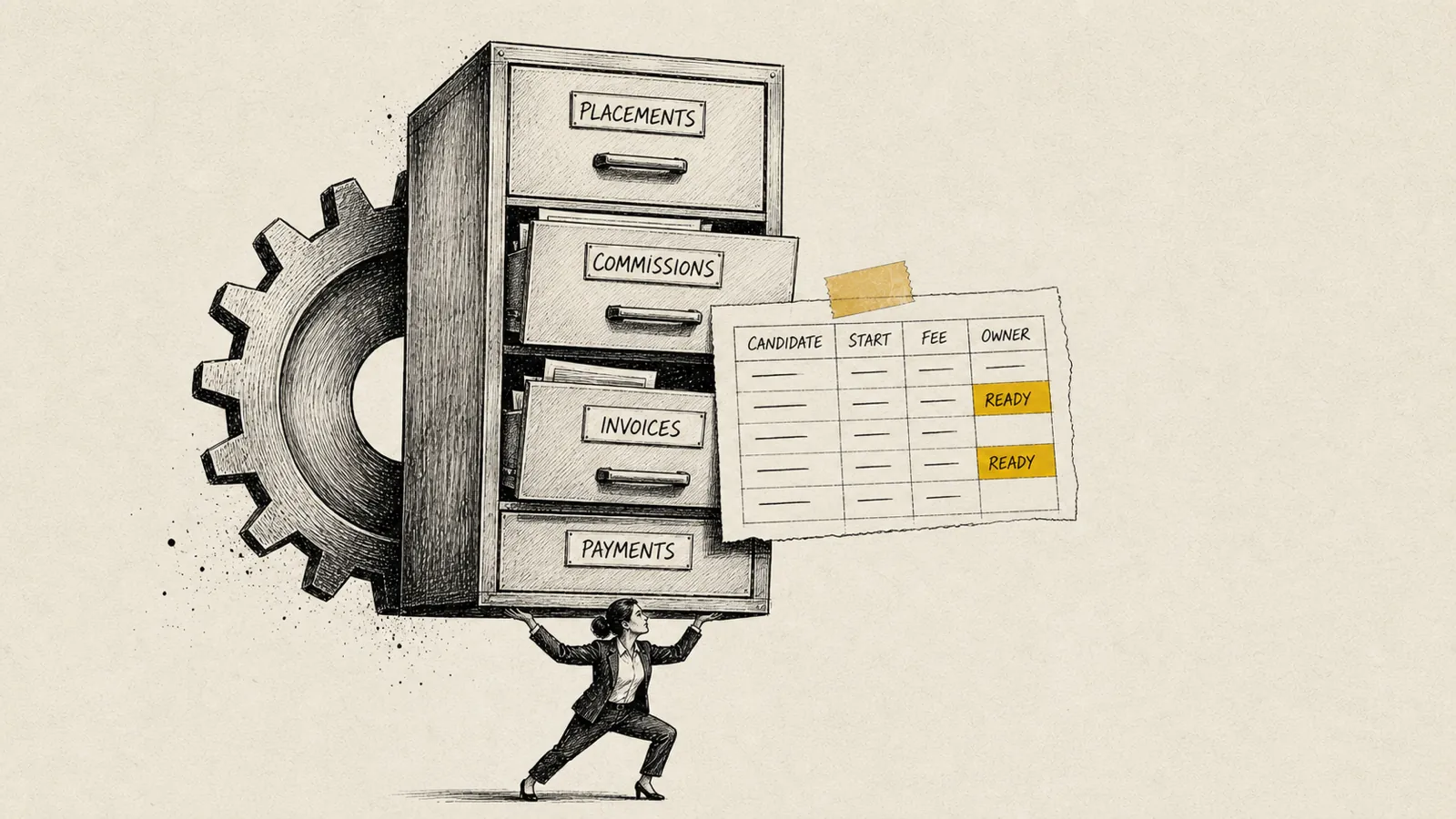
Falloff prevention only pays off if the money side is wired to it: the invoice fires on the start date, the commission trigger accounts for the guarantee, and someone can see every open guarantee period in one place without rebuilding a spreadsheet. That is the mid-office, and it is what most firms are holding together by hand.
Collected handles what happens after the placement (commissions, guarantee and clawback tracking, invoicing, and collection) in one system.
Get started free: all features unlocked for your first 5 placements, no credit card required.
Never sweat invoicing or commissions again.