
Time to Cash for Recruiting Firms

Time to cash is the number of days between the moment a fee is earned and the moment the money is in your account. For a direct-hire firm that interval has two halves: the days you control, from the trigger event to the invoice going out, and the days the client controls, from the invoice to the payment. Almost every firm measures the second half and almost none measure the first, which is why the number most firms quote is shorter than the number their bank balance responds to.
The two halves have different fixes. The first is a process problem inside your firm. The second is a terms and follow-up problem outside it. Treating the whole interval as one number hides which one you have.
How long does it take a recruiting firm to get paid?
Measured properly, the clock runs from the trigger event named in your fee agreement to the day funds clear, and on most direct-hire books it is materially longer than the payment terms on the invoice. Net 30 describes one segment of the interval. It does not describe the interval.
A fee that took 58 days to convert is often 14 days of internal lag, 30 days of terms, and 14 days of the client being slightly late. Each of those three numbers has a different owner and a different remedy, and the aggregate tells you none of that. The only version of this number worth tracking is the one that starts before the invoice exists.
Where the invoice comes from and what should trigger it is a separate subject, covered in how recruiting firms invoice and collect placement fees. This page is about the clock: how to measure it, what moves each half, and how to forecast cash off it.
Why does standard DSO mislead a direct-hire firm?
Days sales outstanding divides your receivables balance by revenue for a period and multiplies by the days in that period. It was built for businesses that invoice continuously in similar amounts. A perm firm invoices a handful of times a month in amounts that vary by a factor of three, so the formula produces a number that swings on the timing of one deal rather than on the health of your collections.
Two illustrative months make the failure visible. The figures are made up to show the arithmetic, not drawn from any firm.
| March | April | |
|---|---|---|
| Fees invoiced in the month | $180,000 | $60,000 |
| Receivables at month end | $120,000 | $120,000 |
| DSO (31 days in the month) | 21 days | 62 days |
| Actual collection behavior | Unchanged | Unchanged |
Nothing about the firm's collections changed between the two months. One large placement invoiced in March and not in April moved the reported DSO by 41 days. A number that can triple without any change in behavior is not a measure of behavior.
The fix is to stop measuring a balance against a period and start measuring individual fees against their own dates. Every placement carries its own clock. Average those clocks, or better, look at their distribution, and you have something that means what it appears to mean.
How do you measure your real time to cash?
Pull your last twenty placements and record four dates for each: the date the fee became earned under the agreement, the date the invoice was issued, the date payment was due, and the date the money cleared. Four dates, twenty rows. That is the whole exercise and it takes an afternoon.
From those four dates you get three intervals per placement:
- Trigger to invoice. Your half. This is the number that exists nowhere in your accounting system, because no document is aging during it.
- Invoice to due date. Your terms. Not a measurement, a policy. Record it so the third number means something.
- Due date to cash. The client's lateness, which is the only part most firms are actually chasing.
Report the median rather than the mean. One invoice that took 140 days because a client was acquired mid-cycle will drag an average of twenty placements far enough to make the typical case unrecognizable. Then look separately at the slowest quarter of the list, because that group is where the working capital is trapped and it usually has a cause the other three quarters do not share.
Two cuts of the same twenty rows are worth more than the headline number. Split them by client, because a single large client with a procurement portal can own most of your slow tail on its own. Then split them by whether the placement was contingency or retained, since a retained series has several clocks running out of phase and a firm-wide average silently blends them.
If your median trigger-to-invoice interval is more than a couple of days, you have a process problem, and no amount of collections effort will fix it.
Which half of the clock is actually yours?
The first half is yours outright. Nobody else can shorten it and nobody else is watching it. A day added there is a day added to the whole interval, with no negotiation and no visibility anywhere in your reporting.
The reason it grows is not carelessness. Invoicing loses to revenue work every week, because Friday afternoon belongs to the search you are running and the account you are opening. The task is also cognitively dense: knowing what to invoice means holding the state of every open deal at once, including which retained installments have gone out and which of those have been paid. That density is what makes the task slide, and it is why a weekly ritual usually fails as a fix. The ritual assumes the problem is finding the time.
The second half is not fully the client's either. Terms are negotiated, validity requirements are discoverable, the recipient is your choice, and the follow-up is entirely yours. What the client genuinely controls is narrower than it looks from inside a firm that has never separated the two halves.
What actually moves the client's half of the clock?
Four things, in descending order of how much time they typically account for: whether the invoice was valid on arrival, who received it, what your terms say happens after the due date, and how the money physically moves. Payment method is last on that list and it is the one firms usually try first.
Invoice validity is the quiet one. A client that requires a purchase order number, a cost center, or submission through a procurement portal will not tell you the invoice is wrong. It will sit in a rejected or unmatched state, aging in your system and absent from theirs, until somebody asks. Confirming the billing requirements at the point the fee agreement is signed, rather than at the point the first fee is earned, removes a delay that costs nothing to prevent and weeks to discover.
The recipient matters nearly as much. Fees are often sent to the hiring manager because that is the person the recruiter talks to, and hiring managers do not pay invoices. The document then waits in an inbox with no process attached to it, which is indistinguishable from a client stall and is not one.
Payment method affects the tail rather than the whole. A mailed check adds transit and deposit time on top of whatever decision time the client took. Bank transfers are faster than their reputation suggests: Nacha reports that approximately 80% of ACH Network volume settles in one banking day or less, against the common belief that ACH takes three to five days. The practical read is that moving a client from check to ACH or card recovers days at the end of the cycle, which is worth doing, and that it does nothing at all about the weeks that came before it.
Terms decide when you have standing to escalate, which is a different question from when you get paid. Net 30 does not predict cash on day 30. It means that on day 31 the conversation changes from a request to a claim. A firm that treats the due date as the expected cash date is forecasting on a policy rather than on its own history.
What does a slow clock cost?
The cost shows up in three places: working capital you have earned and cannot spend, fees that get harder to collect the longer they sit, and, in the worst case, fees that get written off because the timing made the conversation awkward rather than because the claim was bad.
The third one is the expensive one and it does not appear in any DSO calculation. A placement falls off in month three. The company that hired the person now feels strange about paying a $40,000 invoice that went out late. The money is genuinely owed. Collecting it turns into a delicate negotiation, and at year end it gets written off because the timing was bad.
Set that against what the process costs. At $500 a month, a system that would have chased that invoice runs $6,000 a year. The invoice written off was $40,000. That is one invoice against roughly seven years of the thing that would have chased it. For a firm billing $40,000 to $80,000 per placement, one write-off a year is not a rounding error, and the write-off is a downstream effect of the first half of the clock rather than of the collections effort at the end of it.
The working capital effect is simpler arithmetic. The numbers below are an illustration, not data.
| Firm A | Firm B | |
|---|---|---|
| Placements per year | 40 | 40 |
| Average fee | $45,000 | $45,000 |
| Annual billings | $1,800,000 | $1,800,000 |
| Median trigger to invoice | 2 days | 14 days |
| Median invoice to cash | 38 days | 38 days |
| Median trigger to cash | 40 days | 52 days |
| Average cash tied up in the cycle | about $197,000 | about $256,000 |
The two firms bill identically and collect identically once the invoice exists. The 12-day difference in the half nobody measures is worth roughly $59,000 of permanently parked cash. That is not lost revenue. It is revenue you have earned and cannot spend, and it is the cheapest money a recruiting firm can free up because releasing it requires no client to agree to anything.
How do you forecast cash off a placement pipeline?
Build the forecast on your own measured intervals rather than on your terms. For each open deal, the expected cash date is the expected trigger date plus your median trigger-to-invoice days plus your terms plus your median days late. Four inputs, three of which you just measured on twenty placements.
A worked version, using an illustrative firm whose median lag is 6 days, whose terms are net 30, and whose clients run a median of 9 days past due:
| Deal | Expected start date | Plus lag | Plus terms | Plus days late | Expected cash |
|---|---|---|---|---|---|
| Offer out, VP Finance | Oct 5 | Oct 11 | Nov 10 | Nov 19 | Nov 19 |
| Final stage, Director | Oct 19 | Oct 25 | Nov 24 | Dec 3 | Dec 3 |
| Retained, installment 2 | Sep 30 milestone | Oct 6 | Nov 5 | Nov 14 | Nov 14 |
Two rules keep this honest. Weight by stage rather than by optimism, using your own historical close rate for deals at that stage, and never move an expected cash date forward because a client promised to pay. Record the promise separately and let the model keep running on measured behavior. A forecast that absorbs client promises becomes a record of what people said rather than a prediction of what will happen.
Run it on a rolling thirteen weeks. Thirteen weeks is long enough to show a gap while there is still time to act on it, and short enough that the pipeline assumptions underneath it are not fiction. If the forecast shows a trough, the fastest lever available is almost never a new placement. It is the fees already earned and sitting in the first half of the clock.
Is a slow clock a collections problem or a process problem?
Split the twenty rows at the invoice date and the answer is usually obvious within a minute. If the median trigger-to-invoice interval is small and the tail sits after the due date, you have a collections problem and the fix is sequence and escalation. If the interval before the invoice is where the days are, no amount of chasing will help, because the thing you would be chasing has not been sent.
Most firms that feel slow have the second problem and treat it as the first. It is an understandable mistake. Overdue invoices are visible, they generate emails, and they feel like the place where the money is stuck. The days before the invoice generate nothing at all, so they never present as a problem to be solved.
There is a third case worth naming. A firm whose clock is fine on median but terrible in the slowest quarter does not have a firm-wide problem. It has two or three client relationships with a billing requirement nobody documented. That is a half-day of investigation and a change to one process, not a project.
If the diagnosis lands on collections, the sequence and the wording are in the invoice reminder scripts and escalation playbook, and the aging process around it is in the accounts receivable guide. If it lands on process, start with the trigger event rather than the reminder.
How do you measure the clock on a retained engagement?
Measure each installment as its own placement. A three-installment retained search has three trigger events, three invoices, and three payment clocks that start on different dates, so treating the engagement as one row hides the installment that actually went slowly. Three rows, four dates each, same as before.
Doing it that way surfaces a pattern that a single engagement-level number cannot. The first installment usually converts quickly, because signing is an event with ceremony attached and somebody is present for it. The middle installment fires on a milestone, which is an event nobody attends, and it is the one that sits. By the time the third is due, the firm is sending a new invoice to a client who still has an older one open, which weakens the position on both documents at once.
The measurement that matters here is the gap between the milestone date and the invoice date on installments two and later. If that gap is much larger than your contingency lag, the problem is not collections and not the client. It is that a milestone with no ceremony produced no task.
How does the clock interact with commissions and guarantees?
Two other dates sit on top of the same fee and neither of them moves when your invoice slips. The guarantee period runs from the candidate's start date, so a late invoice does not buy a later expiry. It buys a shorter window in which the cash is already in the bank before your replacement obligation ends.
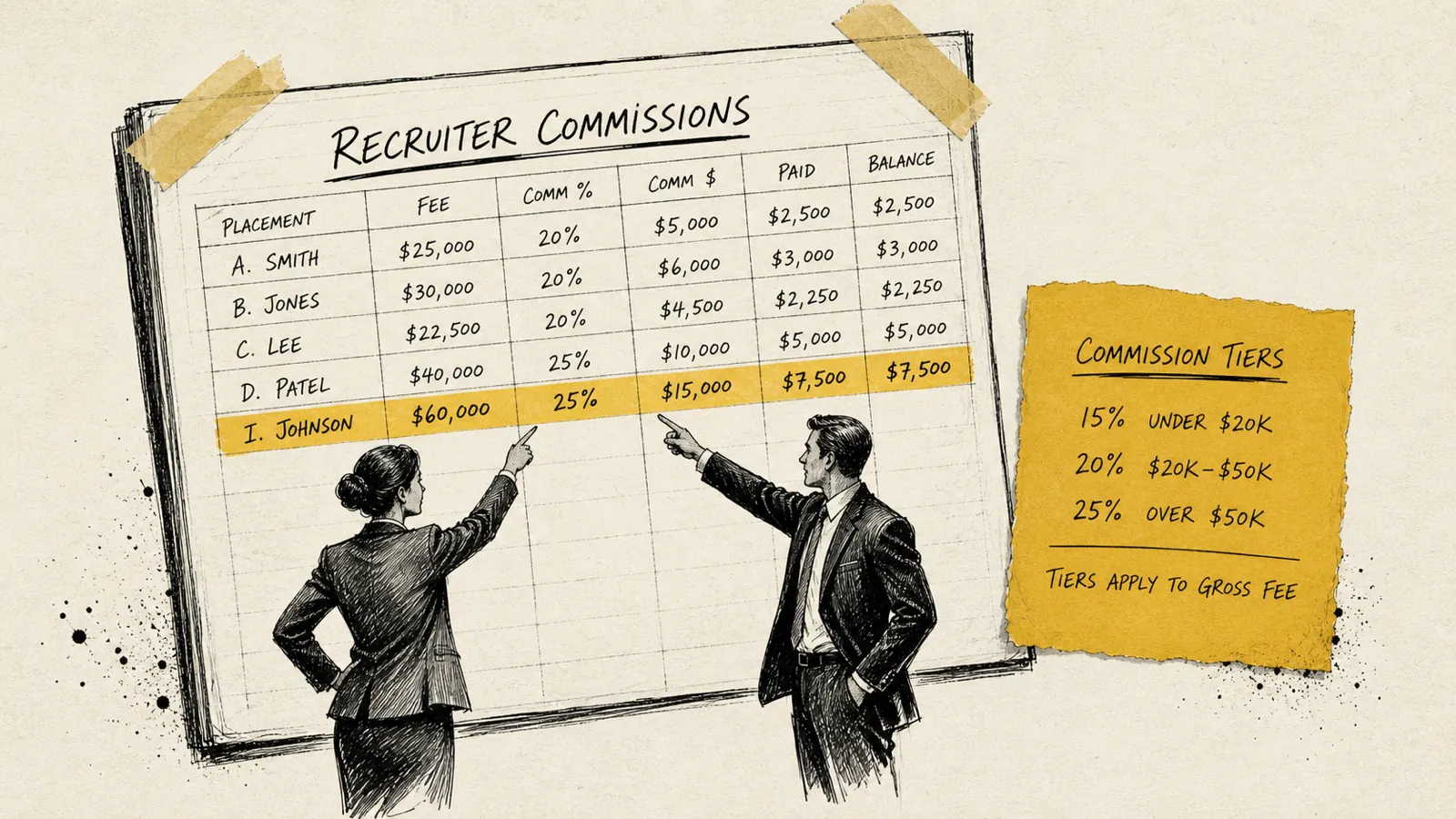
Commission timing is the other one, and it makes the clock a recruiter-facing issue rather than a finance one. A plan that pays on invoice paid exposes the recruiter directly to how quickly the back office issues the document, which is not a thing the recruiter controls. A plan that pays on invoice sent puts the risk on the firm. A plan that pays after the guarantee clears puts it on the recruiter for longer. The recruiter commission plans guide covers that decision, and the falloff prevention playbook covers keeping the placement alive through the window that all of this depends on.
Both connections point the same way. The days before the invoice are not an administrative detail. They set the terms of a conversation with your client and with your recruiter at the same time.
What to do first
Pull the twenty rows. Compute the median of each of the three intervals. Look at which one holds the days, then fix that one and leave the other two alone until the first has moved.
Most firms find the answer sits in the segment they have never measured, and it is the segment they can change without asking anyone's permission. The tactics for the second half, once you know that is where your problem actually is, are in the guide to collecting placement fees.
Frequently asked questions
What is a good DSO for a recruiting agency?
The honest answer is that DSO is the wrong measure for a direct-hire firm, so a target for it is not worth chasing. Because a perm firm issues few invoices in uneven amounts, the calculation swings on the timing of individual deals rather than on collection performance. Measure the median interval from trigger event to cash across your last twenty placements instead. It is comparable to your own prior number, which is the only comparison that changes a decision.
How do you calculate time to cash for a placement fee?
Take the date the fee became earned under your fee agreement, not the date the invoice was raised, and subtract it from the date the funds cleared. Do that for the last twenty placements and take the median. Splitting it at the invoice date gives you the two halves, one of which is yours and one of which is partly the client's.
Does taking card or ACH payments actually speed up collections?
It shortens the end of the cycle rather than the middle. Nacha reports that approximately 80% of ACH volume settles in one banking day or less, so moving a client off checks removes transit and deposit time. It does not touch the days before the invoice went out or the days the client spent deciding, which on most books are where the delay actually lives.
Should you invoice before the guarantee period ends?
Most fee agreements are written that way, because the guarantee is a replacement or refund obligation sitting on top of a fee that has already been earned rather than a condition of billing. Clients sometimes ask to hold payment until the guarantee clears. That is a commercial concession rather than a contractual requirement, and agreeing to it converts your standard terms into a much longer cycle.
Why does one slow client distort the whole number?
Because perm fees are large and infrequent, a single client with a procurement portal or a long approval chain can account for most of the slow tail across an entire quarter. That is why the slowest quarter of your placements deserves a separate look. A firm-wide average blends a specific, fixable relationship into a general problem that has no owner.
Measure the half nobody is measuring
The days between the trigger event and the invoice belong to you, appear in no report, and on most books are longer than anyone at the firm would guess. Twenty rows and four dates will tell you whether that is true of yours.
Get started free: five free placements, no card.
Never sweat invoicing or commissions again.