
How Recruiting Firms Invoice and Collect Placement Fees

A placement fee moves through six states before it is cash: the placement happens, the trigger event fires, the invoice is issued, the client's payment terms run, the money arrives, and the guarantee period closes. Most recruiting firms manage the first and the last well and lose weeks in the middle. The gap between the placement and the invoice is the part the firm controls, and it is usually the longest segment on the clock.
What follows is the money path itself, not the mechanics of the document. For how to build and format the invoice, read how to invoice clients as a recruiting firm.
What does the money path from a placement to the bank actually look like?
Six states, in order: placement made, trigger event fired, invoice issued, terms running, payment received, guarantee closed. Each handoff is owned by a different person or by nobody. A fee that is 40 days old is rarely 40 days of client delay. It is usually 12 days of your own lag plus 28 days of net 30.
Writing the states down is worth doing because it forces a name onto the segment nobody names. Everyone tracks accounts receivable, which starts at the invoice date. Nothing tracks the days between the candidate starting and the invoice going out, because during those days no document exists to age.
| State | Starts when | Who controls the duration | Visible in your accounting system |
|---|---|---|---|
| Placement made | Candidate signs | Client and candidate | No |
| Trigger fired | Your fee agreement says the fee is earned | Your agreement | No |
| Invoice issued | Somebody creates and sends the document | You | Yes, from this point |
| Terms running | Invoice date plus net terms | Your agreement | Yes |
| Payment received | Funds clear | Client, and your follow-up | Yes |
| Guarantee closed | The replacement window expires | Your agreement | No |
Two of the six states are invisible to the system that is supposed to be watching your money, and both of them are states you control.
Why does the invoice go out late?
Invoicing loses to revenue work. Friday afternoon belongs to the candidate you are placing next and the account you are trying to open, so the invoicing turns into a weekend project you never quite start. The failure is not discipline. It is that the task is cognitively dense: it requires holding the state of every open deal in your head at once.
The density is the specific thing. Retainers are straightforward. What is not straightforward is tracking who needs a milestone invoiced, who needs the placement fee charged, who is getting close to a guarantee date, whether the first invoice in a retained series was ever paid, whether the second one got followed up, and whether it is now time to send the third. It bloats fast, and it bloats in a way that resists being written on a to-do list, because every item's status depends on an item somewhere else.
That is why "just invoice on Friday" fails as a fix. A weekly ritual assumes the hard part is finding the time. The hard part is reconstructing the state.
What event should trigger the invoice?
Pick one event, write it into the fee agreement, and make it the only thing anyone has to check. The three common triggers for direct hire are offer acceptance, the candidate's start date, and, for retained work, a milestone in the engagement. Each moves cash earlier or later and changes who carries the risk if the hire does not stick.
| Trigger | Cash arrives | Who carries the risk | Where it gets argued |
|---|---|---|---|
| Offer acceptance | Earliest | Client pays before the person shows up | Candidate reneges before day one and you are refunding, not just replacing |
| Start date | Middle | Balanced | Start dates slip, and nobody tells accounting they slipped |
| Milestone or installment | Split across the search | Shared by design | Which milestone was reached, and whether invoice two went out |
Start date is the most common trigger for contingency work because it is the event both sides agree happened. It also has a defect worth naming: it depends on information that arrives from outside your firm, from a candidate or a hiring manager, and it arrives by email or not at all. If your invoice trigger depends on somebody remembering to tell you, your trigger is really "somebody remembered."
Retained work has the harder version of this problem, because the trigger fires more than once. A three-installment engagement generates three invoices with three separate follow-up threads, and the second one is where firms lose track. See the executive search invoice template guide for how the document changes across a series.
How does the guarantee period sit on top of your payment terms?
They are two clocks running at the same time on the same fee, and they do not measure the same thing. Payment terms start at the invoice date and decide when the money is owed. The guarantee period usually starts at the candidate's start date and decides whether you keep it. A 30-day guarantee and net 30 terms are not the same 30 days.
The interesting case is where the two clocks overlap. If you invoice on the start date with net 30 terms and carry a 90-day guarantee, the client is asked to pay 60 days before the point at which your obligation ends. That is a normal arrangement and it is what most fee agreements do. It also explains a certain kind of client stall, where an accounts payable department that would pay any other invoice on time sits on this one because somebody upstream said "let's see if he sticks."
The case that actually costs firms money is the reverse. A late invoice can land close enough to the guarantee expiry that the two events collide. A fee invoiced weeks after the start date, on a placement that then falls off, becomes a conversation instead of a receivable. The money is genuinely owed under the agreement. Collecting it becomes a delicate negotiation with a client who now feels strange about paying, and a fee like that tends to get written off at year end because the timing was bad rather than because the claim was bad.
An invoice sent on time is a document. An invoice sent late is an opening for a discussion you did not want to have. The falloff risk was always there. Late invoicing is what converts it from a replacement obligation into a collection problem. The falloff prevention playbook covers the other half of that, which is keeping the placement alive through the window.
What do your payment terms actually control?
Terms control when the client is contractually late, and nothing else. Net 30 does not mean money arrives on day 30. It means that on day 31 you have a clean basis for escalating. Terms are the boundary of a conversation, not a forecast, and firms that treat the terms date as the expected cash date build the wrong forecast.
Three details in the terms are worth setting deliberately, because each of them decides an argument in advance:
- What starts the clock. Invoice date is standard. Receipt date is a common client edit and it quietly adds several days plus a dispute about when receipt happened.
- What counts as a valid invoice. Many clients require a purchase order number, a cost center, or a specific submission portal. An invoice missing that field is not late, it is rejected, and it often sits rejected without anyone telling you.
- What happens after the due date. Interest terms, escalation, and whether placement work stops. Terms with no consequence are a preference.
The second one causes more silent delay than anything else on the list. A first invoice to a new client is the highest-risk document your firm sends, because it is the one most likely to be missing a field that nobody told you about. Confirm the billing requirements when the fee agreement is signed rather than when the first fee is earned.
Where does a placement fee actually stall?
Five places, in the order they occur: nobody knew the trigger fired, the invoice was built but not sent, the invoice was sent to the wrong person, the invoice was rejected on a technicality, and the invoice is genuinely past due with nobody chasing it. Only the last one shows up in an AR aging report.
The first four are the expensive ones precisely because they are invisible. An aging report is a good tool for a problem it can see, and it cannot see a fee that has no invoice yet. If your aging report looks healthy and your cash does not, the stall is upstream of the report.
The third is worth its own sentence. Fees are often sent to the hiring manager because that is who the recruiter talks to, and hiring managers are not the people who pay invoices. The document then sits in an inbox belonging to somebody with no process for it, which reads exactly like a client stall and is not one.
For the last case, where the invoice is real, delivered, correct, and simply not paid, the sequence and the language matter more than the frequency. Our invoice reminder scripts and escalation playbook has the wording, and the accounts receivable guide covers the aging process around it.
What does a delay actually cost? A worked example
The numbers below are an illustration, not data from any firm. Run the same arithmetic on your own last ten placements and the shape will hold even if the figures do not.
Take a $45,000 fee, net 30 terms, a 90-day guarantee, and a candidate who starts on March 2.
| Invoiced on the start date | Invoiced 12 days later | |
|---|---|---|
| Start date | March 2 | March 2 |
| Invoice issued | March 2 | March 14 |
| Due date (net 30) | April 1 | April 13 |
| Paid at due date plus 9 | April 10 | April 22 |
| Days from start to cash | 39 | 51 |
| Guarantee expires (day 90) | May 31 | May 31 |
| Cash in hand before guarantee expiry | 51 days | 39 days |
Twelve days of internal lag became twelve days of cash, and the guarantee window did not move, because the guarantee never cared about your invoice. On one fee that is an inconvenience. Across a year, the arithmetic is the part worth doing: a firm closing 40 placements a year at an average $45,000 fee bills $1.8 million, and 12 days of average lag on that book is roughly $59,000 of cash sitting in a state that no report is tracking. That is not lost revenue. It is revenue you have earned, cannot see, and cannot spend.
The falloff case makes it sharper. If that placement leaves on day 70, the firm that invoiced on March 2 is having a replacement conversation with the fee already collected. The firm that invoiced on March 14 may still be holding an unpaid invoice, and is now having a different and much worse conversation.
How do you build follow-up that starts before the invoice is late?
Set the sequence off the invoice date, not the due date. A reminder that fires on day 31 is a collections email. A short confirmation on day 2 that the invoice arrived and reached the right person is an administrative note, and it catches four of the five stall points above while they are still cheap to fix.
A workable shape for net 30, with the first two doing most of the work:
- Day 2: confirm receipt and confirm the recipient. This is the one that catches a wrong address, a missing purchase order, or a portal you did not know existed.
- Day 15: a neutral note that the invoice is on terms and due on the date, sent to accounts payable rather than the hiring manager.
- Day 31: the invoice is past due. Reference the agreement and the due date, not the relationship.
- Day 45: escalate a level, and involve the person who signed the fee agreement.
- Day 60: a decision point rather than another email. Somebody at your firm chooses between a payment plan, a hold on further work, or a write-off, and that choice is made deliberately instead of by default in December.
The reason to write the sequence down, rather than run it from memory, is the retained series problem from earlier. Once a single engagement has three invoices at three different points in this sequence, tracking it by memory stops working and the second invoice is the one that goes quiet.
How does a retained engagement change the money path?
It multiplies it. A contingency placement has one trigger and one invoice. A three-installment retained search has three triggers, three invoices, three sets of terms running on different dates, and three follow-up threads that all belong to one client relationship. The states from the first section do not change. There are simply three copies of them running out of phase.
The failure mode is specific and it is almost never the first invoice. The engagement fee goes out at signing, because signing is a memorable event that somebody is present for. The second installment fires on a milestone, which is an event with no ceremony attached, and it is the one that gets missed. By the time the third is due, the firm is in the position of sending a new invoice to a client who has an older one still open, which weakens the position on both.
Two things make the series manageable. Number the installments on the document itself so that any invoice states which one it is and what remains, and never send installment three while installment two is unresolved without deciding, deliberately, that you are doing that. The second rule is the one that gets broken, and it gets broken because sending the next invoice is easier than chasing the last one.
What changes as the firm gets bigger?
The task does not change. The reconciliation load does. Invoicing at two recruiters and invoicing at fifteen involve the same steps, but at fifteen the steps are spread across more open deals, more fee structures, and more people who each hold one piece of the state. The work grows in the checking, not in the doing.
This is why headcount is a poor trigger for fixing it. The useful question is not how many recruiters you have, it is how many hours a week somebody spends reconstructing what has been billed and what has been paid. A two-recruiter firm can easily be carrying a full-time person on that reconciliation while a ten-recruiter firm with a single fee structure and one trigger event runs it in an afternoon. Count the reconciliation hours, not the recruiters.
The related trap is that the process rarely produces a visible failure. Invoices do go out. Clients do pay. Nothing breaks in a way that generates an incident, so the cost stays hidden in the calendar of whoever is absorbing it, and the problem never earns a place on the list of things to fix. A process that fails quietly is not the same as a process that works, and firms tend to discover the difference during a quarter when cash gets tight for an unrelated reason.
What should you measure?
Three numbers, and the first one is the one almost nobody has: days from trigger event to invoice sent, days from invoice sent to cash received, and the share of open receivables past due. The first is yours to fix outright. The second is partly the client's. The third tells you whether the follow-up is working.
Calculate the first on your own last twenty placements. For each, take the date the fee became earned under your agreement and the date the invoice was actually issued, and average the difference. There is no benchmark to compare it to that we would stand behind publishing, and you do not need one, because the useful comparison is your own number against zero. Every day in it is a day you chose.
The second is the standard receivables measure and your accounting system already computes it, whether you use QuickBooks or Xero. Add the first number to it to get the real interval, which is the one your bank balance responds to. Measuring both halves, why the standard DSO calculation misbehaves on a perm book, and how to forecast cash off the result are covered in time to cash for recruiting firms. The tactics for the client's half are in the guide to collecting placement fees.
One accounting note changes how these numbers read. If your firm reports on the accrual method, income is recognized when it is earned rather than when payment arrives. The IRS guidance on accounting periods and methods puts that point at the moment all events fixing your right to the income have occurred and the amount is determinable.
So a profitable-looking month on an accrual P&L can sit on top of a cash position that has not moved. On the cash method the distortion runs the other way, and the month a slow client finally pays looks like a strong month for work you did in the spring. Neither view shows you the invoicing lag. Only the first of the three numbers does.
How invoicing connects to commissions and falloffs
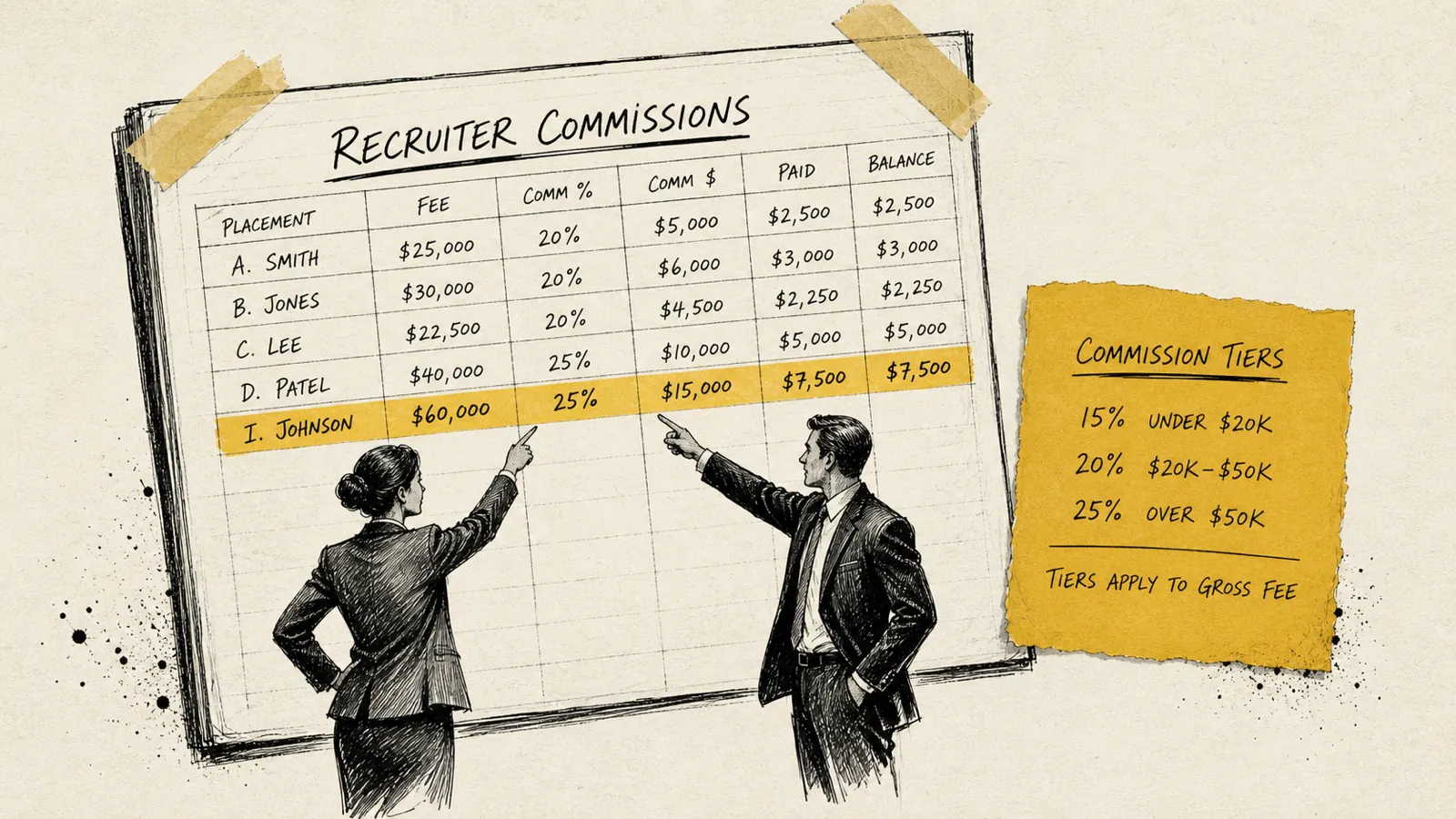
The invoice date is an input to your commission plan, not just to your bank balance. A plan that pays on invoice sent, one that pays on invoice paid, and one that pays after the guarantee clears are three different distributions of risk between the firm and the recruiter, and the invoice timing decides when each of them fires.
This is the practical reason invoicing lag is not only a finance problem. A recruiter whose commission is triggered by payment is directly exposed to how fast the back office issues the document, which is not something the recruiter controls and not a thing anyone enjoys explaining. The payout trigger decision is covered in the recruiter commission plans guide, and the clawback mechanics that follow a falloff are in the falloff playbook.
If you are moving this off spreadsheets, the two practical starting points are automating the invoice itself and comparing the tools that do it.
Frequently asked questions
Should a recruiting firm invoice on the offer acceptance or the start date?
Start date is the more common trigger for contingency placements because both parties agree the event happened and it is defensible if the fee is challenged. Offer acceptance moves cash earlier and is more usual in retained and executive search work, where the fee is structured across the engagement rather than earned at a single point. Whichever you choose, the fee agreement should name it explicitly, because a trigger that is not written down becomes a negotiation at the worst possible moment.
Can you invoice before the guarantee period ends?
Yes, and most fee agreements are written that way. The guarantee is a replacement or refund obligation that sits on top of a fee that has already been earned. It is not a condition that has to be satisfied before you bill. Clients sometimes ask to hold payment until the guarantee clears, which is a commercial concession rather than a contractual requirement, and agreeing to it turns your standard terms into a much longer cycle.
What are standard payment terms for a placement fee?
Net 30 from the invoice date is the common starting position for direct-hire work, with larger clients pushing to net 45 or net 60 through their own procurement standards. The number matters less than three things being explicit: what starts the clock, what makes the invoice valid, and what happens after the due date. A client who edits your terms will almost always edit one of those three rather than the number itself.
What do you do when a placement falls off and the invoice is unpaid?
Read the agreement first, because a refund obligation and a replacement obligation are different positions and the client will argue for whichever is better for them. Then separate the two questions: whether the fee is owed, and whether you want to press it with this client. Firms usually make that call implicitly, by letting the invoice age until it is written off. Making it explicitly, at a defined point in the follow-up sequence, is the whole improvement.
How is invoicing different for a contract staffing firm?
A contract staffing firm funds payroll weekly and bills weekly, so its receivables problem is a financing problem and factoring is a normal answer to it. A direct-hire firm bills in large, infrequent amounts with no payroll obligation running underneath, so its receivables problem is a timing and tracking problem instead. Most of the published advice on staffing AR is written for the first case, which is why it reads as slightly beside the point for a perm firm.
Who should own invoicing at a small recruiting firm?
One named person, even at three recruiters, and the owner is usually the wrong choice because the task loses to revenue work every week and the owner has the most revenue work. What matters more than the identity of the owner is that the trigger event produces a task automatically rather than depending on somebody remembering that a candidate started.
Get the middle of the clock back
The segment between the placement and the invoice is the one you own outright, it does not appear in any standard report, and on most books it is longer than anyone would guess. Measure it on your last twenty placements before you change anything else.
Get started free: five free placements, no card.
Never sweat invoicing or commissions again.