
The recruiting firm mid office: what it is and who owns it

The mid office at a recruiting firm is everything that happens between a placement being made and the money being fully settled: raising the invoice, chasing it, recording the payment, calculating the commission, honouring the guarantee, and reconciling all of it to the books. The ATS owns the front. Accounting owns the ledger. The mid office is the stretch in between, and at most firms it is a spreadsheet and one person's memory.
It is the only part of a recruiting firm nobody bought software for. Every firm has it. Very few firms have named it, staffed it, or measured it, which is why owners describe it as heavy without being able to point at the heavy part.
What is the mid office at a recruiting firm?
The mid office is the set of processes that turn a completed placement into collected cash and a paid recruiter. It covers invoice generation and delivery, accounts receivable and follow-up, payment recording, commission calculation and payout, guarantee and clawback tracking, and the reconciliation of all four to the accounting system. It starts the moment the front office stops caring and ends when the money is in the bank and the recruiter has been paid.
The boundary on either side is worth being precise about, because the confusion about what belongs where is most of the problem.
| Function | Owns | Typical system | Ends when |
|---|---|---|---|
| Front office | Clients, jobs, candidates, submissions, offers, the placement record | ATS or CRM | The candidate accepts and a start date exists |
| Mid office | Invoices, AR and follow-up, payments, commissions, splits, draws, guarantees, clawbacks | Spreadsheets, email, a person | Cash is collected, commission is paid, the guarantee has cleared |
| Back office | The general ledger, payroll runs, tax, financial statements | QuickBooks or Xero, a payroll system, a bookkeeper | The month is closed |
Plenty of firms use "back office" for all of it, and that is fine in conversation. It stops being fine when you are deciding what to buy or who to hire, because the back office has software and the mid office does not. Ask a bookkeeper to own the mid office and you get a bookkeeper doing collections badly. Ask the ATS to own it and you get a placement record with a commission percentage typed into a notes field.
Why the staffing definition of mid office does not fit a perm firm
Search the term and almost everything you find is about contract staffing: timesheet capture, pay rates against bill rates, weekly billing cycles, worker payroll. That is a real mid office and it has real software behind it. It is also not the problem a direct-hire firm has, because a direct-hire firm has no timesheets, no weekly cycle, and no worker on its payroll.
The term itself is borrowed. Its origin is in investment banking, where the middle office was the group that calculated realised profit and loss after a trade and made sure the deal the front office negotiated actually got processed and booked. That is a surprisingly good description of what a recruiting firm needs, and a poor description of what the staffing vendors sell under the name.
Strip out the contract-specific machinery and the perm mid office is a smaller list with a nastier property: every item on it is event-driven rather than calendar-driven.
Contract billing runs weekly. It is dull, it is predictable, and a dull predictable process can be put on a calendar and given to somebody. Perm billing fires on a start date, or an offer acceptance, or a shortlist delivery, or a guarantee expiry, and those land whenever they land. A process with no calendar cannot be given to a calendar, so it gets given to somebody's attention, and attention is the scarcest thing in a recruiting firm.
What actually lives in the mid office
Six things, in the order they happen to a single placement.
- The invoice trigger. Deciding and then detecting the event that makes the fee billable. Offer acceptance, start date, or a retained milestone. The decision is one line in a fee agreement. The detection is the hard part.
- The invoice itself. The right fee on the right entity with the right terms, the right PO or reference where the client demands one, delivered to the address that actually pays rather than the one you have on file.
- Follow-up. The sequence of reminders between issue and payment, plus the escalation when the sequence runs out.
- Payment and reconciliation. Recording what arrived, matching it to the invoice, handling the short payment and the client who nets off a credit you had forgotten about.
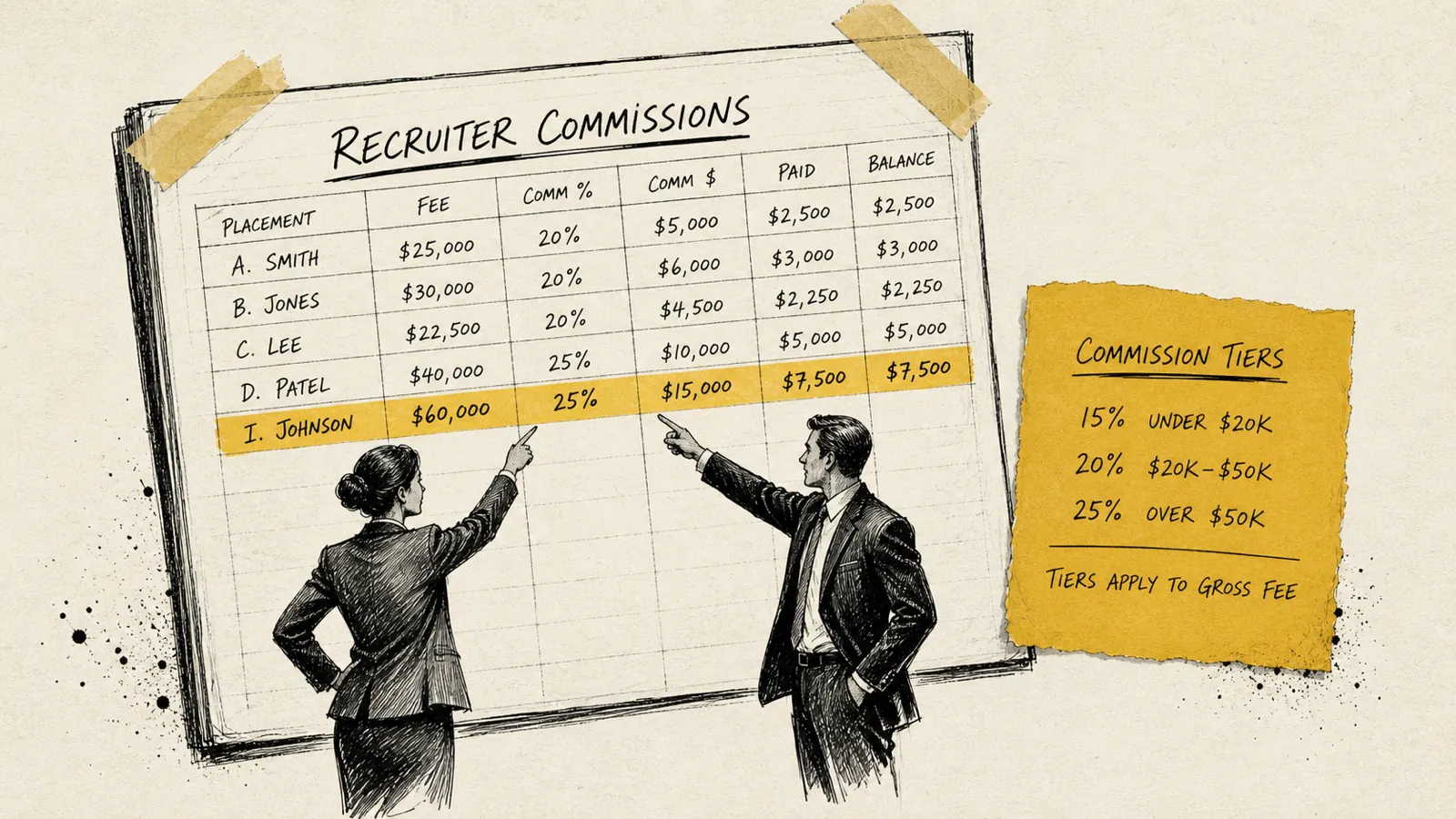
- Commission. The plan applied to the fee, the split applied to the plan, the draw balance applied to the result, and the payout released on whichever trigger the plan names.
- The guarantee. Watching the window on every placement inside it, and knowing what a falloff does to the invoice you already sent and the commission you may already have paid.
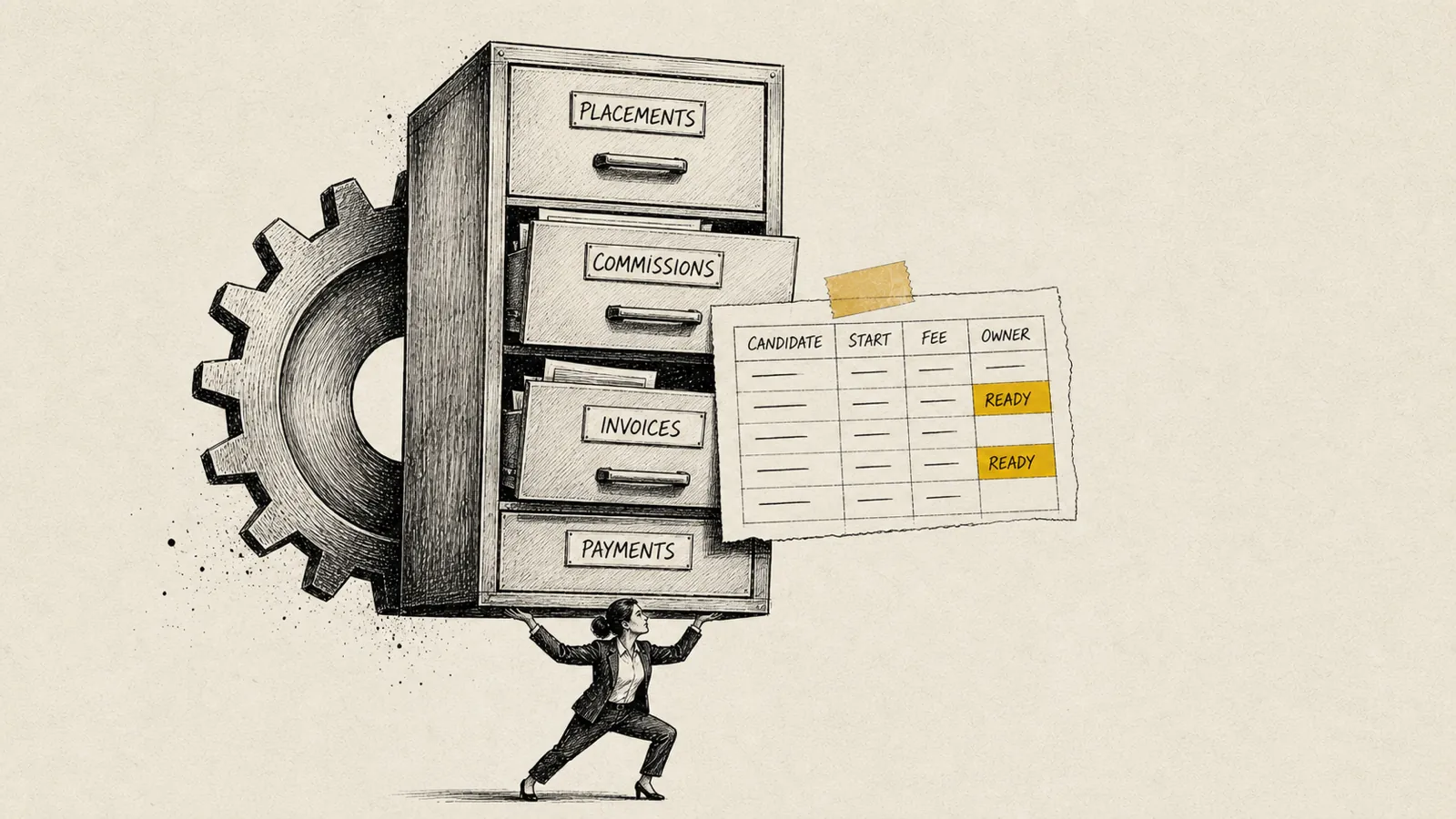
None of those six is difficult. Any competent person can do any one of them. The difficulty is that a firm is never doing one of them. It is holding all six across every open placement at once, in six different states, with nothing that shows all of it on one screen.
The load is state, not hours
The instinct is to size this problem in hours, and the hours estimate is always wrong, because the work does not sit in a block. It sits in interruptions, and the cost is holding the state between them.
Count the state instead. Take a firm doing eight placements a month. The figures below are an illustration, so run yours.
| Object | Per placement | At 8 placements a month | Carried across a quarter |
|---|---|---|---|
| Invoice trigger to detect | 1 | 8 | 24 |
| Invoices raised | 1 | 8 | 24 |
| Follow-up touches before payment | 2 | 16 | 48 |
| Payments to match and record | 1 | 8 | 24 |
| Commission calculations | 1 | 8 | 24 |
| Split reconciliations (on a third of deals) | 0.33 | 2.7 | 8 |
| Guarantee windows open at once (90 days) | 1 | 8 | 24 open simultaneously |
| Discrete events somebody must notice | 7.3 | 59 | 176 |
Fifty-nine events a month is not a lot of work. It is a lot of remembering. And the failure mode is not that somebody does an event badly, it is that nobody notices the event happened at all: the milestone that produced no invoice, the guarantee that expired without anyone releasing the held commission, the client who short-paid by $1,200 and was never asked about it.
Scale it to twenty-five recruiters and the arithmetic does not get harder, it gets longer. That is the specific reason this problem survives at firms with every resource available to them. It never fails loudly enough to get fixed.
When does a firm need a mid office?
Earlier than headcount suggests. The common rule of thumb puts the pain at around five recruiters, and that rule is measuring the wrong thing. It counts producers. The load is carried by reconcilers, and a firm can have two recruiters and a full-time person reconciling behind them.
I used to give the five-recruiter number myself, until a two-recruiter firm made me stop. The owner had one admin holding commission tracking across several spreadsheets, plus invoicing as a separate mess, on a master sheet so fragile that nobody would edit it. Every time the owner asked for an update, the admin built a fresh copy. Her words were that she did not have clarity into her own comp plans. Two recruiters, and a full-time salary spent on knowing what had been earned and what had been billed.
The better test is three questions, and any one of them being true means the mid office already exists whether you have named it or not.
- Can you say, without opening anything, how much is invoiced and unpaid right now, and how old the oldest one is?
- If a recruiter asked today what they are owed and when it pays, would the answer take longer than a minute, or would it require the owner?
- Does any single spreadsheet exist that would take a week to rebuild and that only one person will touch?
The third one is the real signal. A fragile master sheet is not a document, it is an undocumented system with one maintainer and no backup.
Who owns it: the first ops hire
Most firms arrive at the same three-stage sequence, and most arrive at it by accident rather than by deciding.
| Stage | Who holds the mid office | What breaks first |
|---|---|---|
| 1 to 3 recruiters | The owner, on evenings and weekends | Invoicing slips, because it loses to revenue work every single Friday |
| 4 to 10 | An admin or office manager, part time, on spreadsheets | One person becomes the single point of failure for the money |
| 10 to 25 | A dedicated ops or finance coordinator | The role fills with reconciliation and never gets to margin or forecasting |
| 25+ | A small ops team, or an in-house build | Headcount is thrown at a process problem and the process is never fixed |
The trap is stage three. A firm hires an ops coordinator expecting analysis, forecasting, margin by client, a view of what is actually profitable. Then the job fills with invoice chasing and commission arithmetic, because those have deadlines attached and analysis does not. A year later the firm has a good person doing data entry and still no idea which clients make money.
If you are making that hire, the useful discipline is to write down which of the six items above the role owns end to end, and which are automated before they arrive. Hiring a person to be the automation is how you get a person who cannot leave.
Build, buy, or add a person
All three are live options, and firms much larger than yours have tried all three and got it wrong.
There is a firm doing north of $50 million a year running its invoicing on software it wrote itself in the nineties, on an old computer in a closet. Green font on a black screen. It works, and four full-time people run the back office with it. Nobody makes the hardware any more. If that machine dies or the person who maintains it retires, everything stops. Building it yourself is not the safe option, it is a deferred single point of failure.
At the other end, the founder of a 300-recruiter firm told me they have every resource available to them and have never solved this. They tried building and could not get it right, so they threw headcount at it. It was a problem at ten recruiters and it was still a problem at three hundred.
So run the comparison on your own numbers rather than on a vendor's. An illustration, using the published price of the software rather than a quoted one:
| Option | First-year cost | What you get | What you carry |
|---|---|---|---|
| Add a person | Salary plus roughly 25% loaded cost. Put your own number in. | Judgement, and someone to call | A single point of failure, and a role that fills with reconciliation |
| Build it | Engineering time, then maintenance forever | Exactly your process | Every future change, and the maintainer's resignation letter |
| Buy it | 5 seats at $49/seat/month is $2,940 a year at the published Build price | The six items running as process rather than memory | Migration, and fitting your plans to someone else's model |
The two-recruiter owner did that arithmetic herself and reached the obvious conclusion: for what the software costs every month, it is well under the cost of a person doing the same job, with less room for error, and the admin gets moved onto work that grows the firm. That is her math, not a claim about what any firm will save.
The migration fear is usually the thing that stops the decision, and it is usually misplaced. Owners picture three weekends of spreadsheet cleanup before anything can start. The mess gets imported along with everything else. The cleanup is not an assignment you have to finish first.
What a monthly close looks like for a search firm
A perm firm's close is short, and it is short because most of the work should already have happened as events fired. If your close is long, the mid office is running as a monthly batch instead of as a process, which is the actual diagnosis behind "month end is brutal here".
- Every placement made this month has an invoice, or a written reason it does not yet.
- Every invoice issued has a follow-up state, and nothing is sitting untouched past its terms.
- Every payment received is matched to an invoice, with short payments flagged rather than silently absorbed.
- Commission is calculated on the agreed trigger, splits applied, draw balances moved, and a statement exists per recruiter that they could check themselves.
- Guarantee windows closing next month are listed, with the held commission each one releases.
- Invoices, payments and commission expense agree with what the accounting system says.
Commission is the step that never fails, and that is exactly why it never gets fixed. Owners protect it, because most of them came up as recruiters and remember waiting on a check. So nobody's commission is late. There is no error to point at. It just quietly turns into a day-long job across several people once there are enough plans and tiers to reconcile, and a task with no visible defect never makes it onto anybody's list of things to change.
What to measure once it exists
Four numbers, and none of them requires software to start producing.
- Days from fee earned to invoice issued. The half of the cash cycle you control alone, and the one no aging report can see, because nothing is aging yet. Method is in time to cash for recruiting firms.
- Days from invoice issued to cash received. The client's half. Compare it to your stated terms rather than to an industry number.
- Open AR by age. Not the total. The shape of it.
- Commission cycle time. From the triggering event to money in the recruiter's account. This is the one recruiters actually feel, and the one that generates the 9 PM text.
Margin by client and by recruiter is the number owners most want and the last one they get, because it needs all four of the above to be reliable first. That is the right order. A margin report built on a commission spreadsheet nobody trusts is a confident wrong answer.
How to start this week
Pick the last ten placements and build one row each: date the fee became billable, date the invoice went out, date the cash landed, date the commission was paid, whether the guarantee has cleared. Ten rows, five columns.
Two things fall out of it immediately. The first is the gap between column one and column two, which is almost always larger than the owner expects and is entirely yours to close. The second is how long it takes to build the ten rows at all. If assembling them takes an afternoon of digging through email and spreadsheets, that is the answer to whether the mid office needs to be a system rather than a memory.
Then fix the trigger before anything else. Make the billable event produce a task automatically, the way a signed contract already does, so that the invoice is raised by the thing happening rather than by somebody remembering it happened. Every other improvement in the mid office is downstream of that one. The full money path, state by state, is in how recruiting firms invoice and collect, and the commission side is in the recruiter commission plans guide. If the honest answer is that the whole thing currently lives in one fragile spreadsheet, start with what breaks when a recruiting firm outgrows spreadsheets, and the software category itself is covered in back office software for recruiting firms.
Frequently asked questions
What is the difference between mid office and back office in recruiting?
The mid office turns a placement into collected cash and a paid recruiter: invoicing, AR and follow-up, payments, commissions, splits, draws and guarantees. The back office is the accounting function behind it: the general ledger, payroll runs, tax and financial statements. The distinction matters when you are buying software or hiring, because the back office has established tools and the mid office usually does not.
Do direct-hire firms need a mid office, or is it only for staffing?
Both, but they are different jobs. Contract staffing has a calendar-driven mid office built around timesheets, pay and bill rates, and weekly billing, and there is established software for it. A direct-hire firm has no timesheets and no weekly cycle. Its mid office is event-driven, firing on start dates, offer acceptances, retained milestones and guarantee expiries, which is harder to schedule and easier to drop.
At what size does a recruiting firm need dedicated ops?
Count reconciliation hours rather than recruiters. Firms with two producers sometimes carry a full-time person tracking what has been earned and billed, while others run leaner at ten. The practical test is whether you can state your open AR and its oldest item without opening anything, whether a recruiter can find out what they are owed without asking the owner, and whether a single fragile spreadsheet would take a week to rebuild.
Can our ATS handle the mid office?
An ATS is built for where revenue is generated, and it does that job well. It generally stops at the placement record, which is precisely where the money side of the placement begins. Most firms bridge the gap with spreadsheets and a person, which works until the number of open states outgrows what one person can hold.
Why does invoicing always slip at recruiting firms?
It loses to revenue work, not to laziness. Friday afternoon belongs to candidates, clients and the follow-ups that were already being pushed, so billing becomes a weekend project that never quite happens. The load is cognitive rather than clerical: which milestone needs invoicing, which follow-up is overdue, which guarantee is closing, and whether the second invoice in a series went out before the third is due.
What should a recruiting firm measure first?
Days from fee earned to invoice issued. It is the half of the cash cycle you control without a client's agreement, it appears in no aging report because no document exists yet, and on most books it is the largest single block of delay. Measure it on your last ten placements before buying anything.
Get started free: all features unlocked for your first 5 placements, no credit card required.
Never sweat invoicing or commissions again.