
When recruiters get paid on cash received

Pay commission when the client's money arrives, and you have made the recruiter's pay date depend on your collections process. That is a defensible choice and the most common one, but it only works if three things are written down: what counts as paid, who chases the invoice, and what happens if the money never comes. Most plans name the first and skip the other two.
When should recruiters get paid commission?
There is no legal answer, so the plan document is the whole of the obligation. The U.S. Department of Labor states that the Fair Labor Standards Act does not require the payment of commissions, which means federal law sets no date. State wage law governs how an earned commission must then be paid, and your plan governs when it becomes earned. Nothing on this page is legal advice.
In practice firms choose between the invoice going out, the money arriving, and the guarantee period closing. Which to choose, and what each one costs you, is the subject of the complete guide to recruiter commission plans. This page starts one step later, with the option most firms have already picked.
How many firms actually wait for the money?
Fifteen of 21 recruiting firm owners and leaders release commission only once the client has paid, and one pays on invoice sent. Three wait for the guarantee to close. Those counts come from a survey of 21 owners and leaders at 20 established firms, reported there with their denominators rather than as percentages.
Read that the other way round and it is more useful. Pay-on-invoice-sent is the assumption behind most writing on recruiter pay, and it is the rarest arrangement anyone in that group actually runs. If your plan pays on cash received, you are in the majority and you are carrying the majority's problem.
What does paying on cash received actually commit you to?
It commits you to a collections process, not to a payment date. The recruiter's commission now fires on an event nobody on the revenue side controls. The invoice has to be raised, delivered to the right person in the right format, and followed up until it clears, and only the last of those failures is visible in an aging report.
Where the money actually stalls on a placement fee, and the reminder sequence that catches each stall, is covered in the guide to how recruiting firms invoice and collect. The point for the plan document is narrower. Every one of those stalls is now also a pay event for a person who cannot fix it.
Who owns the chase when a recruiter's pay depends on it?
Finance owns the action and the recruiter owns nothing, which is correct, and it is also how the gap opens. The accounts receivable guide makes the case for keeping the person who made the placement out of the collections conversation, and that case is sound: a recruiter chasing a client they want more work from will under-chase every time.
The gap is what sits between the two. In the same survey, nine of the 15 firms that pay only on cash received have no defined process for a past-due invoice. So the recruiter is barred from chasing, which is right, and nobody else has a dated obligation to chase either. Separation of duties without an owner is not separation of duties.
Three things make it a real assignment rather than a principle. A named person, not a role and not the owner, who runs the follow-up. A review that happens on a date rather than when someone notices. And a stated point at which the person who signed the fee agreement gets involved.
What has to be in the plan document?
Four lines, and the fourth is the one almost nobody writes. Most plans have the first. Firms discover they needed the rest the first time an invoice goes quiet.
| What the plan names | What happens when it does not |
|---|---|
| What counts as paid, and whether partial payment counts | A part-paid retained installment becomes an argument on commission night |
| Which pay run a cleared payment lands in, and the cutoff | Payment arrives on the 30th and nobody can say whether it makes that month |
| Who follows up a past-due invoice, by name, and on what dates | The recruiter's pay date rides on a memory task |
| A backstop date, after which commission is payable anyway | The wait has no end, and the plan has an exception the recruiter never agreed to |
A backstop is the honest version of pay-on-cash. It says the recruiter carries the collection risk for a stated number of days and the firm carries it after that. Without one, the recruiter carries it indefinitely, which is a term no firm would write down on purpose.
What does a backstop date cost the firm? A worked example
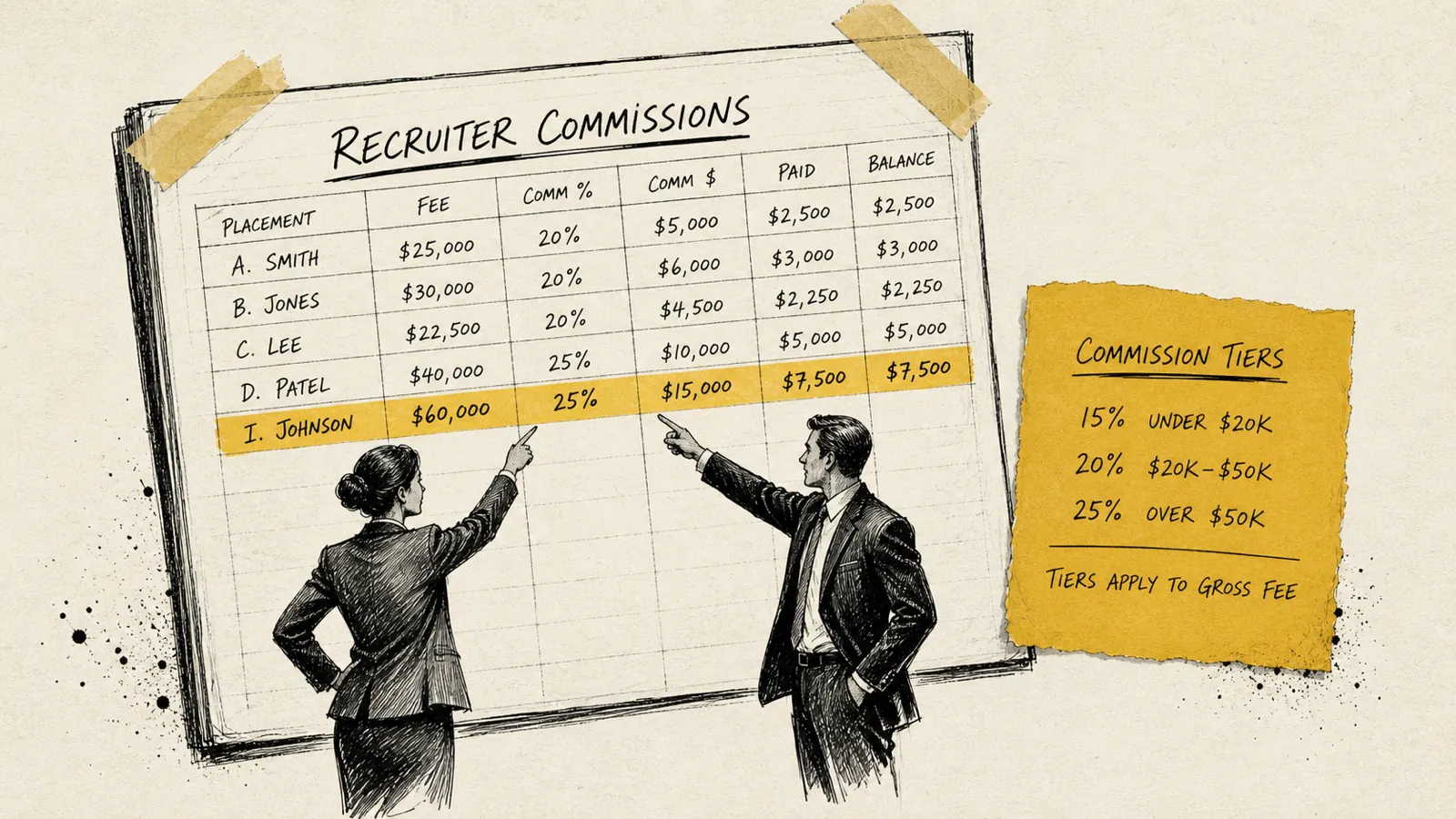
Less than most owners expect, because the backstop only binds on the invoices that run late. The arithmetic below is illustrative. It uses the survey's own middle values, a $35,000 average fee, a 30% commission rate and net 30 terms, and it is not a figure from any firm.
A $35,000 fee at 30% is $10,500 to the recruiter. Say the plan pays on cash received with a backstop at day 60, counted from the invoice date.
| What the client does | When the recruiter is paid | What the firm fronts |
|---|---|---|
| Pays on day 28, on terms | Day 28 | Nothing |
| Pays on day 95 | Day 60 | $10,500 for 35 days |
| Never pays, written off | Day 60 | $10,500 against no revenue |
Now size the middle row. A firm where eight invoices a year cross the backstop and take a further 35 days has roughly $8,100 of its own cash standing out at any moment, which is eight times $10,500 spread across 35 of 365 days. That is a financing cost worth naming and a small one. The third row is the expensive one, and it is the row most plans are silent about.
What happens to commission on an invoice you never collect?
Somebody absorbs $10,500 and the plan should say who before it happens. A placement that stuck and a fee that was never collected is the case where pay-on-cash and silence combine badly, because the recruiter did the whole job and the money is simply gone.
| Who absorbs it | How it reads to the recruiter | What it costs the firm |
|---|---|---|
| The recruiter, in full | Uncapped exposure to a client they did not choose | Nothing in cash, a lot in trust |
| The firm, in full | Pay is settled once the work is done | The full commission on zero revenue |
| Split at a stated share | A known, bounded downside | Part of the commission, predictably |
Any of the three is defensible. Deciding it in the moment is not, because the decision then gets made about a named person and a specific client rather than as a rule. Write the share into the plan, and write in the same line that it applies only after the follow-up sequence has actually run.
This is a different question from a clawback. A clawback reverses commission because the placement did not survive, and the guarantee period is what sets that clock, which is covered in how long a placement guarantee should be. A write-off reverses nothing. There was never any cash to pay from.
What should a recruiter be able to see?
The collection status of their own deals, not just the commission math on them. A recruiter looking at an earnings view can usually see the fee, the rate and the amount. If the plan pays on cash received, the number that decides their pay date is the invoice status, and it is the one thing most views leave out.
Showing invoice sent, invoice due, past due and paid, next to each pending commission, does two things at once. It answers the question the recruiter was going to ask anyway, and it makes a quiet invoice visible to somebody with a reason to care. That is not the recruiter chasing the client. It is the recruiter knowing which internal conversation to start.
What if the client pays late and the candidate leaves too?
Resolve the guarantee first, then the payment, and say so in that order. If the fee is refunded or credited there is no commission to pay, and the question is the clawback. If the fee stands and the client is simply slow, the guarantee is irrelevant and the question is the backstop.
Firms get this wrong by stacking the two waits. A 90-day guarantee on net 30 terms with a payment that lands on day 95 produces a recruiter who closed in January and is paid in May, with no single person able to explain which rule caused which part of the delay. Two clocks, named separately, with one stated order of resolution.
Frequently asked questions
Is it legal to pay commission only after the client pays?
Generally yes, if the plan says so before the placement. The Department of Labor states that the FLSA does not require the payment of commissions, so federal law sets no timing. State wage law then governs how a commission that has become earned must be paid, and some states require the commission agreement to be in writing. Have counsel read your plan rather than taking that from a blog.
What is a reasonable backstop date for commission on an unpaid invoice?
Firms that use one tend to set it a stated interval past the due date rather than past the start date, because the invoice date is the thing the firm controls. The size of the interval is a cash decision, and the worked example above gives you the shape of it: the cost is the commission multiplied by the extra days, across only the invoices that actually run late.
Should the recruiter chase their own past-due invoice?
No. A recruiter chasing a client they want repeat business from will under-chase, which is why the collections conversation belongs with finance or a named administrator. What the recruiter should have is visibility, so an invoice going quiet reaches somebody who notices rather than sitting in an inbox.
What if the client part-pays a retained installment?
Say in the plan whether commission accrues on cash received or on the installment being settled in full. Both work. A retained engagement with three installments at three different stages is the case that breaks an unstated rule, because the second installment is usually the one that goes quiet.
Does paying on invoice sent fix all of this?
It moves the collection risk from the recruiter to the firm, which removes the fairness problem and adds a cash one. The firm pays commission on money it has not received, and a fee written off later means commission already out the door. That trade is the decision the commission plans guide walks through.
Get the pay date off a memory task
Get started free: all features unlocked for your first 5 placements, no credit card required. Start free.
Never sweat invoicing or commissions again.