
The weekly billing run, timesheet to invoice

A weekly billing run is a calendar, not a task. Hours close Sunday. Chasing starts Monday morning. Approvals are due end of Tuesday. Invoices and the payroll file both come off the same approved record on Wednesday. Four things make it slip: a missing timesheet, an overtime rate nobody agreed, an expense with no receipt, and a PO number nobody asked for.
The contract staffing back office guide walks the chain from hours captured to payment collected and names where it breaks. This page is the week itself: the dates, the chase, the pricing rules, the invoice format, the corrections, and the reconciliation that tells you whether you billed everything you approved.
What does a weekly billing run actually look like, day by day?
Put the run on fixed days and the only variable left is whether the hours arrived. A run with no dates attached becomes whenever somebody has an afternoon free, which is how a week of approved hours ends up invoiced eleven days after it was worked. Pick the days once and hold them.
This is a work week ending Sunday, billed on net 30. Shift the days if your week closes elsewhere, but keep the gaps the same.
| When | What happens | Who you are waiting on |
|---|---|---|
| Sunday, end of day | Work week closes. Contractors submit hours. | Contractor |
| Monday, first thing | Pull the exception list: who has not submitted, who submitted hours that look wrong. | Nobody. This is yours. |
| Monday, morning | First chase to every contractor on the exception list. | Contractor |
| Tuesday, morning | Approvals requested. Second chase, this time to the named approver at the client. | Client approver |
| Tuesday, end of day | Approval deadline. Anything unapproved after this is carried, not chased into Wednesday. | Client approver |
| Wednesday, morning | Price the approved hours: standard, overtime, any premium, expenses. | Nobody. This is yours. |
| Wednesday, afternoon | Raise and send invoices. Cut the payroll file from the same approved record. | Nobody. This is yours. |
| Thursday | Reconcile approved against billed. Carried items go on next week with a written reason. | Nobody. This is yours. |
Two rules make the calendar hold. Payroll and billing come off one approved record, in that order, on the same day, so the hours you pay and the hours you bill can never be two different numbers. And the Tuesday deadline is real: a run that waits for the last approver teaches every approver that the deadline is decorative.
What do you do about the timesheets that have not arrived?
Bill what is approved and carry the rest, because one unapproved timesheet is worth a few hundred dollars and a delayed run is worth the whole week. The firms that hold the run until everything is in are trading a known small loss for an unknown large one.
The chase is a ladder with a time on each rung, and it runs on the calendar above rather than on how annoyed you are getting.
- Monday morning, contractor. Automated reminder with the exact week and the exact hours expected. Most missing timesheets are a forgotten submission, not a dispute.
- Tuesday morning, named approver. Send the submitted hours and ask for approval against them. This is also when you find out the approver is away.
- Tuesday afternoon, account owner. Whoever owns the client relationship, not the person running billing. An approval that has stalled twice is a relationship problem.
- Wednesday, carry it. The item moves to next week's run with a note saying which week it belongs to and why it was not billed.
Here is the asymmetry that makes unapproved hours expensive rather than merely late. Under the Fair Labor Standards Act, covered nonexempt employees must be paid for hours worked, and that obligation does not wait for a client manager to click approve. You cannot invoice an unapproved hour. So an unapproved hour is not a billing delay. It is money already out of your account with no invoice behind it.
At a $60 pay rate with burden running at 12% of pay as a labelled assumption, eight unapproved hours cost you $537.60 that you have paid and cannot bill. That is the real price of a missing approver, and it recurs every week the approval is missing.
Two things stop it at the source, and both belong in the client agreement before the first assignment starts. Name the approver and a named backup. And write down what happens to hours that go unapproved past the deadline, because the alternative is discovering the answer during a dispute.
How do you price an hour that is not a standard hour?
Every non-standard hour needs a bill rate agreed in writing before it is worked, and overtime is the one that turns a profitable assignment into a losing one if you skipped it. A flat bill rate covers a standard hour. It does not cover an hour that costs you half again as much.
Run the arithmetic on a $85 bill rate against a $60 pay rate, with burden at 12% of pay. Substitute your payroll provider's burden figure before you decide anything on it.
| Hour | You are paid | You pay | Burden at 12% | Margin per hour |
|---|---|---|---|---|
| Standard | $85.00 | $60.00 | $7.20 | $17.80 |
| Overtime, flat bill rate | $85.00 | $90.00 | $10.80 | minus $15.80 |
| Overtime, billed at 1.5x | $127.50 | $90.00 | $10.80 | $26.70 |
The middle row is the trap. Ten overtime hours a week on a flat bill rate costs you $158 a week, and across 48 billed weeks that is $7,584 on one contractor. The firm does not see it as a loss because the invoice still goes out and still gets paid. It shows up as an assignment that never makes the margin it was quoted at.
The same applies to anything else that moves your cost: holiday hours, shift premiums, on-call, and travel time that counts as hours worked. Each needs its own agreed bill rate. A premium that exists on the pay side and not on the bill side is one you are funding.
Expenses follow different rules. Pass them through at cost on their own line with the receipt attached, and add no markup unless the contract allows one. Agree up front whether expenses sit inside the purchase order value, because an expense that pushes an invoice over the PO total stops the whole document rather than just that line.
Should each contractor get their own invoice, or should the client get one?
The answer is whatever the client's accounts payable system matches against, which is usually a purchase order. One PO covering four contractors wants one invoice. Four POs, or four cost centres, want four. Ask during onboarding rather than guessing and correcting later.
| Format | When it is right | What it costs you |
|---|---|---|
| One invoice per contractor | Separate POs, separate cost centres, or a client that disputes at line level | More documents to raise, send and chase |
| One consolidated invoice per client | A single PO, and an AP team that wants one document per period | One disputed line can hold up payment on the whole invoice |
| One invoice per PO | Most clients with more than one hiring manager | You have to track PO balances as you bill |
Whichever format you use, the invoice carries the PO number, the work week dates, the contractor name, the hours split by rate type, and the approver's name. Track the remaining balance on every PO as you bill against it. A purchase order that runs out in week nine of a twelve week assignment stops your billing dead, and nobody at the client will warn you it is coming.
How that invoice gets chased once it is out is the same problem it is on perm work, and the invoicing and collections guide covers it without modification.
How do you fix an invoice you have already sent?
Raise a credit note against the original invoice and issue a fresh one with a new number. Never edit an invoice that has already been sent and resend it under the same number. The client's AP team has already matched that number to a PO and a goods receipt, and a second version of it creates two documents where their system expects one.
Three cases cover almost everything that goes wrong.
- Billed too many hours. Credit note for the difference only. The original invoice stays, partly paid, and the rest of it keeps its original due date.
- Wrong rate on a line. Credit the full line, then re-raise it at the agreed rate on a new invoice. Do not net the correction into next week's invoice, because the two weeks then reconcile to nothing.
- Wrong entity, wrong PO, or wrong period. Credit the whole invoice and raise it again correctly. A partial fix on a document that was addressed to the wrong legal entity is not a fix.
The cost of a correction is rarely the admin. It is the clock. Most AP teams count payment terms from the date they receive a valid invoice, so a corrected invoice issued on day 20 of a net 30 period is usually a net 30 invoice again from the day it lands. One correction can add three weeks to a collection, which is why the pricing rules above are worth agreeing before the work happens rather than after. The time to cash guide walks that clock in full.
How do you know you billed every hour you approved?
Three numbers, every week, before the run closes: hours approved, hours billed, hours paid. On a healthy week all three match. Every gap between them means something specific, and each one costs money in a different direction.
| Gap | What it means | What to do |
|---|---|---|
| Approved more than billed | Revenue leakage. You paid for the hours and never invoiced them. | Bill them on the next run with the correct week dates |
| Billed more than approved | A dispute that has not surfaced yet. You will be issuing a credit note. | Correct it before the client finds it |
| Paid more than approved | You funded hours the client never approved. | Chase the approval, and look at whether the approver is the problem |
Run this on Thursday, against the week that just closed, while the detail is still recoverable. A month-end reconciliation finds the same gaps four weeks later, by which point the approver has forgotten the week and an unbilled week has become a conversation about whether you can still invoice it at all.
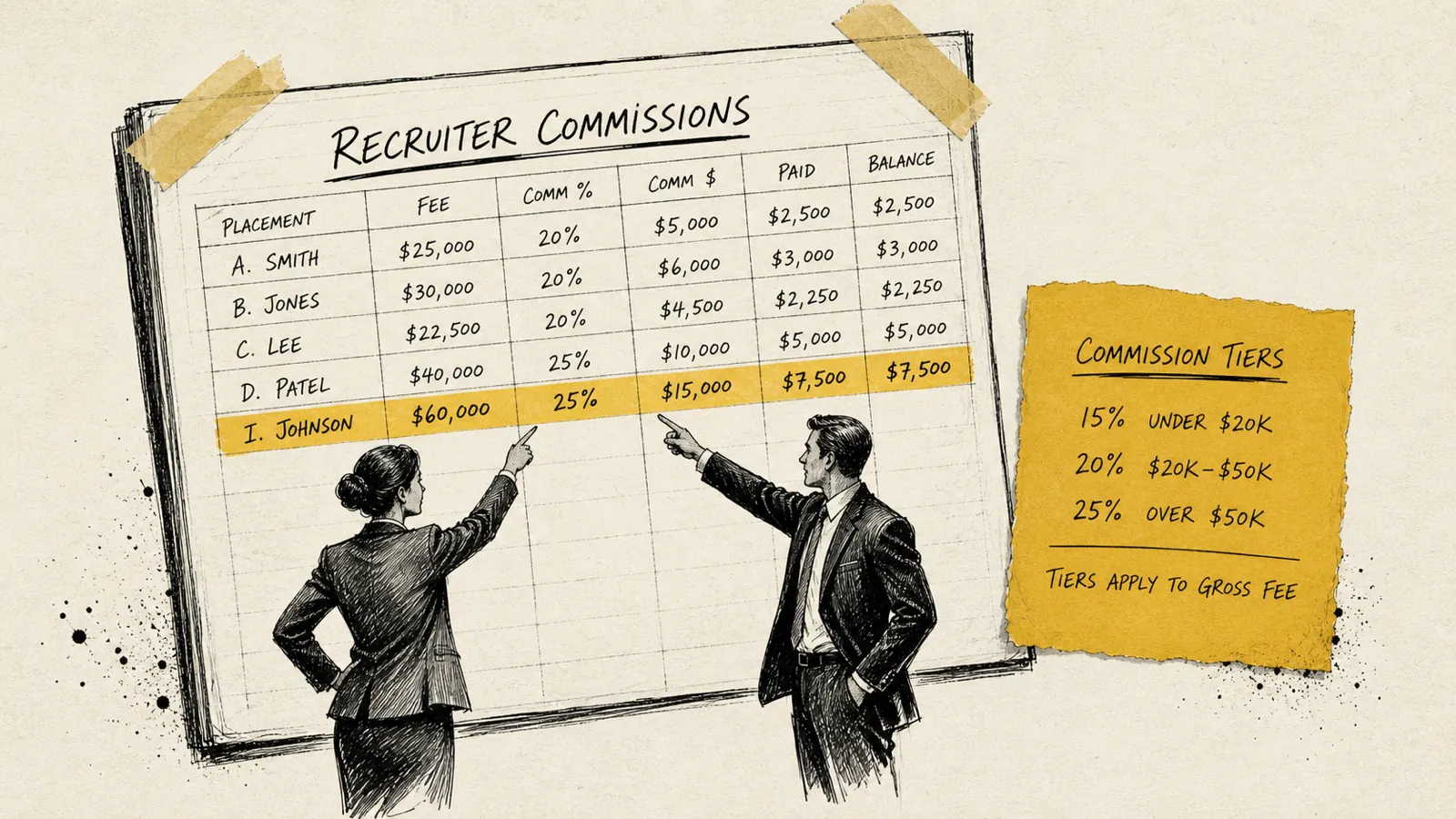
Commission on contract work should be calculated off the margin this reconciliation produces rather than off the invoice total, and the commission plan guide covers how payout triggers work. A plan that pays on billed margin pays on numbers a credit note can reverse. A plan that pays on collected margin does not.
Which numbers tell you the billing run is healthy?
Three: the share of timesheets in by the Monday deadline, the days from approval to invoice sent, and the approved hours carried unbilled into the next week. All three are properties of the run itself, and all three are fixable without renegotiating a single client contract.
- Timesheet submission rate at the deadline. Submitted hours divided by expected hours, measured Monday morning before any chasing. This is the number that drives everything downstream, and chasing hides it.
- Days from approval to invoice sent. Should be under one on the calendar above. Anything over two means the run is not actually running on fixed days.
- Approved hours carried unbilled. Counted at the end of each run, in hours and in dollars. A number that grows week over week is revenue leaving quietly.
No published benchmark for these is worth planning against, so compare each week against your own previous eight and watch the direction rather than the level. Margin per contractor and the cash you carry are a different question, and the back office guide runs those numbers.
One wider point about volume. Chasing late or missing timesheets is named as a core manual burden in Staffing Industry Analysts coverage of payroll and invoice automation, alongside applying billing rules by hand and validating data against a deadline. All three are the Monday to Wednesday block above, and all three grow with the number of contractors rather than with the number of clients.
Frequently asked questions
These come up in the first month of running contract placements, roughly in the order they arrive.
Can we invoice before the client approves the timesheet?
You can raise it, and you will usually regret sending it. An invoice for unapproved hours is a disputed invoice the moment the client's AP team checks it against the approval they do not have, and the correction costs you a credit note plus a fresh payment term. The exception is a client contract that explicitly treats hours as approved if no objection is raised within a stated window, which is worth negotiating for precisely this reason.
Who should approve hours, and what happens when that person is away?
A named individual at the client, with a named backup, both written into the client agreement before the first assignment. The common failure is an approver who is a role rather than a person, because a role cannot be chased. Ask for the backup at onboarding, when it is an administrative question, rather than during a week when the approver is on holiday and the run is stalled.
Do we have to pay a contractor for hours the client refuses to approve?
If you are the employer of record and the hours were worked, generally yes. The obligation to pay for hours worked sits with the employer under the Fair Labor Standards Act and is not conditional on your client approving a timesheet. That is exactly why unapproved hours are expensive rather than merely late. Settle the specifics with your payroll provider and your counsel, because state rules add to the federal floor.
Should expenses be invoiced separately from hours?
On a separate line at minimum, and on a separate invoice if the client codes expenses to a different budget or a different PO. Attach the receipt, charge at cost unless the contract allows a markup, and confirm whether expenses count against the purchase order value. Expenses inside a PO that is already close to its limit will block the hours on the same document.
How do we invoice a work week that spans two months?
Bill the week whole and accrue the split internally, unless the client's AP requires invoices cut to calendar months. Splitting a work week across two invoices doubles the documents and splits the approval for a presentation difference. Where the split genuinely matters is your own revenue recognition, which is an accruals entry rather than an invoicing decision, and worth settling with your accountant once rather than every month.
Get started free: all features unlocked for your first 5 placements, no credit card required. Start with Collected.
Never sweat invoicing or commissions again.